How Customer Language Can Improve Your Website Content, FAQs and SEO
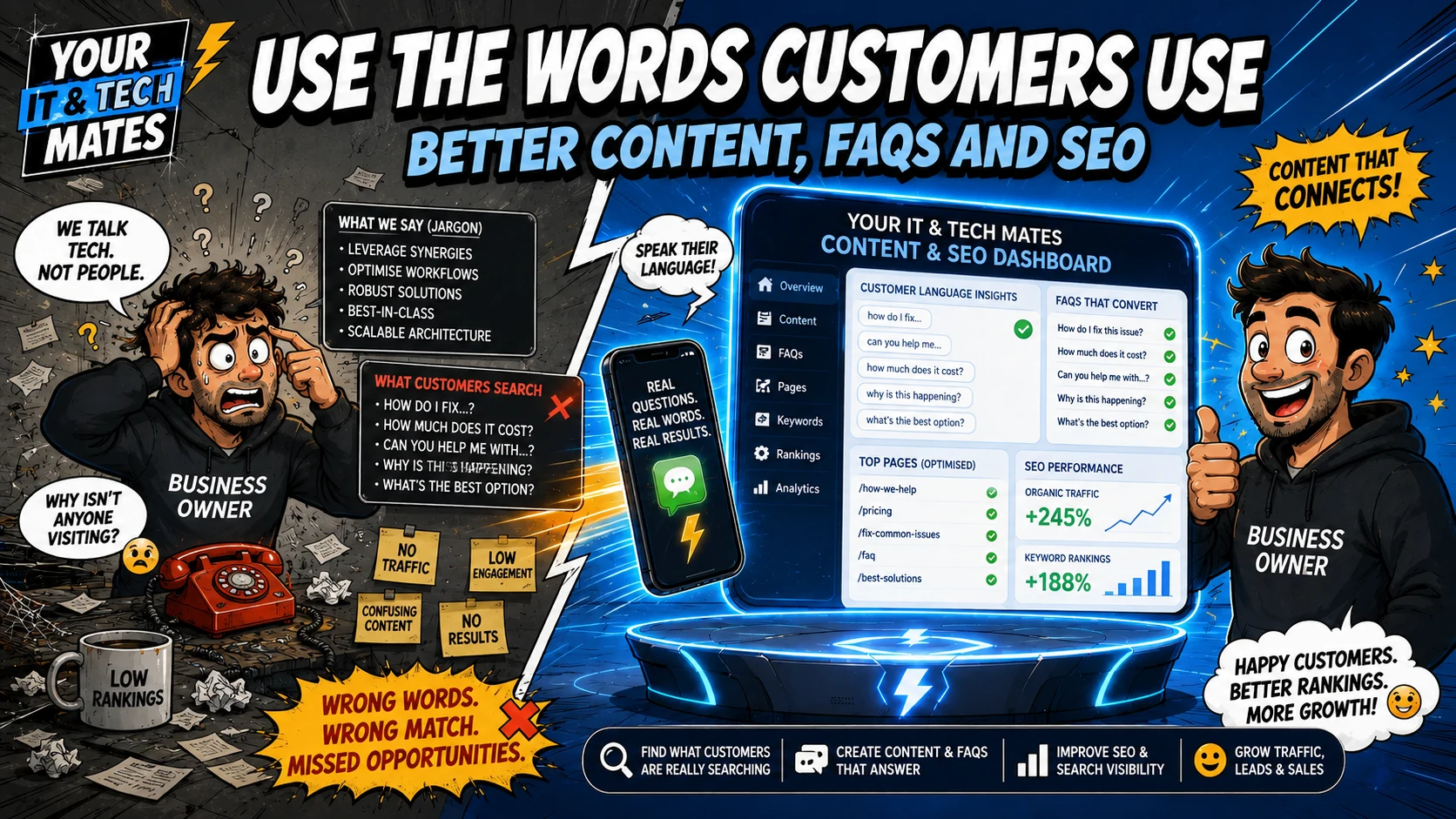
Businesses often write in internal language while customers search in everyday language. Intent data helps close that gap by showing the questions people actually ask and the words they use when they are confused, comparing options or ready to act.
Quick answer
Customer language can improve SEO and AI-search visibility because it reveals the real questions, symptoms and decision phrases people use. The best approach is not to create a separate page for every wording variation. Improve the strongest existing page so it answers the underlying intent clearly, then use FAQs, examples and internal links to cover natural-language variants.
Why this matters to another small business
This article uses a real Your IT and Tech Mates website pattern as the example, but the lesson is broader. Customers usually describe a problem before they know the service name. A useful AI or automation layer should help translate that plain-English intent into an approved business workflow without forcing the customer to learn your internal categories.
For implementation options, see our Small Business Software & AI Solutions Melbourne hub. It explains how we approach workflow review, custom software and practical AI integration before recommending a build.
Internal jargon and customer wording are often different
A business may write “intermittent network connectivity”. A customer writes “Wi-Fi keeps cutting out”. A software consultant may write “workflow orchestration”. A business owner writes “we copy every enquiry into three different places”. Both sides can be correct, but the customer’s wording is usually the better entry point for public content.
Intent is stronger than stuffing synonyms
A good page should answer one clear problem deeply enough that different phrasings still make sense. Adding dozens of near-identical headings for every keyword variation creates noise. Intent data helps identify the central question and the supporting language around it.
Turn repeated searches into better FAQs
If customers repeatedly ask “how much does it cost?”, “can this be done remotely?” or “do I need a new computer?”, those are strong FAQ candidates when the business can answer them accurately.
A useful FAQ gives a direct answer first, then the condition that may change it. That format is helpful for people and easy for search engines and AI answer systems to understand.
Use first-party examples as proof
Generic AI-generated advice is easy to reproduce. First-party examples are harder to replace. Our Intent Intelligence articles explain how we actually route customer wording, maintain learned rules and keep QuoteMe and pricing under their existing owners.
For another business, the equivalent proof could be a real booking workflow, before-and-after admin process, customer question pattern or measured reduction in repeated work.
Let search demand choose what to refresh
When a repeated customer intent already has a good page, improve that page before publishing another article. Add the missing question, example, service boundary or next step. Only create a new page when the customer is genuinely trying to solve a different problem.
Connect informational content to the commercial hub
A useful blog post should not end as an isolated SEO asset. Link it to the relevant service hub, related proof and a sensible next action. For this cluster, the commercial destination is our Small Business Software & AI Solutions Melbourne hub, where the reader can move from learning to a workflow review.
A practical next step
Start with one customer journey and write down three things: what customers actually say, what the business needs to know next, and which existing system owns the final action. That makes it much easier to decide whether better copy, a shorter form, predefined rules, workflow automation or AI is the right tool.
Frequently asked questions
Should I use customer wording in page headings?
Yes, when it clearly describes the real problem or question. Keep technical terms where they help, but explain them in plain English.
Should every search phrase become a new blog post?
No. Group phrases by underlying intent and improve existing strong pages before creating new content.
Can FAQs help AI search engines understand a page?
Clear question-and-answer sections can make the page easier to parse, but they still need to be useful, accurate and consistent with the main content.
What makes content useful for GEO or AI answers?
Direct answers, clear entities, first-party experience, good internal links, structured data and transparent limitations all help machine understanding.
How often should content be refreshed?
Refresh when customer questions, services, pricing boundaries or search demand materially change rather than updating dates for appearance alone.
Could your business use Intent Intelligence?
If customers already describe what they need through your website, forms, email or messages, those conversations may contain enough information to identify intent, capture useful context and start the right controlled workflow.
Intent Intelligence is custom software built around your workflow, not another generic chatbot.
Want content that reflects how customers actually ask for help?
Our Software & AI service can connect customer-intent data with content, FAQs, lead routing and your existing website workflow.
New: Intent-Aware Website business series
These newer guides show how content semantics, customer corrections, journey context and readiness signals can work together without turning ordinary browsing into certainty.