Service enquiries
Identify the service or request type and route it to the right team or workflow.
Custom Intent Intelligence software
Turn messy customer enquiries into structured business actions. Intent Intelligence understands what a customer or staff member needs, extracts the useful context, applies your business rules and moves the request toward the right next action.
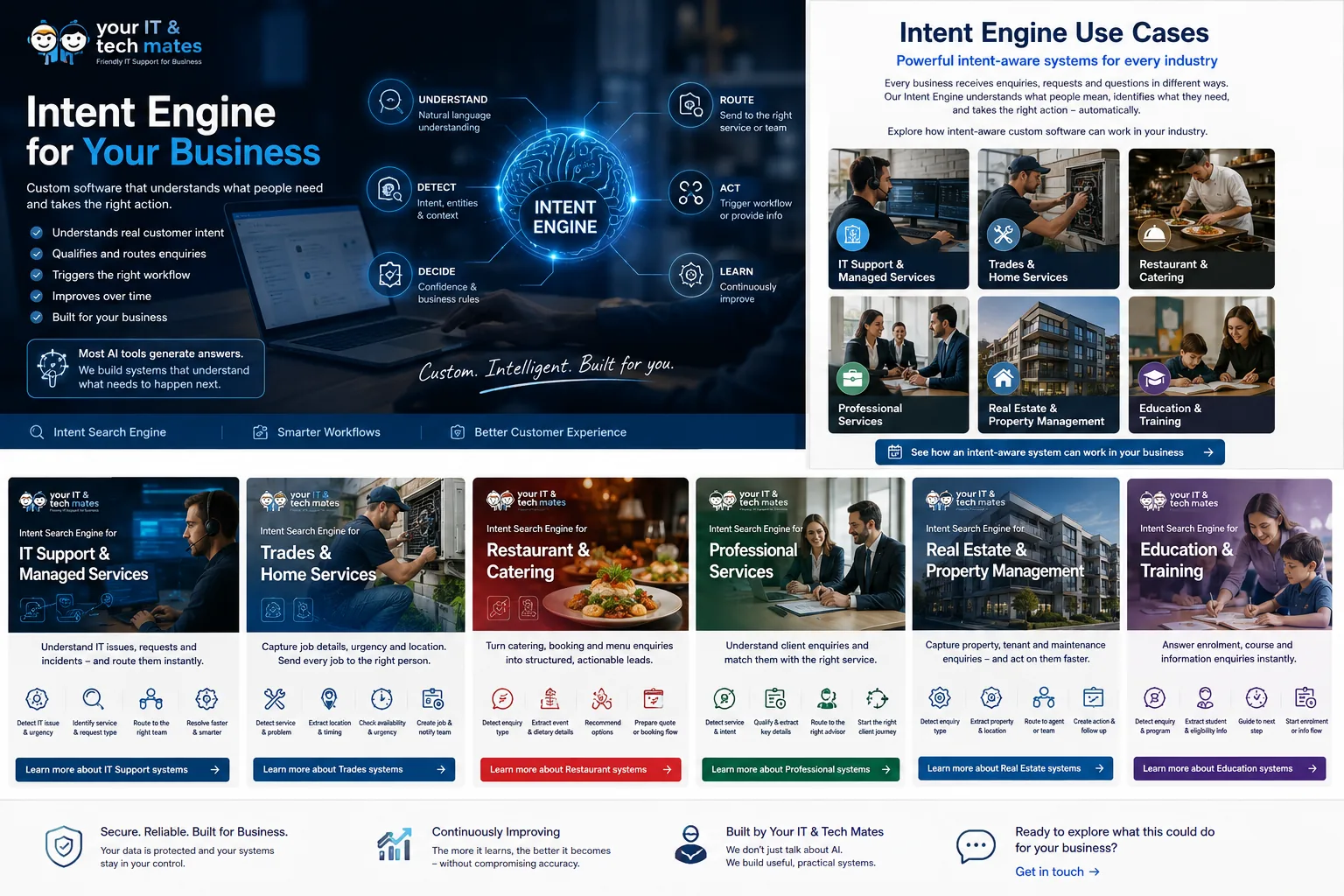
A useful intent-aware system does more than search for keywords. It can identify the service being discussed, pull out useful context, measure confidence, apply business rules and either trigger a safe workflow or hand the request to a person.
Commercial capability
It depends on what should happen after someone asks you a question. The Intent Engine can understand the request, capture the information your team needs, apply your rules and move the enquiry toward the next useful action.
Identify the service or request type and route it to the right team or workflow.
Use context such as timing and business impact to flag requests that need faster review.
Capture dates, locations, quantities, preferences and other booking context from natural language.
Gather the information your existing quote process needs, then hand over to QuoteMe or another controlled workflow.
Ask one useful clarification when something important is missing instead of forcing every customer through a long generic form.
Interpret staff requests and route them into help desk, CRM, operations or approval processes.
Keyword search asks, “Which page contains these words?” Intent search asks, “What is this person actually trying to achieve, what useful context have they already given us, and what should happen next?” Both can be useful, but they solve different problems.
It works well for known-item searches such as a product name, service name or exact topic. Its weakness appears when customers use different language, describe symptoms rather than services, combine several needs, or do not know your internal terminology.
An intent-aware system can recognise the underlying task, extract useful details, apply confidence and business rules, and then route, qualify, answer or hand the request to a person. The goal is not to replace normal search everywhere—it is to handle the enquiries normal search struggles to understand.
A search for “laptop repair” could mean very different things:
“Do you repair laptop screens?”
“My laptop screen broke and I need it repaired today.”
“How much does a MacBook screen repair cost?”
“I already booked my repair — when can I collect it?”
The underlying Intent Engine pattern is reusable, but the commercial value is industry-specific. These are representative advantages rather than claims about a particular client deployment.
Customers can describe what is happening instead of knowing the technical name of the fault. Business impact such as multiple users being affected or an imminent meeting can influence routing.
See the industry proof →People do not need to know whether they need a plumber, hot-water technician or another service category. Problem, location, preferred timing and access information can be captured together.
See the industry proof →Guest numbers, dates, delivery and dietary requirements can be understood as parts of the same event. Structured event details can reach staff without being manually re-entered from a message.
See the industry proof →Prospects can explain their circumstances even when they do not know which professional service they need. Business stage, service needs, urgency and decision intent can be captured before the first conversation.
See the industry proof →Buyer, renter, landlord, tenant-maintenance and appraisal enquiries can follow different paths. Property, problem and urgency information can be collected together before staff review.
See the industry proof →Age, eligibility, days, fees and deadlines can be handled as one enquiry. Common enrolment and program questions can be resolved without staff manually searching the same information.
See the industry proof →Administrative requests can be matched to the relevant service or practitioner pathway. Availability, referral, fee and appointment-type questions can be handled more efficiently.
See the industry proof →Customers do not need to correctly name the faulty component. Vehicle, symptoms and timing can be captured together.
See the industry proof →Quote, policy-information, document and appointment intents can be separated early. Business type, stage and requested product category can reach staff with the enquiry.
See the industry proof →A job seeker and a hiring manager can be routed differently even when they mention the same role. Seniority, location, timing and employment needs can be captured from ordinary language.
See the industry proof →Shoppers can describe what they need instead of guessing exact product names. Model, use case and required features can be interpreted together.
See the industry proof →Capacity, date, catering, AV and room needs can be treated as one opportunity. Core event details can be checked before lengthy back-and-forth.
See the industry proof →Dates, party size, room needs and preferences do not have to be searched separately. Guests can be guided toward relevant accommodation or experiences sooner.
See the industry proof →They can describe the occasion and desired outcome in normal language. Hair, makeup and timing can be understood as one booking journey.
See the industry proof →Property type, size, frequency and timing can be captured together. Different service rules and teams can be applied without relying on one generic form.
See the industry proof →Product, specification, quantity and delivery details can be captured from emails or forms. Drawings, part numbers and specifications can be associated with the enquiry context.
See the industry proof →Product showcase
Intent Intelligence is one of Your IT & Tech Mates’ own AI/software products. The examples below show three parts of the same controlled pattern: understand the request, ground the next step in approved knowledge, and carry reviewed context into the next workflow.
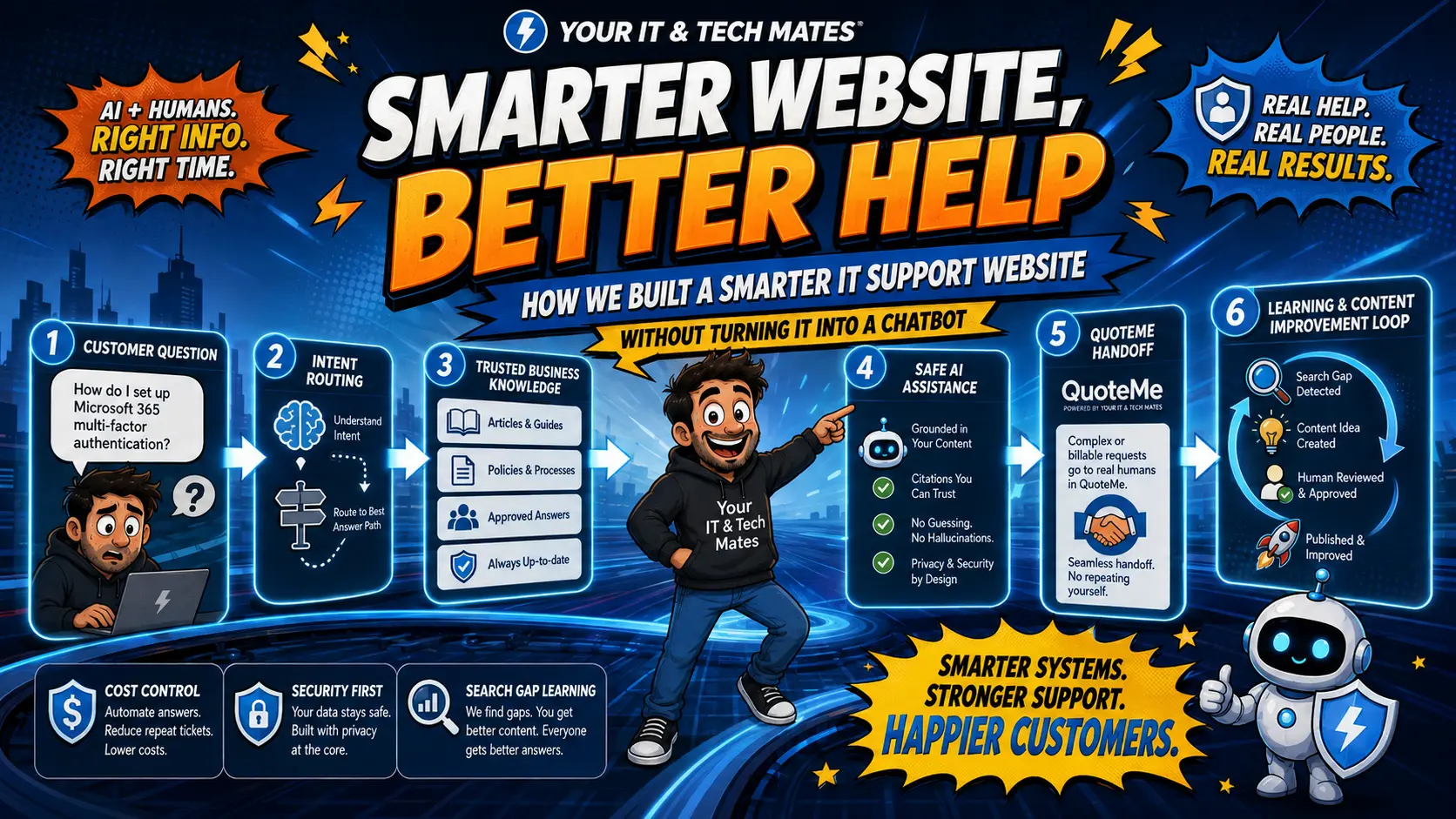
Interpret the customer’s own words and identify the likely intent without forcing a long service menu.
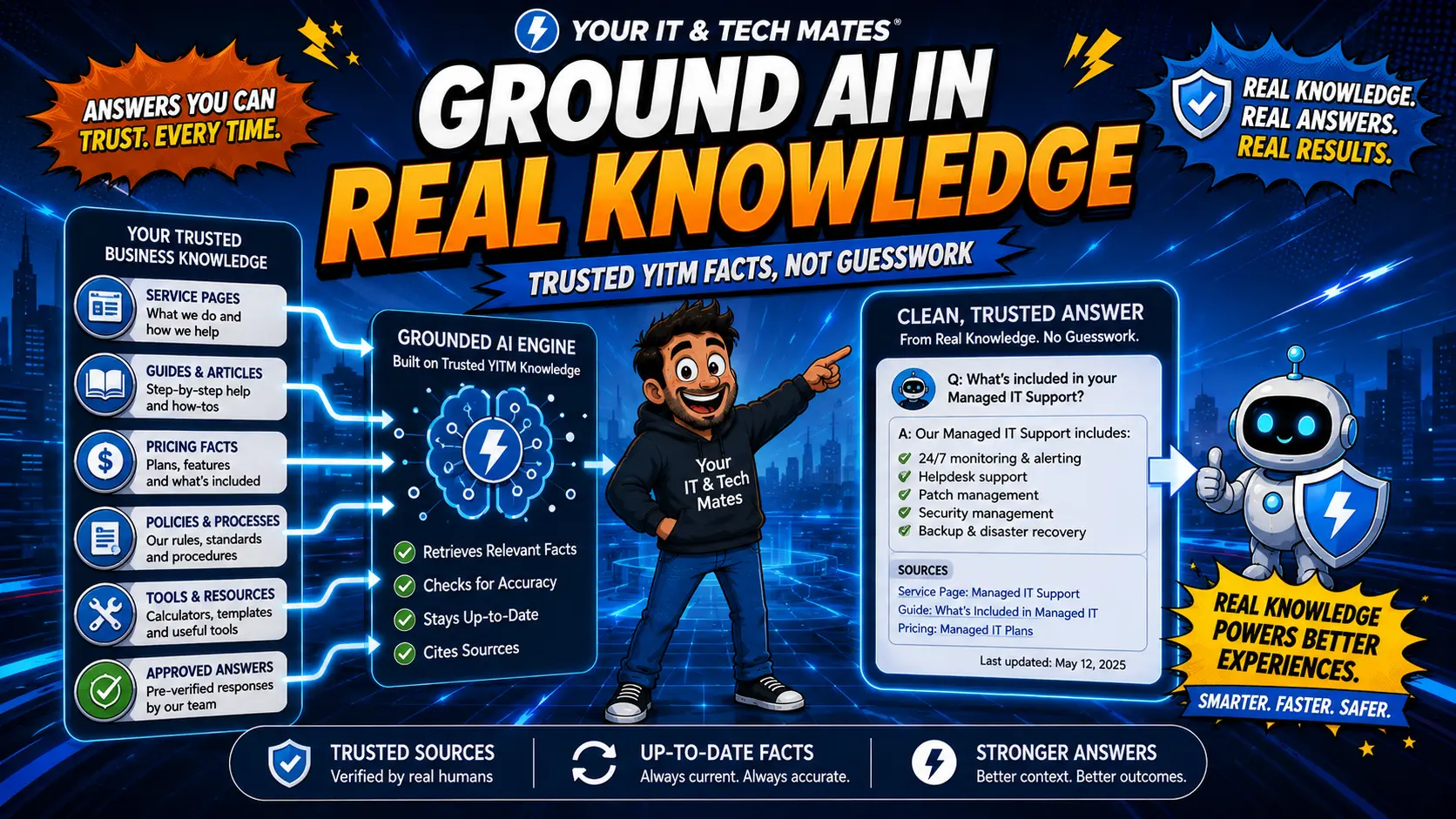
Ground responses and next steps in controlled business information rather than asking AI to invent answers.
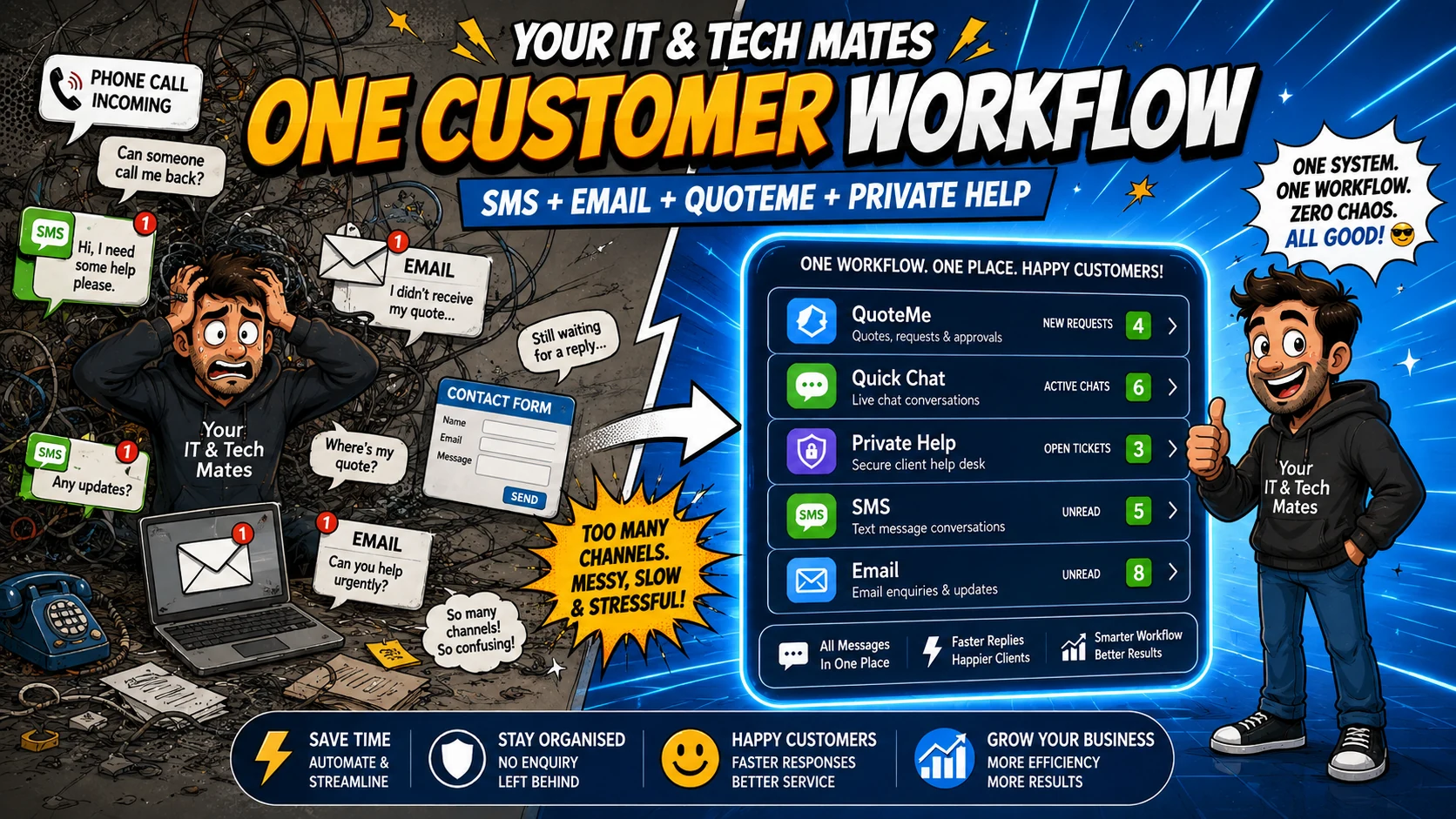
Carry reviewed context into QuoteMe, support or another workflow while keeping important decisions human-controlled.
The homepage repair, pickup and business canvas is a live example of the same Intent Engine approach: customer language first, one useful clarification when needed, then a controlled handoff.
Intent Intelligence is the layer between what a person says and what a business needs to do next. Instead of relying only on exact keywords or a long rigid form, the system interprets the purpose of the enquiry, extracts useful details, applies confidence and business rules, then chooses an appropriate next step.
That next step might be answering from approved information, asking one clarifying question, preparing a quote brief, creating a support ticket, routing to a specialist, starting a booking workflow or deliberately handing the matter to a person.
Every implementation would be scoped around the business rather than copying the same demo workflow. The industry pages below are examples of how the pattern changes when the operational context changes.
V3.1 architecture
Intent Intelligence is designed so the learned layer can respond to recurring gaps and changing customer language without giving AI unrestricted control over your core business logic.
See what customers and staff are actually asking.
Surface recurring intent gaps and emerging language patterns.
Keep learned behaviour bounded and reviewable before it becomes trusted production knowledge.
Use approved knowledge to improve intent recognition and routing.
Allow learned rules to weaken, be replaced, retired or restored as patterns change.
Keep base taxonomy, pricing, safety logic and controlled transaction workflows outside the self-maintaining layer.
AI can help interpret language and surface patterns. Predefined rules, confidence checks and human escalation remain available wherever they matter.
These proof pages use realistic enquiries to show how the same underlying idea can be adapted to different operational workflows.
Custom intent-aware software for IT support and managed service businesses that interprets customer issues, identifies urgency and routes requests to the right support workflow.
Explore this use case →Intent-aware enquiry software for trades and home services that extracts the job type, location, urgency and booking context from customer messages.
Explore this use case →Intent-aware customer enquiry software for restaurants and caterers that recognises booking, catering, guest, dietary, delivery and pricing requirements.
Explore this use case →Intent-aware software for professional service firms that qualifies enquiries, identifies client needs and routes requests to the appropriate next step.
Explore this use case →Intent-aware software for real estate and property management that interprets property, tenant, inspection and maintenance enquiries and routes them appropriately.
Explore this use case →Intent-aware enquiry software for education and training providers that guides enrolments, program questions, eligibility and scheduling enquiries.
Explore this use case →Intent-aware enquiry software for allied health and clinic teams that helps organise appointment, referral, service and administrative enquiries while keeping clinical decisions with qualified people.
Explore this use case →Intent-aware software for mechanics, repairers and automotive service businesses that structures vehicle, symptom, timing and booking information from customer enquiries.
Explore this use case →Intent-aware enquiry software for finance and insurance service teams that classifies administrative, product, appointment and document requests while keeping regulated advice and decisions with authorised people.
Explore this use case →Intent-aware software for recruitment and HR teams that interprets candidate, employer and internal people enquiries and moves them toward the right workflow.
Explore this use case →Intent-aware customer enquiry software for retail and e-commerce businesses that recognises product, compatibility, availability, return, warranty and pre-sales intent.
Explore this use case →Intent-aware enquiry software for event and venue businesses that extracts date, guest, space, catering, equipment and budget context from event enquiries.
Explore this use case →Intent-aware software for accommodation and tourism operators that interprets stay, activity, group, accessibility and booking enquiries.
Explore this use case →Intent-aware enquiry software for salons, spas and wellness businesses that helps classify service, appointment, pricing and preparation questions.
Explore this use case →Intent-aware enquiry software for cleaning and facilities businesses that structures property, scope, frequency, access, timing and quote information.
Explore this use case →Intent-aware enquiry software for manufacturers and B2B suppliers that structures technical, quantity, compatibility, lead-time and quotation requirements from buyer messages.
Explore this use case →Staff repeatedly read emails, forms or messages and decide what service, team or workflow each one belongs to.
Good enquiries become slow because staff need another round of questions before they can act.
The website, inbox, CRM, booking system or help desk each work, but people still bridge them manually.
Your internal service names do not match the way real people describe their problem or goal.
You need confidence checks and human-review boundaries rather than a one-size-fits-all bot.
Structured intent data can reveal what people are asking for, where journeys fail and what demand is emerging.
Is it a fit?
How a project works
Map how enquiries enter the business and what currently happens next.
Identify meaningful intents, required context, exceptions and hand-off points.
Configure terminology, confidence checks, predefined rules and human-review boundaries.
Connect the appropriate website, CRM, help desk, booking, email or internal systems.
Test real-world wording, ambiguity, edge cases and safe fallback behaviour.
Deploy, observe outcomes and refine approved intent knowledge over time.
Intent Intelligence can combine AI interpretation with deterministic business rules, confidence checks and human escalation points.
No. It can work with conversational interfaces, but its main purpose is to understand a request and move it into the appropriate business workflow.
Usually not. A custom implementation can be designed around the systems and processes you already use, subject to the integrations and security controls those systems support.
The workflow can ask one useful clarification or hand the request to a person instead of blindly taking an action.
The architecture can identify recurring patterns and gaps, but learned behaviour is bounded and controlled. Core business rules do not need to be freely rewritten by AI.
It is custom software, so scope depends on workflow complexity, integrations, controls and automation required. QuoteMe can be used to start scoping the project.