Agent-Ready Websites Without Autonomous Customer Decisions
How structured service information can help AI assistants understand a business while quotes, bookings, payments and customer data stay permission-controlled.
Helpful guidance only. You review before anything is sent or changed.
Quick answer
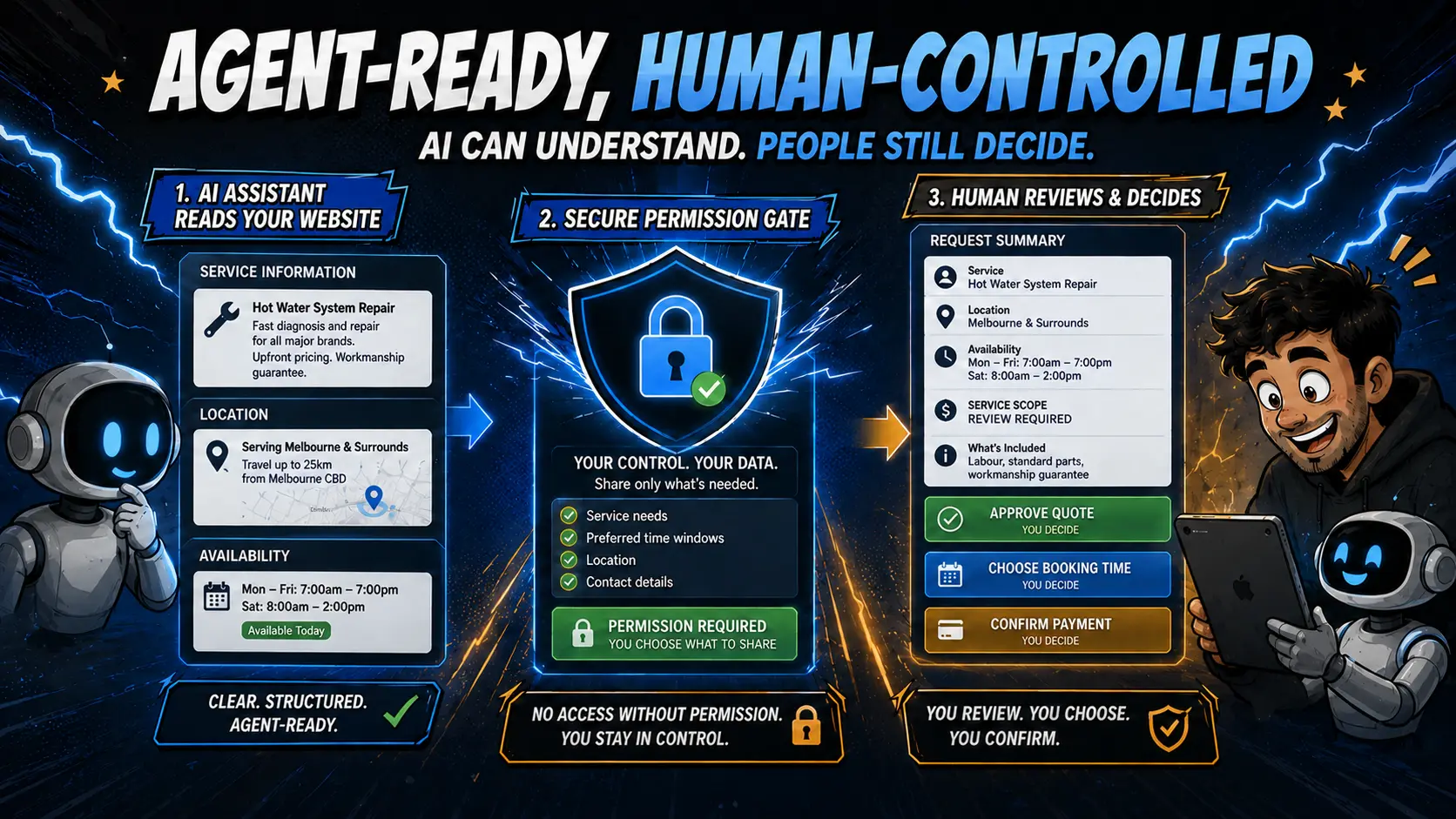
An agent-ready website makes public services, locations, boundaries and next steps easier for software assistants to understand. That does not mean giving an agent permission to submit requests, approve quotes, choose bookings or confirm payments for a customer.
Readable information comes first
Clear headings, descriptive links, structured data, canonical URLs and stable service pages help both people and software understand what the business offers. Agent readiness begins with reliable public information, not with unrestricted automation.
Separate discovery from authority
An assistant may discover a service or prepare a summary from information the customer provides. The business system still validates the service, availability and workflow. The customer reviews what will be shared and explicitly chooses whether to continue.
Permission at every consequential step
Request creation, quote approval, appointment selection and payment are different decisions. They should not be bundled into one invisible agent action. Each needs an authenticated or otherwise appropriate boundary, current information and a clear record of consent.
Design for safe failure
If structured information is missing or stale, the assistant should link to the current owner or ask the customer to review, not fill the gap with a plausible answer. Expired sessions, replayed tokens and unavailable services must fail closed.
What small businesses can do now
Keep service pages current, publish clear location and availability boundaries, use valid structured data, maintain a stable sitemap, label indicative information and create explicit handoff points. These foundations help today’s search systems and future assistants without surrendering customer control.
The boundary that keeps this useful
The Intent Engine may organise language, rank reviewed options and prepare an editable summary. It does not make a final diagnosis, invent a price, approve paid work, book an appointment or submit a request without the customer’s action.
Practical example: prepare information for agents without handing over authority
An agent-ready service page can expose clear service names, eligibility, price guidance, locations, FAQs and approved next actions in structured form. An AI assistant can then explain those facts or navigate to the right page. It does not need permission to invent discounts, approve a repair, promise an appointment or change a customer's request.
The useful design boundary is simple: machines may retrieve, summarise and recommend within published rules; consequential actions remain behind explicit customer confirmation or staff authority. This also makes the same content safer for search engines, AI assistants and the Intent Engine.
Where it can go wrong: Do not create hidden agent-only facts that contradict the public page. Important service conditions should be visible to people as well as machines, with structured data supporting rather than replacing the readable content.
Frequently asked questions
What does agent-ready mean?
It means public business information and controlled handoffs are structured clearly enough for software assistants to interpret.
Can an AI agent approve a quote on this website?
No. Quote approval remains a separate customer-controlled decision.
Is structured data the same as giving an agent access?
No. Public structured data describes information. Access to private workflows requires separate permission and security controls.
Continue the six-part Intent Engine education series
What Happens When an Intent Engine Is Not Sure?Part 2
Safety Before AI: Why High-Risk Requests Need a Safer PathPart 3
From Customer Words to an Approved Service CataloguePart 4
What Happens When a Customer Says “Not Quite”?Part 5
How We Measure Whether an Intent-Driven Website Actually HelpsPart 6
Agent-Ready Websites Without Autonomous Customer Decisions
Related established guides and proof
Could your business use Intent Intelligence?
We review the language customers already use, the approved business outcomes and the systems that own pricing, booking or fulfilment before recommending a build.