Intent Search vs Keyword Search: What Should a Small Business Website Use?
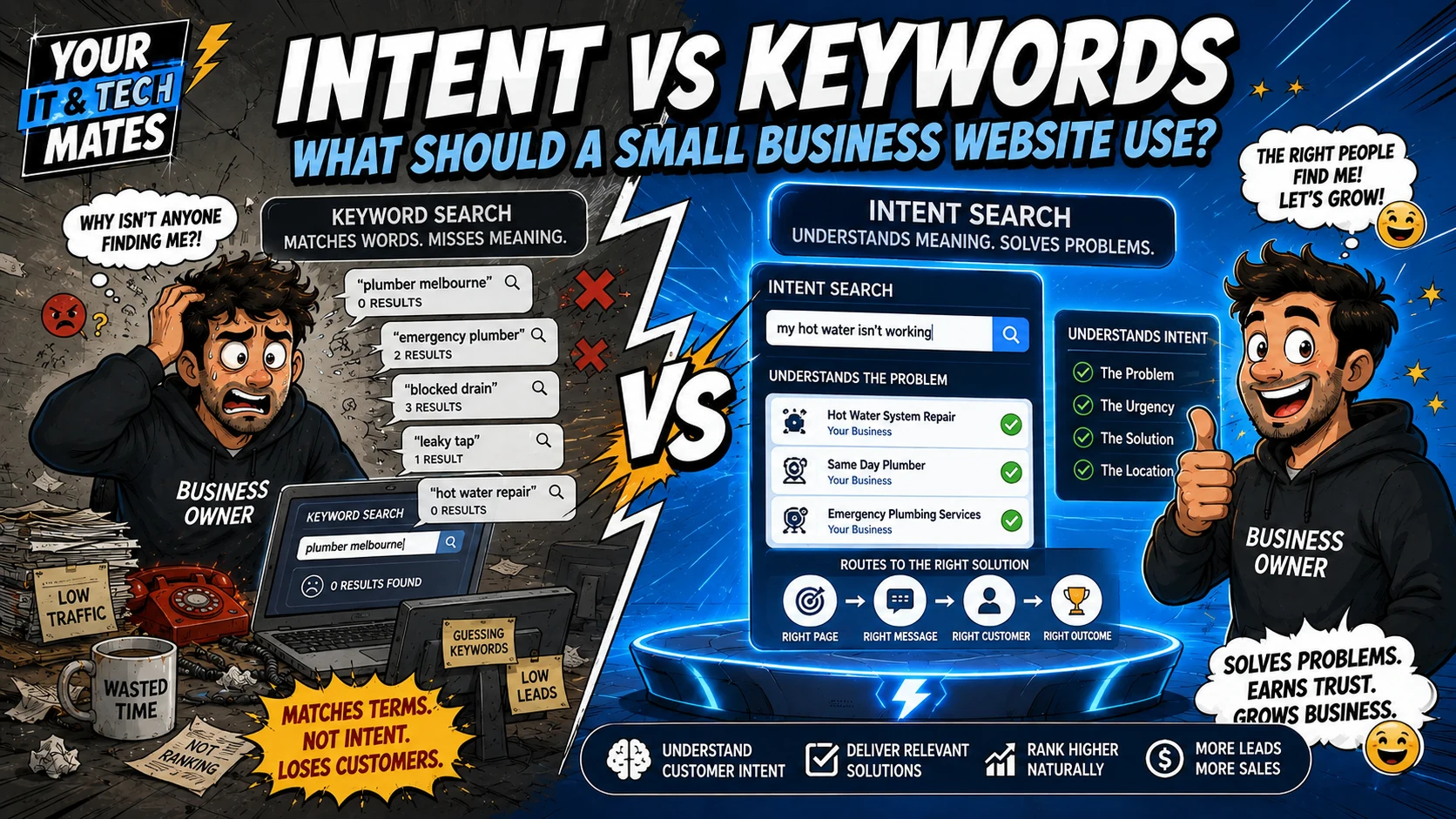
Keyword search asks “which words match?” Intent search asks “what is this person trying to do?” A small-business website can use both. The best choice depends on whether the customer knows the exact term or only knows the problem they are experiencing.
Quick answer
Keyword search is useful when customers know the term, product or page they want. Intent search is useful when customers describe a problem in natural language. A good small-business website can combine them: exact matches stay fast, while intent understanding helps messy or unfamiliar wording reach approved services and content.
Why this matters to another small business
This article uses a real Your IT and Tech Mates website pattern as the example, but the lesson is broader. Customers usually describe a problem before they know the service name. A useful AI or automation layer should help translate that plain-English intent into an approved business workflow without forcing the customer to learn your internal categories.
For implementation options, see our Small Business Software & AI Solutions Melbourne hub. It explains how we approach workflow review, custom software and practical AI integration before recommending a build.
What keyword search does well
Keyword search is simple, fast and predictable. If someone types “pricing”, “Microsoft 365” or “laptop screen repair”, a direct match may be exactly what they need. There is no reason to force AI into a query that already maps cleanly to a page.
Where keyword matching struggles
Customers often describe symptoms rather than service names. “My hot water isn’t working” may not contain the exact words used on a plumbing service page. “Someone changed the bank details on an invoice” may not match a page called business email compromise.
Intent search can use the whole phrase and surrounding context instead of requiring the customer to guess the website vocabulary.
Intent search should still use a controlled destination
Understanding meaning is only half the job. The system should route into approved services, guides and actions. It should not invent a page or create a new service because the wording sounds plausible.
The hybrid approach
We prefer a layered approach. Strong exact or reviewed matches can resolve quickly. Controlled intent rules handle known natural-language patterns. More flexible AI or semantic assistance is reserved for genuinely ambiguous wording, with confidence and safety boundaries around the result.
Example for another business
A mechanic’s site can still match “logbook service” exactly. But a customer typing “car shakes when braking downhill” may need intent understanding before the site can show a brake inspection path. The business gets the benefit of natural language without giving up its approved service catalogue.
How to choose what your website needs
Start with search logs and enquiry behaviour. If customers mostly know the exact terms, improve normal search and navigation first. If staff repeatedly interpret vague descriptions, the site may benefit from an intent layer. Measure wrong routes and customer corrections before expanding it.
A practical next step
Start with one customer journey and write down three things: what customers actually say, what the business needs to know next, and which existing system owns the final action. That makes it much easier to decide whether better copy, a shorter form, predefined rules, workflow automation or AI is the right tool.
Frequently asked questions
Is intent search better than keyword search?
Not in every situation. Keyword search is excellent for exact known terms, while intent search helps when the customer describes a problem in natural language.
Does intent search require generative AI?
No. Reviewed rules, synonyms, semantic matching and controlled classifiers can all contribute without generating free-form answers.
Can both systems run together?
Yes. A hybrid approach can use exact matches first and intent understanding when the wording is broader or ambiguous.
Will intent search improve SEO rankings?
It can improve the customer experience and reveal useful language, but rankings depend on the overall quality and relevance of the website.
What should a small business test first?
Review common failed searches and enquiries that staff routinely reinterpret. Those are the best candidates for intent support.
Could your business use Intent Intelligence?
If customers already describe what they need through your website, forms, email or messages, those conversations may contain enough information to identify intent, capture useful context and start the right controlled workflow.
Intent Intelligence is custom software built around your workflow, not another generic chatbot.
Not sure whether your site needs better search, better forms or an intent layer?
Our Software & AI service can review the customer journey first so you improve the right part of the website instead of adding AI by default.