From Customer Words to an Approved Service Catalogue
How an intent layer can translate everyday customer language into reviewed service categories without inventing prices, products or business rules.
Helpful guidance only. You review before anything is sent or changed.
Quick answer
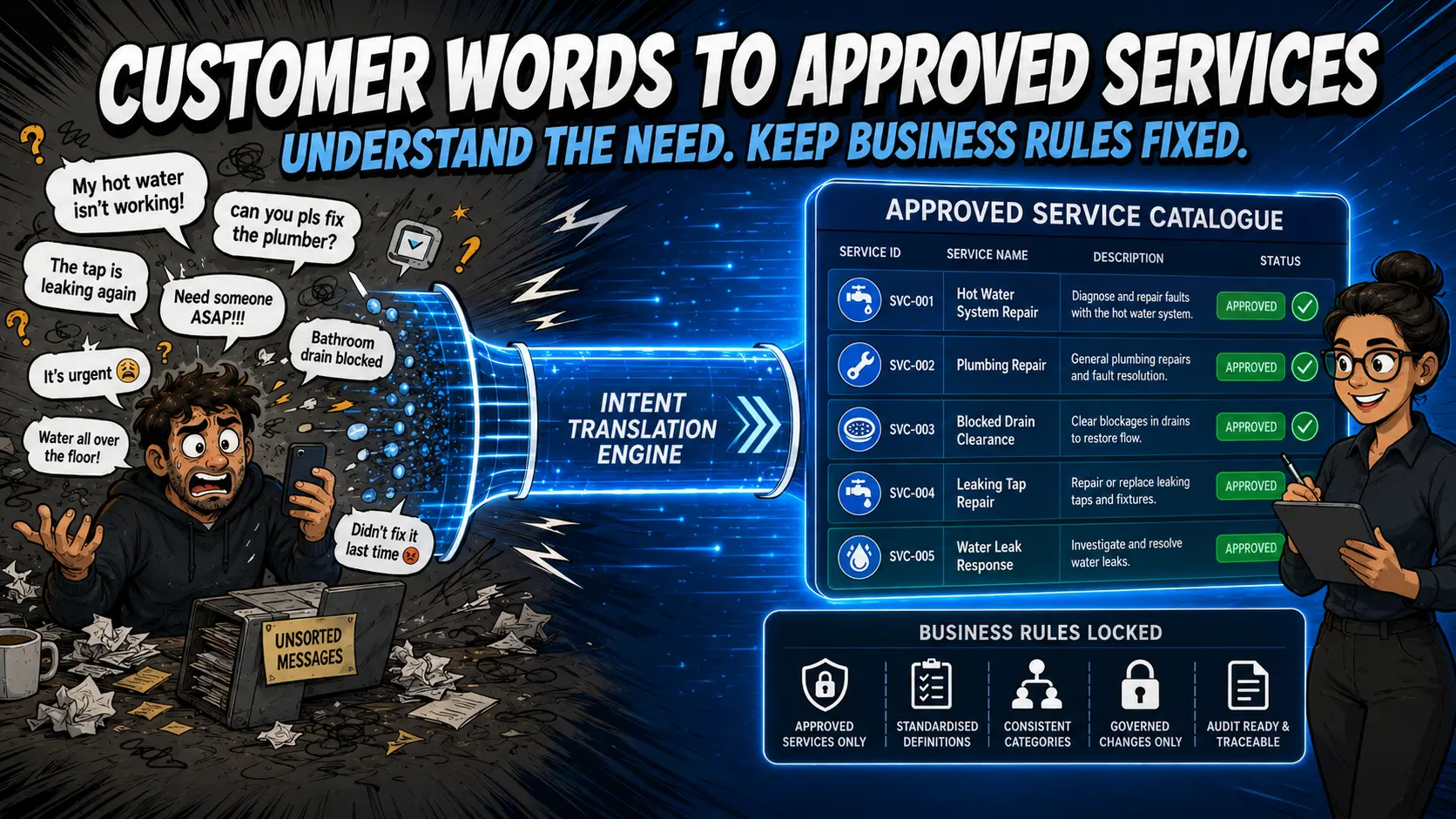
The intent layer should translate what a customer means; it should not become the price book or service database. Once language has been interpreted, deterministic code validates the result against an approved catalogue and the customer checks the summary.
Two different responsibilities
Language understanding handles ambiguity, spelling mistakes and everyday descriptions. The catalogue owns stable identifiers, service availability, approved descriptions, price sources and workflow rules. Keeping those responsibilities separate makes the system easier to test and safer to change.
Why a model must not invent catalogue entries
A plausible-sounding service name is not necessarily a service the business offers. A useful intent result therefore contains only known identifiers or an explicit unknown state. Anything outside the allowlist goes to clarification or human review.
Validation after interpretation
The server validates the suggested category, checks required fields and applies business rules. Pricing comes from its approved owner, not generated prose. Booking eligibility comes from its workflow owner, not the confidence score. Submission still requires the customer’s explicit action.
Versioning and auditability
Catalogues change. Services are renamed, merged, limited or retired. Mapping rules therefore need version history and a way to trace which approved category was used. The language layer can evolve without silently rewriting the underlying business record.
How to prepare a catalogue
Start with a small list of real outcomes: the service identifier, customer-facing name, information needed, safety exclusions, price owner and next workflow. Add examples of what customers say only after those stable outcomes exist.
The boundary that keeps this useful
The Intent Engine may organise language, rank reviewed options and prepare an editable summary. It does not make a final diagnosis, invent a price, approve paid work, book an appointment or submit a request without the customer’s action.
Practical example: translate symptoms into services without inventing services
A customer may type 'the computer only works when the charger is held at an angle'. The service catalogue may call the relevant area laptop power or charging repair. The intent layer can connect those phrases, but it should still return an approved service key and URL rather than generating a new service name on the fly.
Maintain a reviewable mapping between customer phrases, intent keys and the service catalogue. Unknown or conflicting phrases should fall back to a clarifying question or a general support path. That keeps SEO pages, QuoteMe, staff workflows and AI recommendations aligned around the same service authority.
Where it can go wrong: Avoid turning every phrase into a new landing page. One strong service page can answer many natural-language variations while the intent layer handles the translation behind the scenes.
Frequently asked questions
Can AI create a new service when nothing matches?
No. It should return an unknown state or prepare a general request for human review.
Where should prices come from?
From the business’s approved pricing source and rules, not from generated text.
Why use stable service identifiers?
They let different interfaces refer to the same reviewed business outcome without depending on wording.
Continue the six-part Intent Engine education series
What Happens When an Intent Engine Is Not Sure?Part 2
Safety Before AI: Why High-Risk Requests Need a Safer PathPart 3
From Customer Words to an Approved Service CataloguePart 4
What Happens When a Customer Says “Not Quite”?Part 5
How We Measure Whether an Intent-Driven Website Actually HelpsPart 6
Agent-Ready Websites Without Autonomous Customer Decisions
Related established guides and proof
Could your business use Intent Intelligence?
We review the language customers already use, the approved business outcomes and the systems that own pricing, booking or fulfilment before recommending a build.