What Happens When a Customer Says “Not Quite”?
Follow a customer correction from a review button to privacy-safe evidence, weekly human review and a controlled website improvement.
Helpful guidance only. You review before anything is sent or changed.
Quick answer
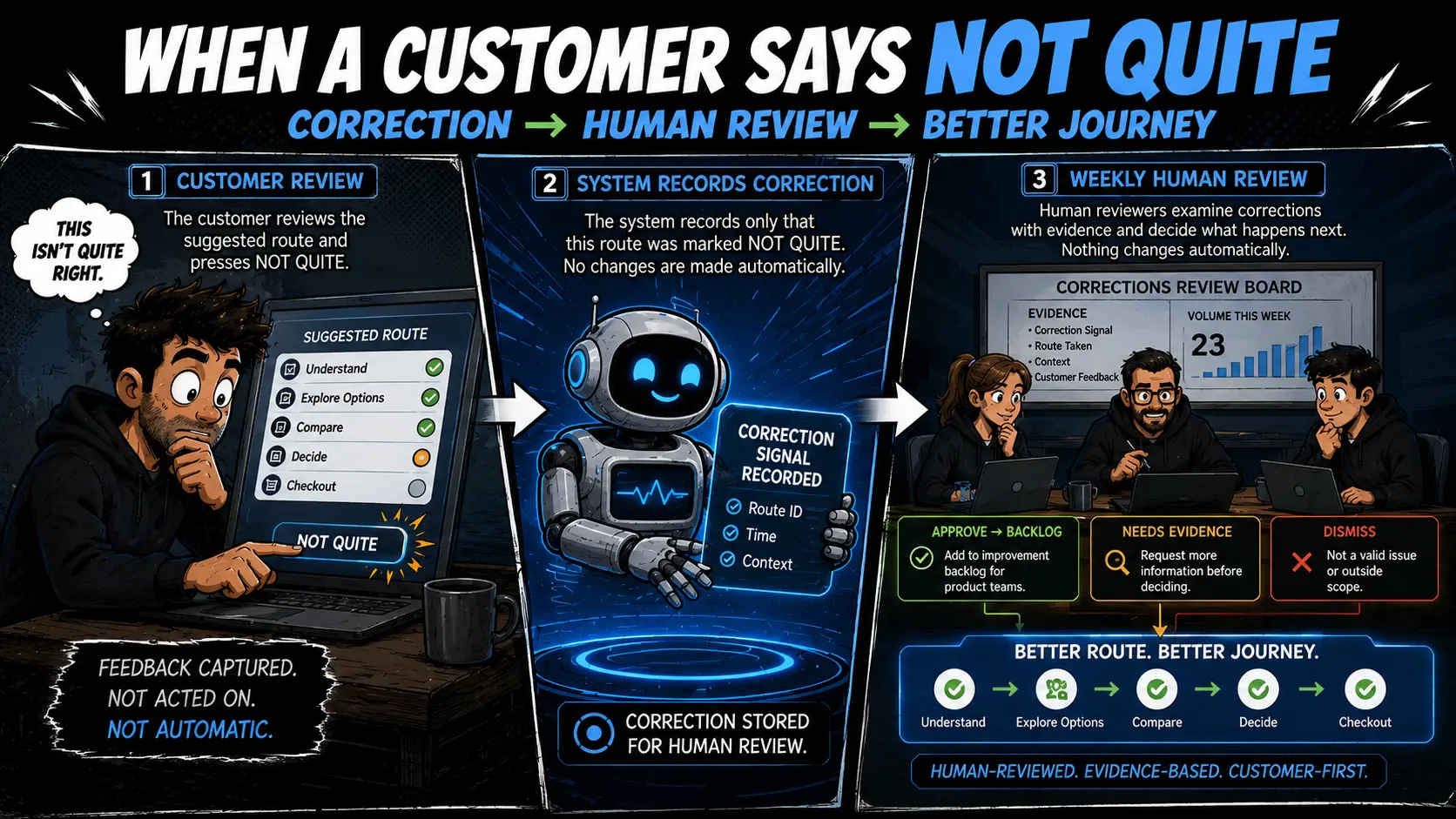
“Not quite” is valuable evidence, but it should not rewrite production automatically. The system can record a fixed correction outcome, combine it with aggregate journey evidence and ask a person whether the route, question or content needs improvement.
Correction is a signal, not a new truth
One person rejecting a route does not prove the route is wrong for everyone. It shows that the current interpretation did not work for that journey. The customer should be able to edit the summary and continue without waiting for the learning system.
Keep private words out of the improvement record
The improvement layer can count an allowlisted correction code, route family and outcome without copying the customer’s full message, contact details or request reference. Raw customer context remains with the existing request owner where access is controlled.
Combine several kinds of evidence
A weekly review is stronger when it considers corrections alongside clarification frequency, unsuccessful searches, content gaps, repeated information and completion outcomes. A repeated pattern is more useful than one isolated complaint.
People decide what changes
A reviewer can approve an item to the backlog, ask for more evidence or dismiss it. Approval means investigate and test, not publish new content, change a safety rule or retune routing immediately. Normal accessibility, safety, release and rollback checks still apply.
Close the measurement loop
After an improvement is released, compare the same customer-effort measure with a non-overlapping earlier period. A change is useful only if it reduces effort or improves the intended outcome without harming safety or another journey.
The boundary that keeps this useful
The Intent Engine may organise language, rank reviewed options and prepare an editable summary. It does not make a final diagnosis, invent a price, approve paid work, book an appointment or submit a request without the customer’s action.
Frequently asked questions
Does “Not quite” retrain the AI immediately?
No. It records governed evidence for human review.
Is the customer’s full message copied into analytics?
The Phase 3 improvement design uses fixed outcome codes and aggregate evidence rather than duplicating raw customer wording.
What does approve to backlog mean?
It creates a reviewed improvement item. It does not change production automatically.
Continue the six-part Intent Engine education series
What Happens When an Intent Engine Is Not Sure?Part 2
Safety Before AI: Why High-Risk Requests Need a Safer PathPart 3
From Customer Words to an Approved Service CataloguePart 4
What Happens When a Customer Says “Not Quite”?Part 5
How We Measure Whether an Intent-Driven Website Actually HelpsPart 6
Agent-Ready Websites Without Autonomous Customer Decisions
Related established guides and proof
Could your business use Intent Intelligence?
We review the language customers already use, the approved business outcomes and the systems that own pricing, booking or fulfilment before recommending a build.
New: Intent-Aware Website business series
These newer guides show how content semantics, customer corrections, journey context and readiness signals can work together without turning ordinary browsing into certainty.