AI Website vs Chatbot: What Is the Difference for Small Business Customer Help?
Compare an AI-assisted website with a chatbot, including when each approach helps customers, where they differ and how a small business can keep the experience simple and controlled.
Quick answer
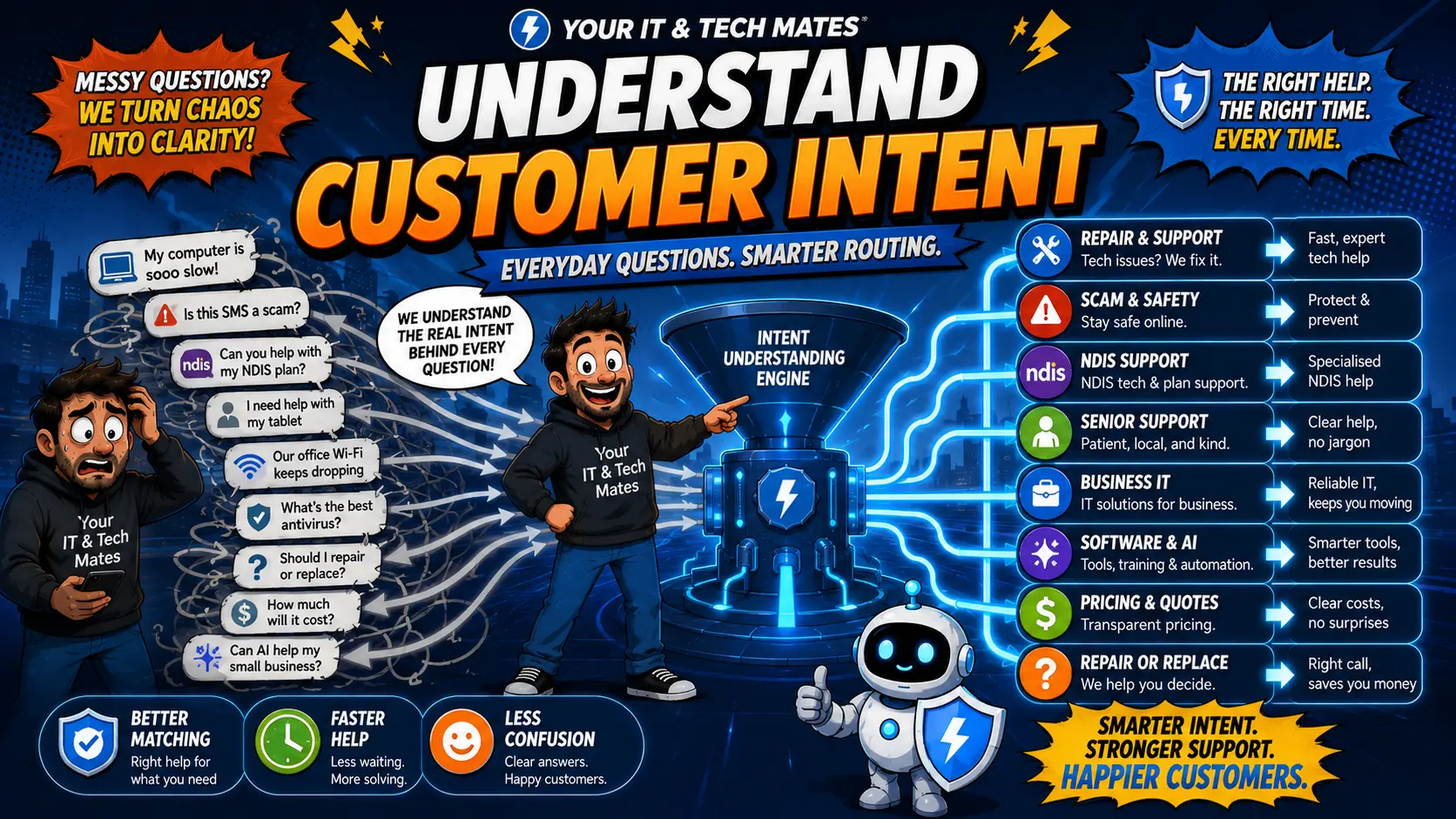
A chatbot is one interface for asking and answering questions. An AI-assisted website can use the customer’s need to change the wider journey, such as which guidance, proof, price information or approved next step is shown without turning the whole site into a conversation.
The easiest way to think about the difference
A chatbot usually says: “Ask me a question.” The answer stays inside the chat experience.
An AI-assisted website can say: “Tell us what happened.” It can then use the result to simplify the normal website around that customer’s goal.
Chatbot: answer inside a chat box → customer still works out which page or form to use.
AI-assisted website: understand the goal → show the right approved information and next step in the normal page journey.
When a chatbot can be enough
- Answering a narrow set of frequently asked questions.
- Collecting a few basic details before a human takes over.
- Providing a simple support or sales conversation where the customer is comfortable with chat.
- Handling a self-contained task that does not need the rest of the website to adapt.
When a smarter website can be more useful
- The customer does not know which service name applies.
- The same problem continues across guides, pricing and a request form.
- Different audiences should see different approved priorities, for example safety help before sales content.
- The business wants normal pages, accessibility and search-friendly content to keep working even if AI is unavailable.
- AI should support the experience without becoming the only way to navigate.
A small-business example
A customer writes: “We get enquiries from our website, Facebook and SMS and then copy them into a spreadsheet.”
A chatbot might explain that automation could help. A smarter website can also bring forward a workflow example, a relevant guide, a reviewed business-systems service and a clear way to ask for a human review, all from approved content already owned by the business.
The best answer is often a hybrid
You do not need to choose “chatbot” or “website” as competing technologies. A focused chat or answer box can be useful inside a wider adaptive website. The important design choice is ownership: the business should still control the possible actions, important facts and customer-request pathways.
What customers should notice
Customers should not need to learn the difference between a chatbot, AI model, workflow or other website technology. A good experience should simply feel easier: fewer irrelevant choices, less repetition and a clearer next step.
Frequently asked questions
Is an AI website just a chatbot built into the homepage?
No. A chatbot can be one component, while an AI-assisted website can use the customer’s goal across normal pages, guides and approved actions.
Which is cheaper to start with?
It depends on the problem. A narrow FAQ or guided form may be simpler than either option, so the first step should be defining the customer problem rather than choosing the technology.
Can a normal website still work if AI fails?
It should. Important services, contact details, safety information and request paths should remain available without depending on an AI response.
Should a chatbot be allowed to create quotes or bookings automatically?
Only where the business has deliberately designed and approved that transaction. For higher-consequence work, explicit customer action and human review are safer defaults.
Not sure whether you need a chatbot at all?
Start with the customer journey that is confusing or repetitive. We can review whether a better page, form, workflow, chatbot or broader AI-assisted website is the simplest fit.
From interface to customer journey
A chatbot is only one possible interface. See how a broader intelligent customer journey can connect website discovery, context and the next workflow without forcing every customer into chat.