Safety Before AI: Why High-Risk Requests Need a Safer Path
Learn why dangerous device, scam and account-security requests should be intercepted by reviewed safety rules before normal AI routing.
Helpful guidance only. You review before anything is sent or changed.
Quick answer
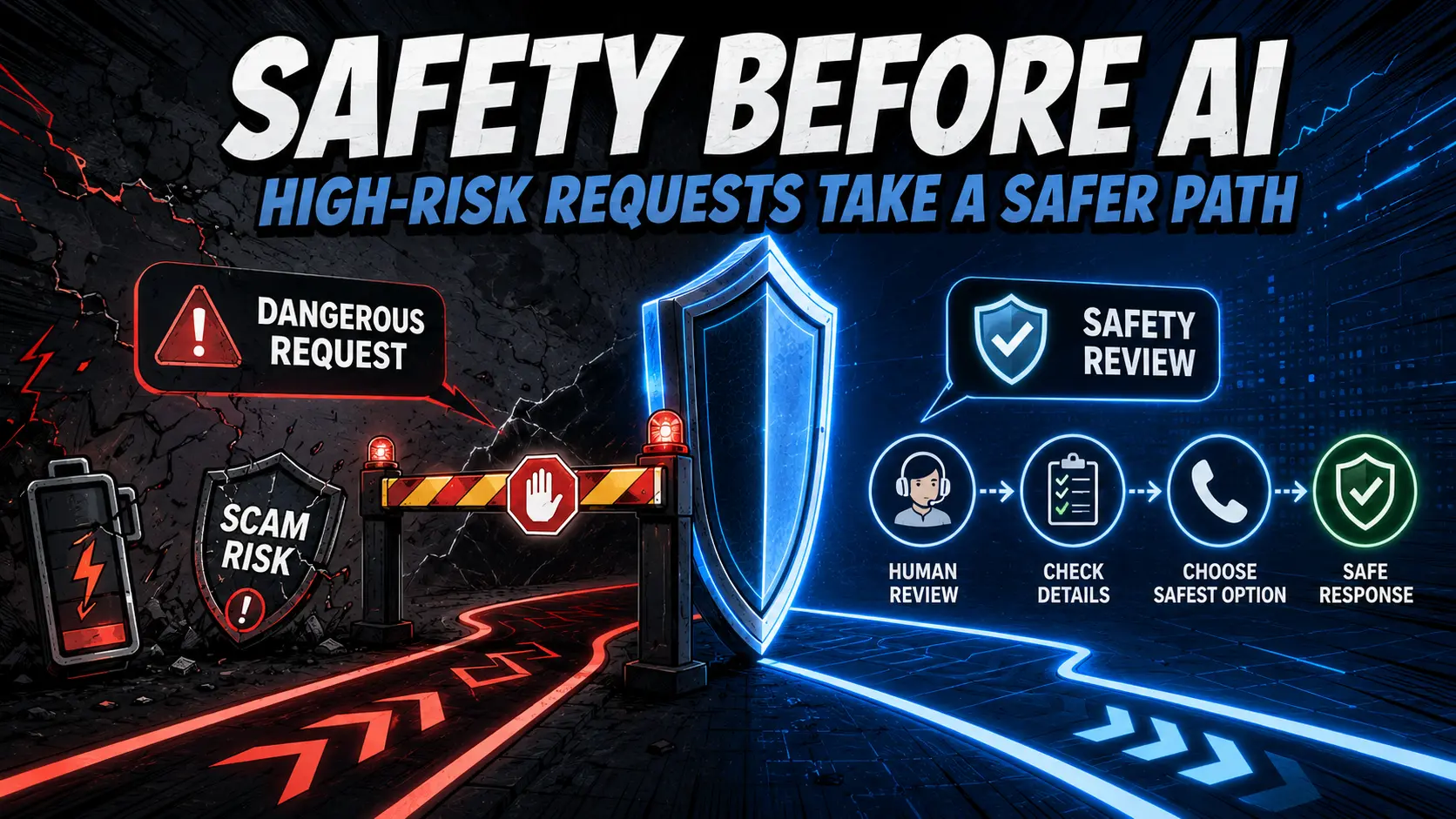
Some customer words are not ordinary lead-routing signals. They may indicate immediate physical danger, a scam in progress or an account-security risk. Reviewed predefined rules should intercept those cases before playful animation, normal service suggestions or generative advice.
Why safety has priority
A normal intent journey optimises relevance and effort. A safety journey has a different job: stop the customer from moving deeper into an unsuitable workflow and present reviewed, conservative help. That priority must be encoded in rules rather than left to a model to decide differently each time.
What deterministic means here
Deterministic safety mapping uses an allowlisted set of conditions and approved responses. A matching high-risk signal selects the same governed safety state, suppresses ordinary conversion prompts and makes the safety boundary visible. The AI does not get to improvise instructions, pricing or reassurance.
The interface must change too
Safety is not only a backend classification. The visual experience should remove playful reactions, replace the smiling guide with a clear shield and avoid normal booking language. Reduced motion and accessible status text help make the change understandable without relying on colour alone.
Human-reviewed information
Safety content needs a named editorial owner, current authoritative sources and a review date. The website can help someone recognise a risk and find the correct next contact, but it should not pretend to replace emergency services, banks, law enforcement or qualified safety professionals.
A practical design test
For every high-consequence route, ask: what must never be generated, what must always be shown, which ordinary actions must disappear, who reviews the wording and how quickly can the rule be changed if official advice changes?
The boundary that keeps this useful
The Intent Engine may organise language, rank reviewed options and prepare an editable summary. It does not make a final diagnosis, invent a price, approve paid work, book an appointment or submit a request without the customer’s action.
Practical example: safety can override normal routing
If someone says a laptop battery is swollen, the normal path of troubleshooting questions should stop. The customer first needs clear safety advice such as powering the device down and avoiding pressure or charging, followed by an appropriate repair path. Similar overrides can apply to active scams, electrical danger or suspected data-security incidents.
High-risk intents should use explicit business rules, conservative matching and approved wording. AI can help recognise the signal, but the safety response and allowed next actions should be controlled content reviewed for the relevant risk.
Where it can go wrong: Never let a general recommendation outrank a safety rule because its model score is higher. When risk is plausible but uncertain, ask a short clarifying question or present the safer fallback.
Frequently asked questions
Why not ask the AI to decide whether something is dangerous?
A model may assist with low-risk interpretation, but reviewed predefined rules should own the high-consequence routing boundary.
Should the robot animate during a safety warning?
No. The guide should switch to a clear shield or equivalent safety symbol without playful movement.
Does safety routing diagnose the problem?
No. It identifies a safer information path and keeps diagnosis or official advice with the appropriate people and organisations.
Continue the six-part Intent Engine education series
What Happens When an Intent Engine Is Not Sure?Part 2
Safety Before AI: Why High-Risk Requests Need a Safer PathPart 3
From Customer Words to an Approved Service CataloguePart 4
What Happens When a Customer Says “Not Quite”?Part 5
How We Measure Whether an Intent-Driven Website Actually HelpsPart 6
Agent-Ready Websites Without Autonomous Customer Decisions
Related established guides and proof
Could your business use Intent Intelligence?
We review the language customers already use, the approved business outcomes and the systems that own pricing, booking or fulfilment before recommending a build.