How AI Websites Can Discover Customer Language Without Storing Every Customer Conversation
Better customer language can improve prompts, service categories, content and SEO without turning every website conversation into permanent training data.
Quick answer
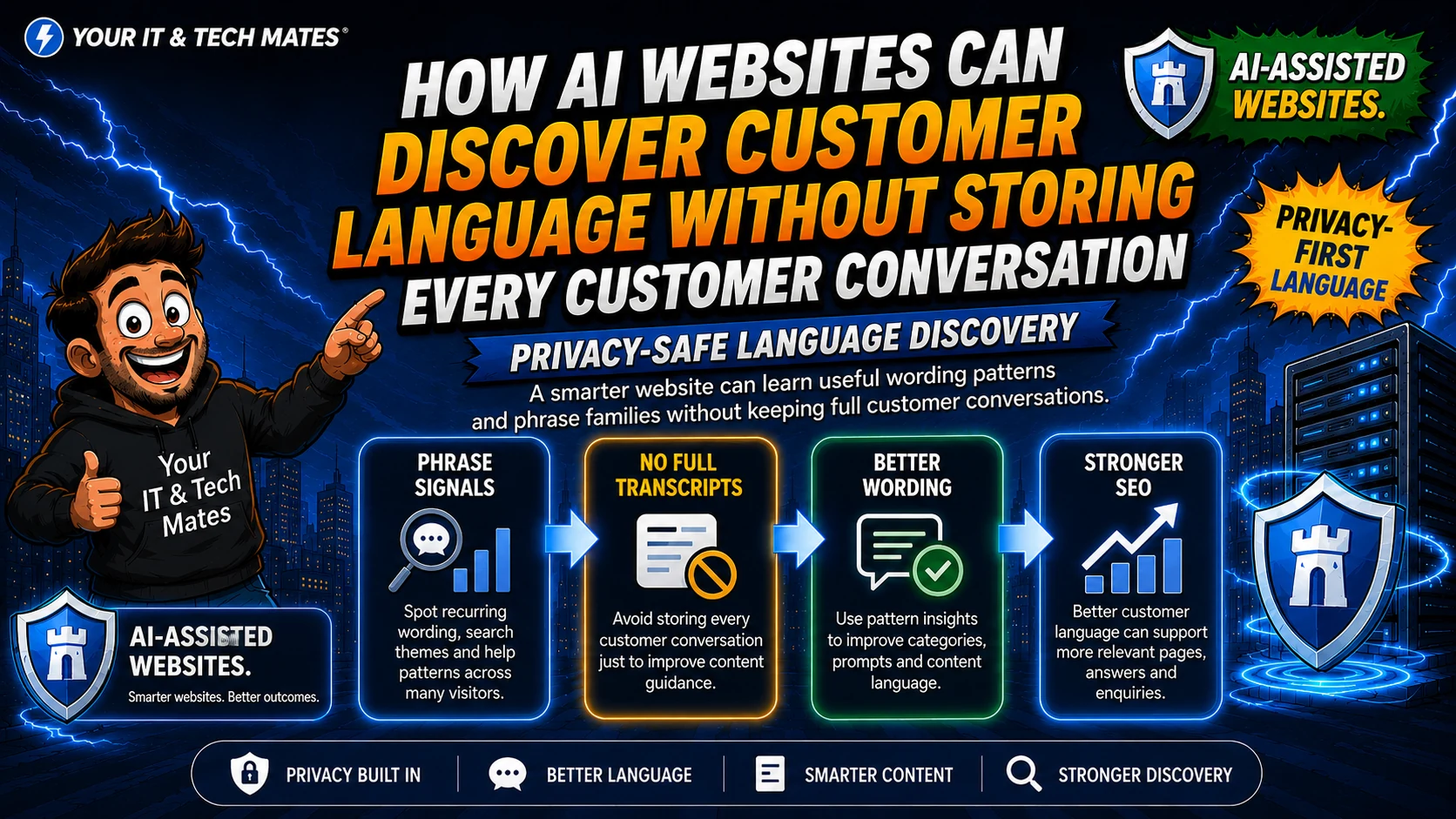
AI-assisted websites can discover recurring phrase families from privacy-safe aggregates, approved search-gap data and correction patterns without keeping full customer conversations. The goal is to understand common language, not build a permanent record of individual visitors.
Why customer language matters
Businesses often describe services using internal terminology while customers use everyday phrases. Recognising recurring wording helps the website create clearer headings, FAQs, search behaviour and service pathways.
Use phrase families instead of transcript hoarding
A phrase family groups semantically similar wording such as “keeps dropping out”, “wifi disconnects” and “loses connection”. The business can review the family and its associated help area without retaining the entire original interaction.
Combine search gaps with corrections
Search terms that fail to match, repeated Not quite corrections and support-team observations can all suggest missing language. The strongest candidates are patterns that recur across multiple privacy-safe sources.
Turn language insight into SEO and GEO value
Customer wording can inform page titles, question-based headings, FAQ answers and concise definitions that are easier for search engines and AI answer systems to retrieve. The page should still be written for humans first.
Keep phrase promotion controlled
A discovered phrase should not automatically become a production synonym. Review whether it is unambiguous, safe and genuinely relevant before adding it to search or intent logic.
Practical example: learn phrases, not people
Customers rarely use the same labels as a service catalogue. They may say 'the Wi-Fi keeps dropping in the back room' rather than 'wireless coverage issue', or 'someone changed the bank details on an invoice' rather than 'business email compromise'. Those phrases can reveal useful language patterns without keeping a permanent transcript linked to the person who typed them.
A privacy-aware workflow can extract short de-identified phrases or aggregate intent patterns, review them for usefulness, and then add approved language to content, FAQs or intent rules. Names, email addresses, phone numbers, request references and unnecessary free-text detail should be excluded from the learning set.
Where it can go wrong: Do not assume every phrase deserves a new keyword page. Use customer language to make existing pages clearer and to improve routing, while keeping one authoritative page for each real service or topic.
Related AI-assisted website guides
Continue with the guides that explain the underlying customer-experience, intent and governance ideas in more detail.
Learn from patterns, not personal histories
A website can improve its wording without building a permanent record of everything each customer typed. One safer approach is to keep only controlled learning signals such as the problem category, whether a suggestion was accepted or corrected, and whether people found a useful next step.
For example, if many people describe the same Wi-Fi issue using the phrase “works on my phone but not my laptop”, the business can learn that this wording is useful. It does not need to keep the person's name, email address or full conversation in the learning dataset.
Useful privacy-minimised evidence
- approved intent or topic codes;
- customer-confirmed corrections;
- anonymous counts of useful or unhelpful outcomes;
- page or tool categories rather than detailed browsing profiles;
- reviewed phrases that are deliberately promoted into the knowledge base.
The goal is to make future guidance clearer while keeping personal information out of the optimisation loop wherever it is not needed.
Frequently asked questions
Can AI learn customer language without storing conversations?
Yes. Phrase-family and aggregate evidence can reveal recurring wording without keeping every raw conversation.
What is a phrase family?
It is a reviewed group of different expressions that appear to describe the same underlying customer need.
How can customer language help SEO?
It can improve headings, FAQs, service descriptions and answer-ready content by using the words customers actually search and ask with.
Should new phrases automatically change intent routing?
No. Candidate phrases should be reviewed for ambiguity, safety and business relevance before production use.
Could your website make customer journeys easier?
Tell us where customers get stuck, repeat themselves, choose the wrong path or submit poorly matched enquiries. We can review whether clearer content, website logic, automation, custom software or bounded AI fits the problem.