What Happens When an Intent Engine Is Not Sure?
See how confidence checks, one useful clarification and safe fallbacks help an intent-driven website avoid guessing what a customer means.
Helpful guidance only. You review before anything is sent or changed.
Quick answer
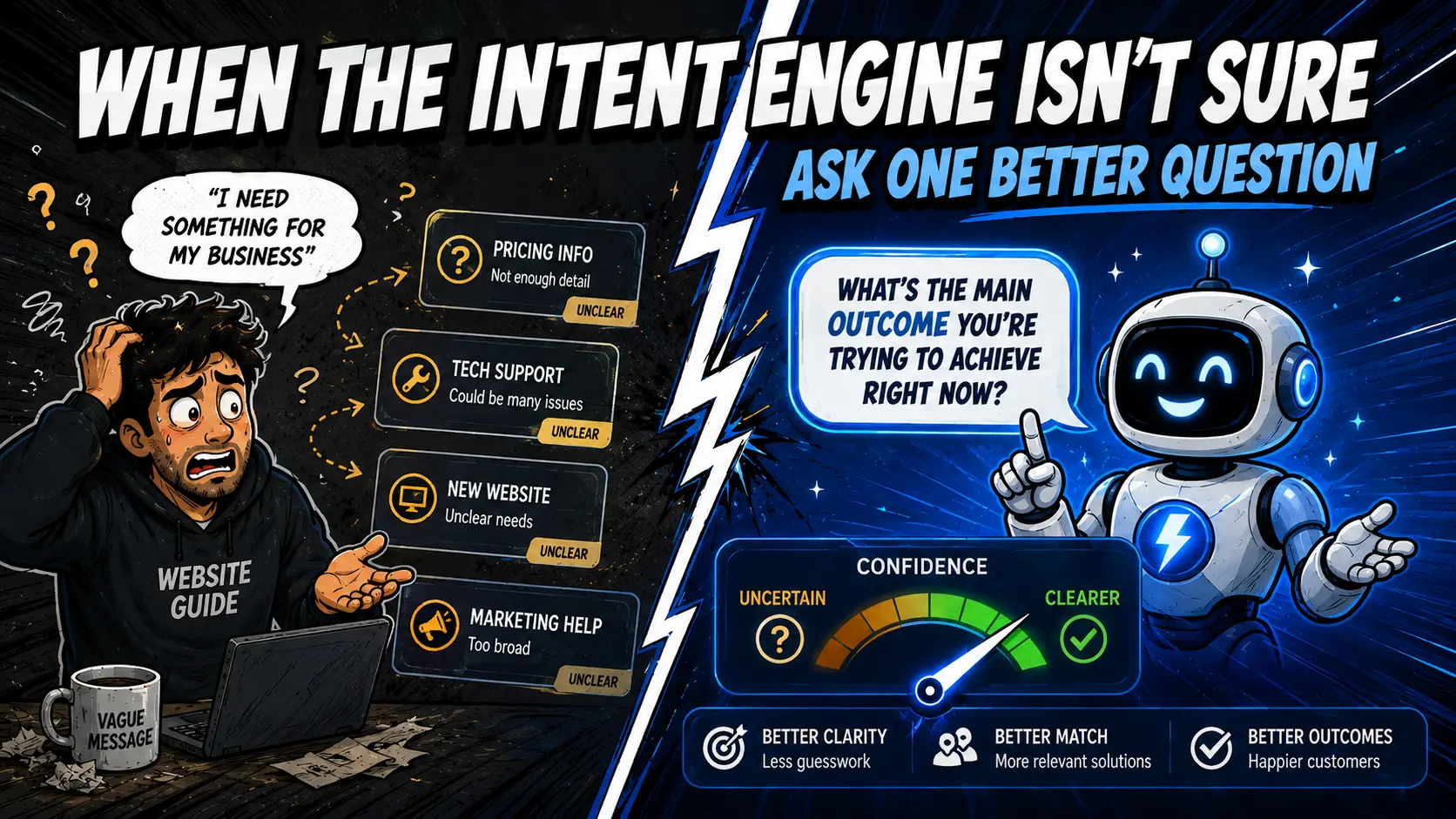
A responsible intent engine does not hide uncertainty. When a request could reasonably mean several things, it should avoid silently choosing a route. It can ask one useful question, offer a clear fallback or let the customer continue in their own words.
Confidence is not certainty
A confidence score is a routing signal, not proof that the website has diagnosed a problem. “My computer is broken” might describe no power, a damaged screen, slow performance, lost data or an account problem. A high-looking number should never turn an unclear sentence into a confirmed fact.
Ask the smallest useful question
The best clarification is not a second long form. It is the single answer that most clearly separates the likely paths. For a laptop problem that may be “What happens when you press the power button?” For damaged hardware it may be the device brand or model. “Other” and “Not sure” remain valid answers.
Three safe outcomes
If the answer makes the need clear, the system can prepare a reviewable summary. If uncertainty remains, it can ask another controlled question. If the route is still unclear or the service is outside the reviewed catalogue, it should fall back to a general human-reviewed request rather than inventing an answer.
Why the customer sees the score
Showing how well the request is understood helps set expectations. The percentage stays beside the friendly guide and progress bar, while the customer can edit the summary or say “Not quite”. It is an aid to review, not a diagnosis, quote or promise.
What another business can apply
List the phrases that regularly fit more than one service. For each phrase, identify the one answer that would change the next step. That creates a small, explainable clarification system before any AI ranking is added.
The boundary that keeps this useful
The Intent Engine may organise language, rank reviewed options and prepare an editable summary. It does not make a final diagnosis, invent a price, approve paid work, book an appointment or submit a request without the customer’s action.
Frequently asked questions
Does low confidence mean the AI failed?
No. It means the system has detected uncertainty and should ask for useful context or use a safe fallback.
Should a website show customers a confidence score?
It can help when the label is explained plainly and the customer can correct the result.
Can an AI choose the final service automatically?
Not in this design. The customer reviews the summary and important business decisions remain controlled.
Continue the six-part Intent Engine education series
What Happens When an Intent Engine Is Not Sure?Part 2
Safety Before AI: Why High-Risk Requests Need a Safer PathPart 3
From Customer Words to an Approved Service CataloguePart 4
What Happens When a Customer Says “Not Quite”?Part 5
How We Measure Whether an Intent-Driven Website Actually HelpsPart 6
Agent-Ready Websites Without Autonomous Customer Decisions
Related established guides and proof
Could your business use Intent Intelligence?
We review the language customers already use, the approved business outcomes and the systems that own pricing, booking or fulfilment before recommending a build.