What Customer Search Data Can Tell You About the Services People Actually Want
Your website search box can tell you more than whether a customer found a page. When repeated queries are grouped by intent, they can reveal the problems customers are trying to solve, the services they cannot find and the language they naturally use.
Quick answer
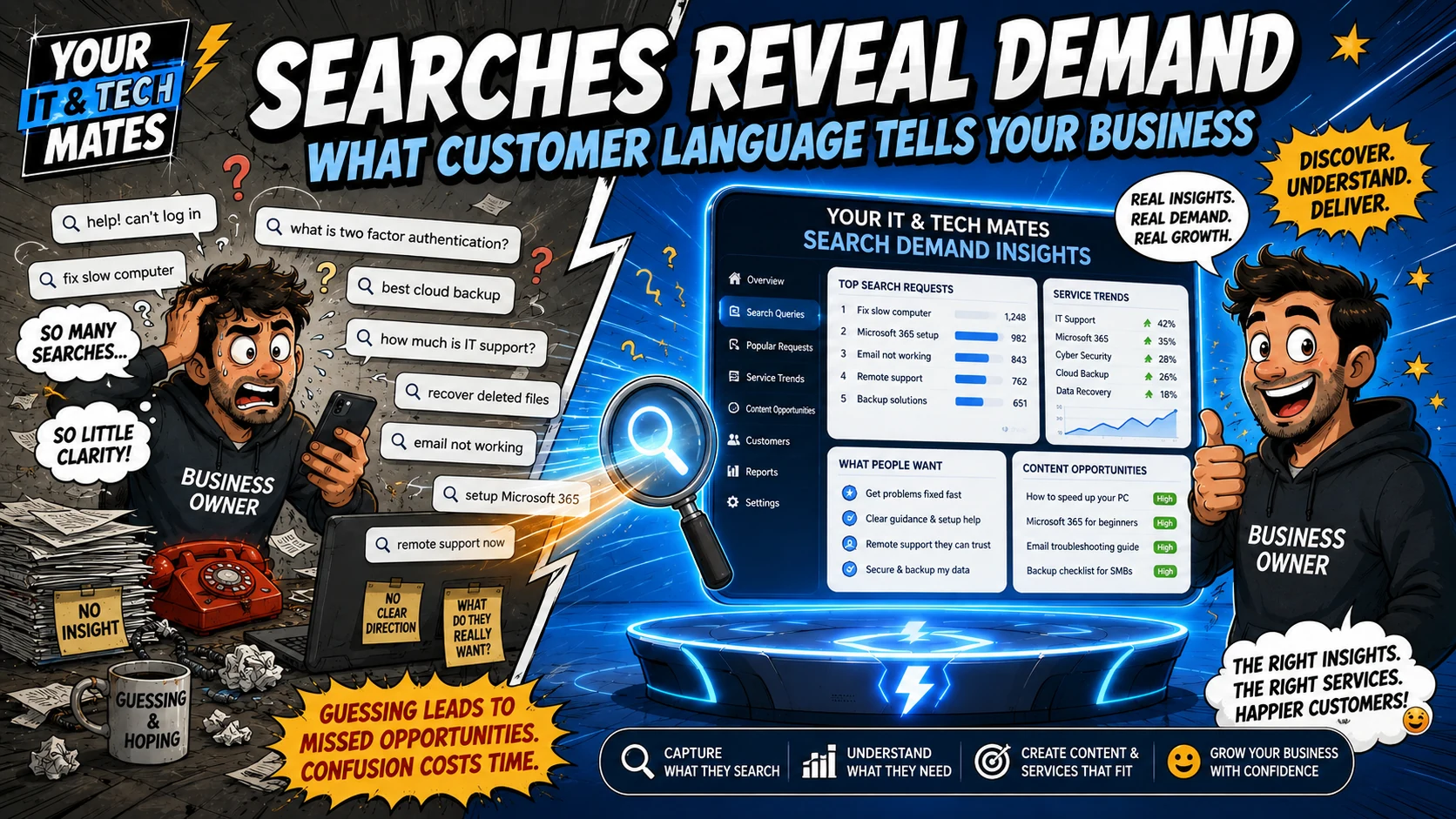
Customer search data becomes useful business intelligence when you group repeated requests by meaning instead of reading isolated keywords. High-frequency searches, low-confidence routes, repeated corrections and searches with no strong content match can point to service demand, confusing navigation, missing FAQs or new content opportunities.
Why this matters to another small business
This article uses a real Your IT and Tech Mates website pattern as the example, but the lesson is broader. Customers usually describe a problem before they know the service name. A useful AI or automation layer should help translate that plain-English intent into an approved business workflow without forcing the customer to learn your internal categories.
For implementation options, see our Small Business Software & AI Solutions Melbourne hub. It explains how we approach workflow review, custom software and practical AI integration before recommending a build.
Search data is customer language, not just SEO data
A query such as “can you set up Microsoft 365 for my team?” is both a search and a statement of demand. “Do you install mesh Wi-Fi?” may reveal a service a visitor cannot easily find. “How much is remote support?” may tell you that price clarity matters before the next step.
Looking at these requests together can show what customers care about before they ever contact the business.
Four signals worth watching
Raw search volume alone is not enough. We look for several signals together.
- Frequency, how often a controlled need appears
- Unique visitors, whether demand comes from many people rather than one repeated session
- Correction or clarification, whether the current route is confusing
- Content match, whether an existing page already answers the need well
How search demand can reveal a service gap
Imagine a small IT business receives repeated searches for smart-doorbell setup but has no dedicated service page. That does not automatically mean the business should launch a new service. It does mean there is enough evidence to review whether the capability exists, whether the work is profitable and whether the website is hiding a service customers already expect.
How it can improve an existing service page
Sometimes the service already exists but customers cannot find it because the website uses different language. If people repeatedly search “Wi-Fi keeps dropping out” while the page says “network optimisation”, the first fix may be clearer customer wording rather than a new service.
That is why search intelligence should feed both service planning and content planning.
Why first-party intent is stronger than guessing topics
Competitor research and keyword tools can suggest ideas, but your own customer searches reveal what people are actually asking your business. We use external research as a starter only when first-party evidence is still thin. As live demand grows, customer behaviour becomes the stronger editorial signal.
What another business can do with this data
A business can review its top intent clusters monthly and ask three questions: do we already offer this, do we explain it clearly, and does the customer have an obvious next step? That creates a practical loop between search, service design, FAQs, blog planning and lead conversion.
A practical next step
Start with one customer journey and write down three things: what customers actually say, what the business needs to know next, and which existing system owns the final action. That makes it much easier to decide whether better copy, a shorter form, predefined rules, workflow automation or AI is the right tool.
Frequently asked questions
What counts as customer search data?
It can include on-site search phrases, intent-box queries, clarification choices and aggregate enquiry language where privacy rules allow it.
Should I create a service whenever searches increase?
No. Search demand is evidence for review, not automatic proof that a new service should be launched.
Can search data improve SEO?
Yes. It can reveal the natural language customers use and the questions existing pages should answer more clearly.
Should raw customer messages be stored forever?
No. Privacy-safe aggregation and controlled features are safer for long-term learning than collecting unnecessary raw wording.
How often should a small business review search demand?
Monthly is a practical starting point, with faster review when a new high-volume or high-risk pattern appears.
Could your business use Intent Intelligence?
If customers already describe what they need through your website, forms, email or messages, those conversations may contain enough information to identify intent, capture useful context and start the right controlled workflow.
Intent Intelligence is custom software built around your workflow, not another generic chatbot.
Want to turn website searches into useful business insight?
Our Software & AI service can help connect customer-language data to your existing services, content and lead workflows without turning analytics into automatic business decisions.