How an Intent-Driven Website Helps Schools and Organisations Find the Right IT Support Faster
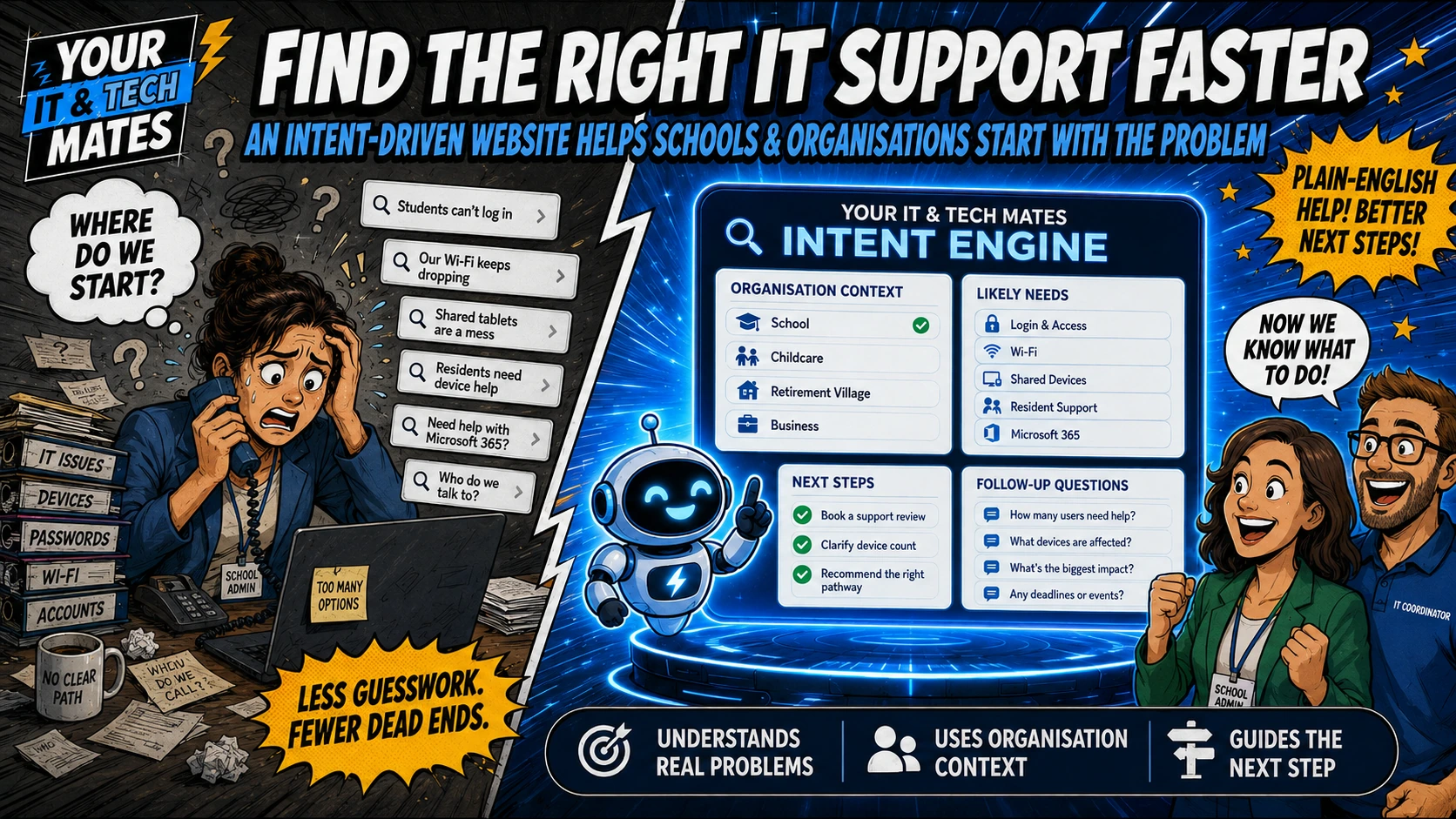
Schools and organisations usually know what is going wrong before they know the technical service name. Our Intent Engine starts with that plain-English problem, adds useful organisation context and guides the person toward a clearer, human-reviewed next step.
Quick answer
An intent-driven website helps schools and organisations find IT support faster by removing the need to choose a technical service first. The visitor explains the problem in everyday language, the website keeps useful organisation context, and the Intent Engine narrows the next step without taking away human or commercial control.
Why schools and organisations often get stuck before support even starts
A school administrator may know that students cannot log in. A childcare manager may know shared tablets are causing problems. A retirement village manager may know residents keep needing help with devices. A business owner may know staff cannot access files from home.
What they may not know is whether the problem belongs under Microsoft 365, Wi-Fi, identity, device management, security, workflow, training or something else. A traditional service menu makes the customer diagnose your internal structure before they can ask for help.
An intent-driven website flips that around. It starts with the customer’s words first.
What the Intent Engine changes
The Your IT & Tech Mates Intent Engine is designed to interpret what the person is trying to achieve, not just match a keyword to a page.
- It starts with plain English. “Students can’t log in” is enough to begin.
- It keeps organisation context. School, childcare, retirement village and business requests can be interpreted differently.
- It asks fewer, better questions. Once the likely need is clear, the website should not make the customer repeat information it already understands.
- It presents approved next steps. The system can bring forward useful support, guidance or request options without inventing actions.
- It keeps people in control. Quotes, prices, purchase orders, credit, billing, payments and paid work remain governed by the existing workflow.
Why organisation context matters
The same sentence can mean something different depending on the setting.
“People can’t log in.” In a school, that might involve student accounts, devices and Microsoft 365 access. In a childcare service, it might involve shared tablets and staff access. In a retirement village, it might involve resident devices or staff systems. In a business, it may involve remote work, identity or permissions.
That is why the homepage organisation pickup is not a replacement for the Intent Engine. It is context that helps the engine understand the request more accurately.
A simple school example
A school writes: “Students can’t log in to Microsoft 365. Some get an error and others get stuck on the loading screen.”
The website does not need the school to decide whether this is an identity issue, licensing issue, network issue or device problem. It can recognise the likely sign-in intent, keep the school context and guide the team toward the most useful checks or escalation path.
For a deeper school example, see How Schools Can Describe an IT Problem Without Knowing the Technical Answer.
The same idea works across different organisation types
Intent-first support is useful because different organisations have different constraints even when the underlying technology overlaps.
- Schools: start with the staff or student problem, not the technical label.
- Childcare services: reduce repeated device and workflow friction.
- Retirement villages: turn mixed resident and staff issues into clearer triage.
- Wider organisations: start with the problem instead of forcing users through a service catalogue.
Why this structure is strong for SEO and AI search
People search in natural language. They ask questions such as “students cannot log in to Microsoft 365”, “our childcare tablets are hard to manage” or “residents keep needing help with devices”.
Pages that answer those real questions clearly are easier for traditional search engines and AI answer systems to understand. This supports SEO, generative engine optimisation and answer-engine visibility without stuffing the page with artificial keywords.
It also creates a stronger content graph. This main guide explains the overall Intent Engine approach, while the school, childcare, retirement village and organisation articles provide deeper examples. Each page links to the others so search engines and readers can understand how the topics relate.
What the Intent Engine should not control
Understanding a request is not the same as having authority to approve it.
- It should not invent or approve binding prices.
- It should not approve paid work automatically.
- It should not bypass purchase-order, credit, billing or payment controls.
- It should not override organisation continuity or verified existing-customer pathways.
- It should not make sensitive or high-risk decisions without the appropriate human review.
The strength of the approach is not “AI does everything”. It is that the website understands more while keeping the important controls where they belong.
How Your IT & Tech Mates uses this approach
On the Your IT & Tech Mates website, an organisation can first identify its context, then describe what it needs in its own words. That organisation context is carried into the existing Intent-first journey rather than sending the visitor into a separate catalogue of technical services.
Existing organisations also have a continuation path so a known customer does not have to start again as a new lead. The Intent layer improves understanding and routing, while the existing organisation, QuoteMe and commercial workflows remain authoritative.
Related Intent Engine guides
Frequently asked questions
What is an intent-driven website?
An intent-driven website starts with what a person is trying to do or what has gone wrong, then uses that wording and context to guide them toward the most relevant approved next step.
Why does organisation type matter?
The same words can mean different things in a school, childcare service, retirement village or business. Organisation context helps the website interpret the request more accurately.
Does the customer need to know which IT service they need?
No. The point is to let people explain the problem in ordinary language instead of forcing them to diagnose the technical category first.
Does the Intent Engine approve quotes, prices or paid work?
No. It helps with understanding and routing. Pricing, quote approval, purchase orders, credit, billing, payment and paid-work controls remain in the approved business workflow.
How can this help SEO and AI search?
Clear problem-first content mirrors how people actually search and ask questions, which makes pages easier for search engines and AI answer systems to understand and retrieve.
Could your organisation use Intent Intelligence?
If customers, staff, families or residents already describe what they need through your website, forms, email or messages, those conversations may contain enough information to make the next step much clearer.
Intent Intelligence is custom software built around your workflow, not another generic chatbot.