
How an AI Website Decides Which Question to Ask Next
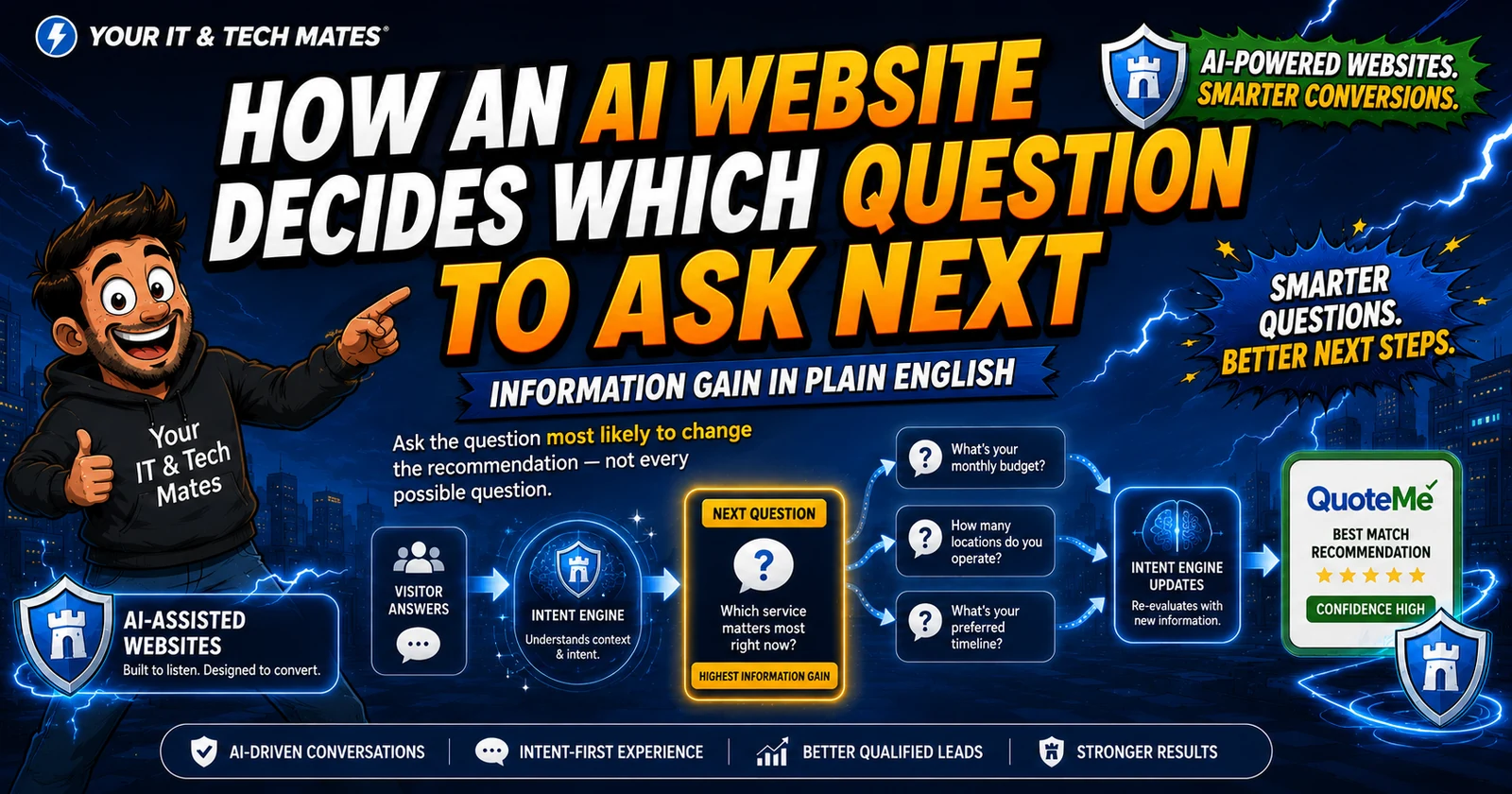
Information gain in plain English: ask the question most likely to change the recommendation, not every possible question.
Quick answer
A smarter website should not ask every question it knows. It should ask the one unanswered question most likely to change the recommendation, improve safety or make the customer ready for the next step.
Why this matters
This guide is part of our Adaptive Intent & Verified Evidence series. It explains a production design principle behind a website that tries to understand the customer with fewer questions while keeping safety, external evidence and real requests governed by predefined rules and customer or human confirmation.
Why fixed questionnaires create friction
Traditional forms usually ask the same questions in the same order. That is simple to build, but it ignores what the customer has already explained. A customer who clearly says their laptop battery is swollen should not have to finish questions about age, performance and upgrade value before seeing safety guidance.
Information gain in plain English
Information gain is a way of asking: if we ask this question, how much could the answer change what we recommend? A high-value question separates meaningful paths. A low-value question may add detail without changing the customer’s next step.
The Intent Engine scores candidate questions
Our governed approach can compare candidate questions using decision value, booking-readiness value, required-slot importance, safety priority, answerability and customer friction. Safety rules always take precedence. The language model is not allowed to invent a question or decide that a safety check can be skipped.
A simple example
If a customer says “my laptop is very slow”, knowing whether it has an HDD or SSD may strongly change an upgrade recommendation. Asking which browser they normally use probably does not. The first question has much more information value for that journey.
Ask one question, then recalculate
After each answer, the Intent Engine updates what it knows and recalculates. It does not blindly continue through a pre-written sequence. If the recommendation becomes stable and QuoteMe has enough useful context, the website stops asking.
The goal is not maximum data
A website can always collect more information. That does not mean it should. The goal is the smallest set of customer-confirmed facts needed to provide a useful, safe and reviewable next step.
Frequently asked questions
What is information gain on a website?
It is a controlled way of estimating which unanswered question is most likely to improve the next decision or recommendation.
Does AI choose any question it wants?
No. In our design the Intent Engine chooses only from governed questions and rules. The LLM can help explain approved information but does not control routing or safety.
Why not ask all the questions at once?
Because unnecessary questions increase effort and abandonment without necessarily improving the recommendation.
What happens when there is enough information?
The clarification state can move to Ready, allowing the customer to review the known context and continue to QuoteMe without another diagnostic question.
How this fits with Intent Intelligence and QuoteMe
The Intent Engine is the decision controller: it interprets governed facts, decides whether another clarification materially helps and returns a readiness state. The QuoteMe Journey Controller carries approved context across the website. QuoteMe remains the only component that creates a real request after the customer reviews and submits it.
Could your website ask less and understand more?
Tell us where customers repeat themselves, choose the wrong service or need clearer evidence before the next step. We can review whether intent-driven logic, automation, structured evidence or something simpler fits the problem.
New: Intent-Aware Website business series
These newer guides show how content semantics, customer corrections, journey context and readiness signals can work together without turning ordinary browsing into certainty.