
Can an AI Website Learn Which Questions Actually Help Customers?
Measure what questions actually improve the journey, then tune them through human review instead of letting production rules rewrite themselves.
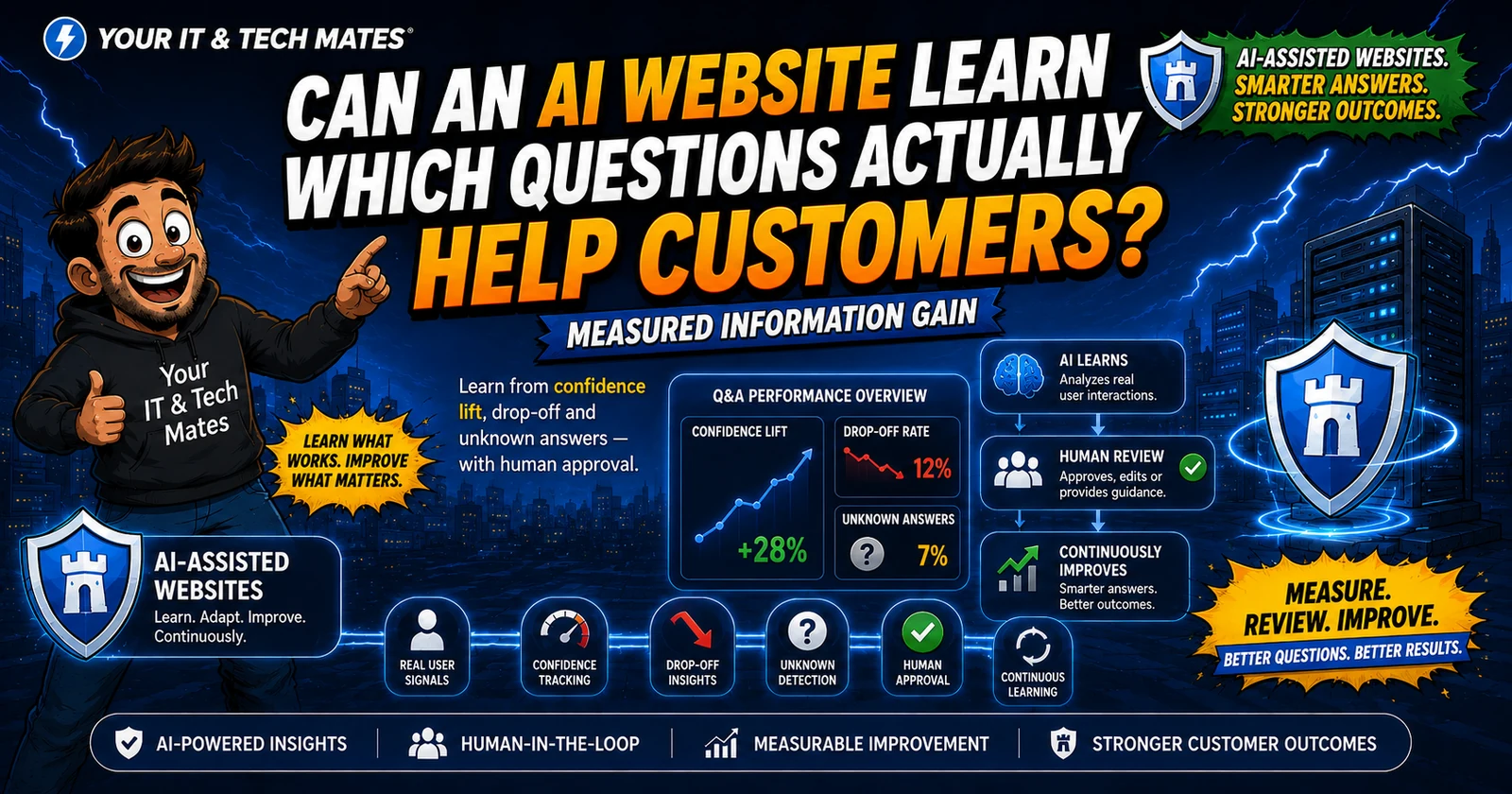
Quick answer
Yes but “learn” should mean measure, propose and review, not silently rewrite production logic. A useful system can compare each governed question with real outcomes such as confidence lift, recommendation change and customer drop-off.
Why this matters
This guide is part of our Adaptive Intent & Verified Evidence series. It explains a production design principle behind a website that tries to understand the customer with fewer questions while keeping safety, external evidence and real requests governed by predefined rules and customer or human confirmation.
Measure the effect of a question
For each governed question, the system can record the state before the question and the state after the answer. That makes it possible to calculate whether understanding improved or the recommendation materially changed.
Useful signals go beyond conversion
A question may be valuable even if it does not immediately increase QuoteMe submissions. Confidence improvement, recommendation change and reduced ambiguity are direct decision-quality signals. Unknown-answer rate and drop-off help show whether the question is difficult or frustrating.
Keep the analytics privacy-minimised
The measurement layer can store a controlled question ID, numeric before/after scores, a known-or-unknown answer class and state transitions. It does not need the customer’s free-text answer, email or phone number.
Require enough evidence before tuning
Small samples are noisy. A governed system can require a minimum number of answered examples before it even proposes a weight adjustment. That protects against reacting to one unusual day or a handful of customers.
Human approval stays in the loop
Analytics can recommend that a question appears more useful, less useful or more friction-heavy than expected. A person reviews that evidence before a bounded, versioned adjustment is applied.
Safety questions are different
Safety-critical questions should not be promoted or demoted because they correlate with commercial conversion. Their priority is determined by policy. Analytics can still measure them for understanding, but commercial outcomes should not decide whether they are asked.
Frequently asked questions
What is measured information gain?
It is the observed improvement after a customer answers a governed question, using controlled measures such as confidence movement, recommendation change and readiness change.
Can the website automatically change its own questions?
Not in this design. It can generate evidence and bounded proposals, but a human approves any production tuning.
Why measure unknown answers?
A high “I’m not sure” rate can reveal that a question expects technical knowledge customers often do not have.
Should QuoteMe conversion decide which questions are asked?
No. Conversion can be one journey signal for ordinary questions, but it must not override safety, accuracy or required routing information.
How this fits with Intent Intelligence and QuoteMe
The Intent Engine is the decision controller: it interprets governed facts, decides whether another clarification materially helps and returns a readiness state. The QuoteMe Journey Controller carries approved context across the website. QuoteMe remains the only component that creates a real request after the customer reviews and submits it.
Could your website ask less and understand more?
Tell us where customers repeat themselves, choose the wrong service or need clearer evidence before the next step. We can review whether intent-driven logic, automation, structured evidence or something simpler fits the problem.