How an Intent Engine Can Ask for a Model Number Only When It Really Matters
Do not ask every customer for a serial or model number. Ask only when an existing possible recall makes that extra confirmation materially useful.
Quick answer
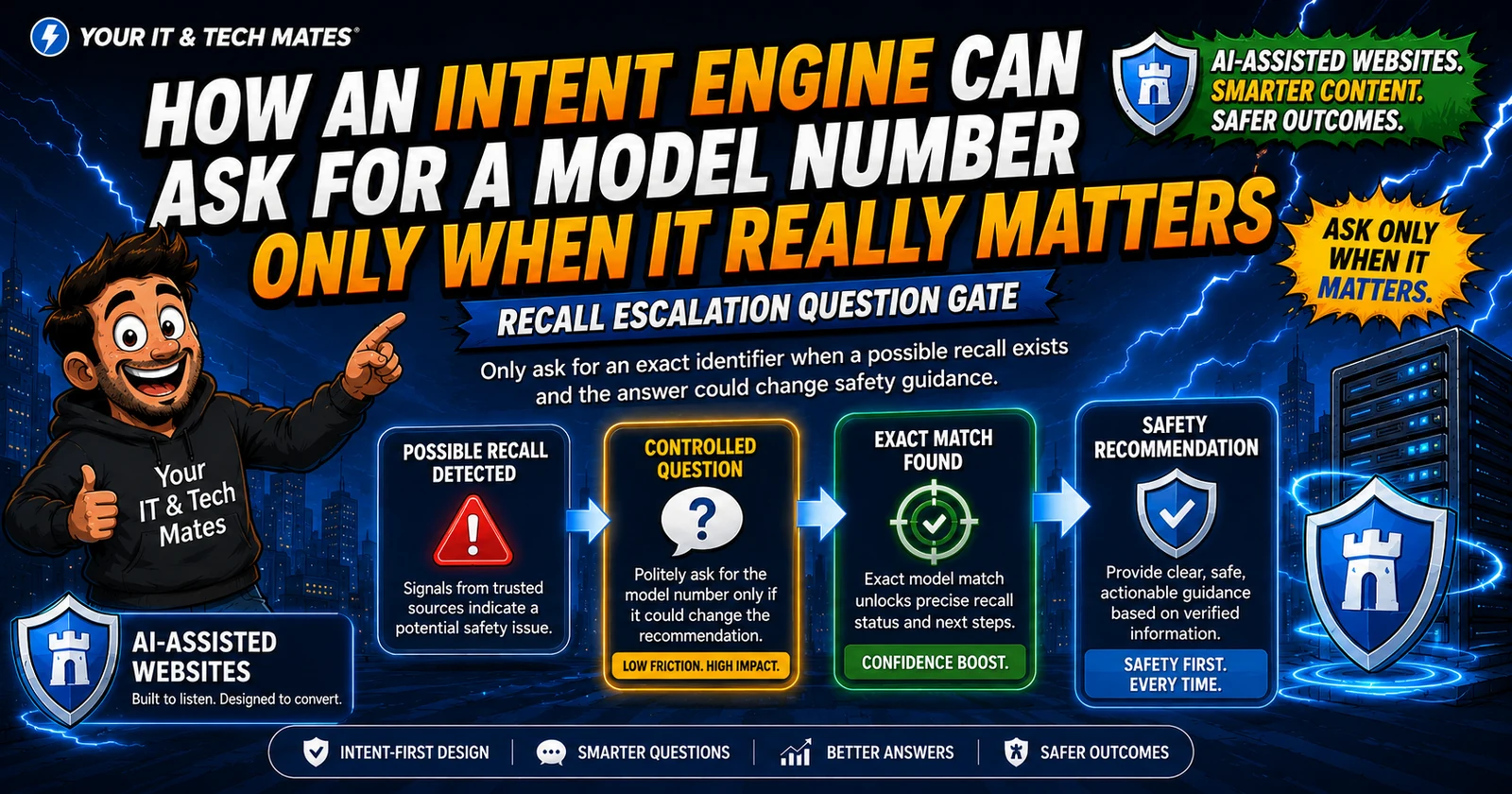
Exact identifiers add friction and can be sensitive or difficult to find. A smart Intent Engine should request one only when a possible governed recall already exists, approved recall data contains useful candidate identifiers and confirmation could materially change safety guidance.
Why this matters
This guide is part of our Adaptive Intent & Verified Evidence series. It explains a production design principle behind a website that tries to understand the customer with fewer questions while keeping safety, external evidence and real requests governed by predefined rules and customer or human confirmation.
Do not make exact identifiers the default
Most repair or support journeys do not need a serial number at the start. Asking for one routinely increases customer effort and can make a simple support tool feel like a warranty registration form.
Let possible evidence create the reason to ask
The matching engine can first use already-confirmed brand or product-family information. If that creates a possible recall match, the controller can evaluate whether a more exact identifier could resolve the uncertainty.
Only ask when the answer changes something important
The recall escalation question should exist only when confirming one of the official identifiers could upgrade the result from possible to exact or otherwise materially alter the safety wording and next step.
Prefer bounded confirmation over unrestricted text
Where the official recall contains trustworthy model identifiers, the customer can be asked whether their model matches one of those options, plus “none of these” and “I’m not sure.” This avoids asking the LLM to interpret arbitrary identifier text.
Safety verification outranks ordinary clarification
When the gate is active, confirming the possible recall should outrank lower-value questions such as age or upgrade preference. Existing hard safety terminals still outrank everything.
No possible recall means no extra question
This is the main UX benefit. Ordinary customers continue through the normal adaptive journey without seeing an unnecessary model-number question. The extra effort appears only when the evidence makes it worthwhile.
Frequently asked questions
Will every customer be asked for a model number?
No. The gate is designed specifically to avoid that. It activates only when a possible governed recall exists and exact confirmation could materially change the result.
What if the customer chooses “I’m not sure”?
The system keeps the match at its existing confidence tier and does not invent certainty.
Can the LLM extract a model number from anything the customer types?
Not for this controlled matching step. The safer pattern is deterministic comparison against approved identifiers.
Does an exact recall match automatically book a repair?
No. It changes the evidence and safety guidance. QuoteMe remains a separate customer-controlled request process.
How this fits with Intent Intelligence and QuoteMe
The Intent Engine is the decision controller: it interprets governed facts, decides whether another clarification materially helps and returns a readiness state. The QuoteMe Journey Controller carries approved context across the website. QuoteMe remains the only component that creates a real request after the customer reviews and submits it.
Could your website ask less and understand more?
Tell us where customers repeat themselves, choose the wrong service or need clearer evidence before the next step. We can review whether intent-driven logic, automation, structured evidence or something simpler fits the problem.