Why Organisation IT Support Should Start With the Problem, Not a Service Menu
Most organisation users are trying to explain what went wrong or what they are trying to do. They are not trying to learn a service catalogue. That is why better organisation IT support should begin with the problem, not the menu.
Quick answer
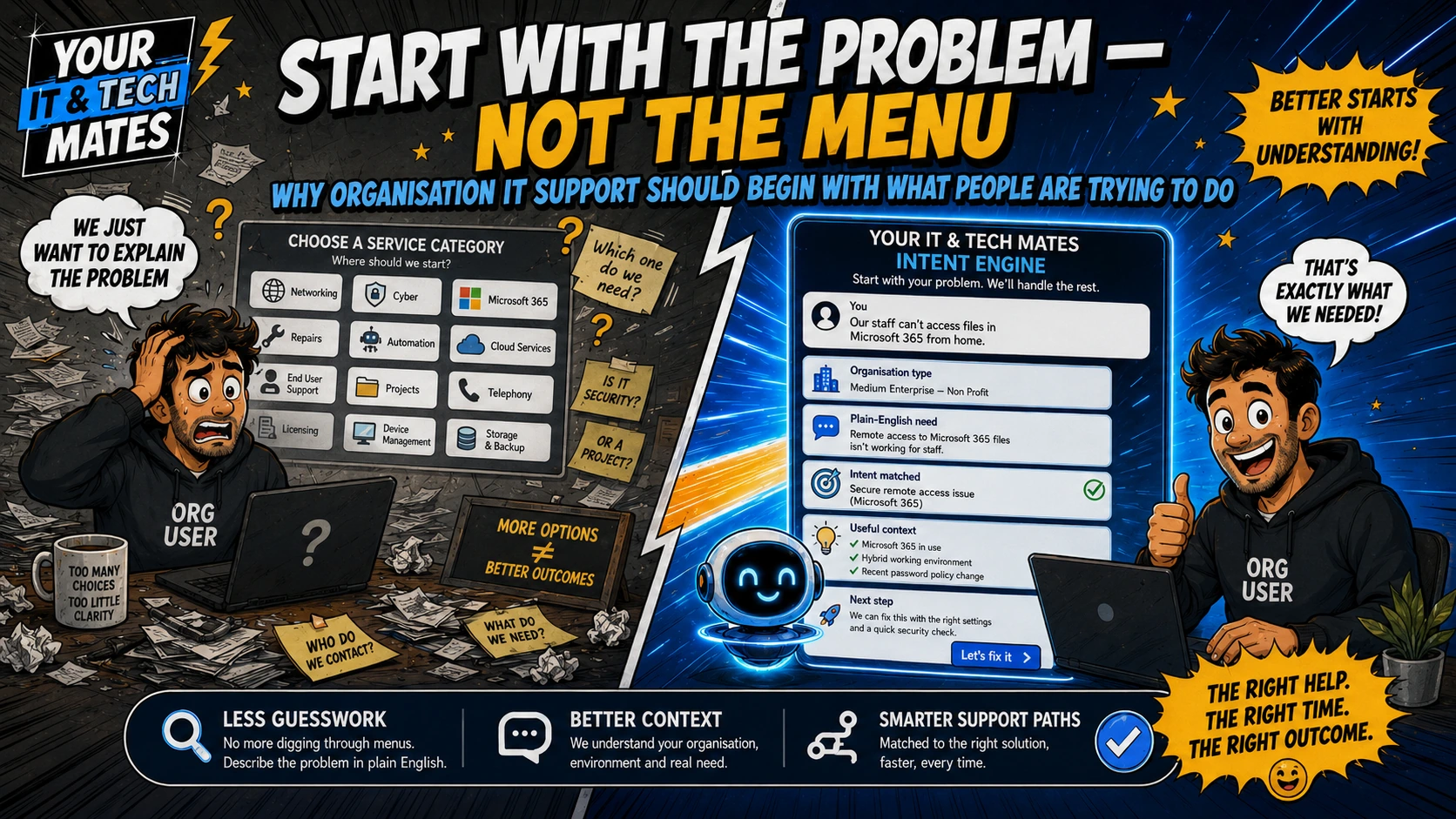
Traditional service menus make customers guess. An intent-driven support journey works better because it starts with what the person is trying to do, uses the organisation context and then guides them toward the most relevant approved next step.
Why service menus create unnecessary effort
Many support websites assume the customer already knows the technical service they need. They show long menus such as networking, security, Microsoft 365, telephony, backups, repairs or projects.
That works for some visitors, but many organisation users arrive with a plain-English problem instead. They say, “Our staff can’t access files from home”, “The login is not working” or “We are not sure who to contact”. A menu-first journey forces them to guess.
What a better starting point looks like
A better journey asks a different first question: What are you trying to do, and what is getting in the way?
From there, the website can use helpful context such as the organisation type, the systems mentioned, the possible urgency and the likely need. That leads to a smaller and more relevant set of next steps.
The role of the organisation pickup
The organisation pickup on the homepage matters because context changes meaning. “People cannot log in” can point to a different support path in a school, a childcare service, a retirement village or a broader business organisation.
That first organisation choice does not replace the intent engine. It improves it by giving the website a better starting context.
How the Intent Engine improves the journey
- It captures the problem in plain English.
- It recognises likely intent.
- It uses organisation context to refine the match.
- It presents approved next steps instead of unlimited AI actions.
- It supports better continuity for existing organisations.
This is closely related to our guides on fewer, better questions and how a website understands business problems, not just keywords.
Why this is good for SEO, GEO and content quality
Problem-first content is easier to understand because it mirrors the questions people actually ask. That helps visitors, search engines and AI answer engines at the same time.
It also helps reduce thin content. Instead of creating a separate page for every minor keyword variation, the business can build stronger pages around real intents and real journeys.
What should still remain controlled
- Approved service and pricing decisions
- Quote, payment, credit and billing controls
- Organisation continuity rules
- Escalation and high-risk decisions
An intent-driven website is not an excuse to give uncontrolled authority to AI. It is a way to reduce customer effort while keeping the important controls where they belong.
Real examples across organisation types
We have explored this pattern across several environments. See how it applies in schools, childcare services and retirement villages. The point is consistent: customers should not need to diagnose your service menu before they can ask for help.
Start with the full organisation Intent Engine guide
For the complete overview of how organisation context, plain-English intent and human-controlled next steps work together, read How an Intent-Driven Website Helps Schools and Organisations Find the Right IT Support Faster.
Continue exploring organisation intent in practice
- How schools can describe an IT problem without the technical answer
- How intent-driven IT support can reduce technology friction in childcare services
- Retirement village technology support: from “it isn’t working” to the right next step
- Why organisation IT support should start with the problem, not a service menu
Frequently asked questions
Why is a service menu a problem?
Because many users know the problem but do not know the technical category, so they have to guess before they can even start.
What is a problem-first support journey?
It is a journey that lets the customer describe what they are trying to do or what went wrong, then uses that wording and context to guide the next step.
How does the organisation pickup help?
It adds useful context such as school, childcare, retirement village or another organisation type, which improves the intent match.
Does this replace pricing and approval controls?
No. The intent layer improves understanding and routing, but the normal business controls remain authoritative.
Why is this useful for SEO and AI search?
Because problem-first wording matches how real people search and how AI answer engines interpret useful, relevant content.
Could your organisation use Intent Intelligence?
If staff, families, residents or managers already describe what they need through your website, forms, email or messages, those conversations may contain enough information to capture intent, keep useful context and send people to a safer next step.
Intent Intelligence is custom software built around your workflow, not another generic chatbot.
Want to replace guesswork with a clearer support path?
We help organisations design intent-first support journeys that reduce menu guesswork, improve context and keep commercial and operational controls in the right place.