How Schools Can Describe an IT Problem Without Knowing the Technical Answer
School staff usually know what is going wrong before they know the technical label. An intent-driven website can start with that plain-English description, add useful school context and guide the team to a clearer, human-reviewed next step.
Quick answer
Schools should not have to diagnose the technical category before asking for help. A better website lets staff describe the issue in ordinary language, recognises the likely intent, keeps the school context and then presents the most relevant next step without removing human control.
Why this matters to schools
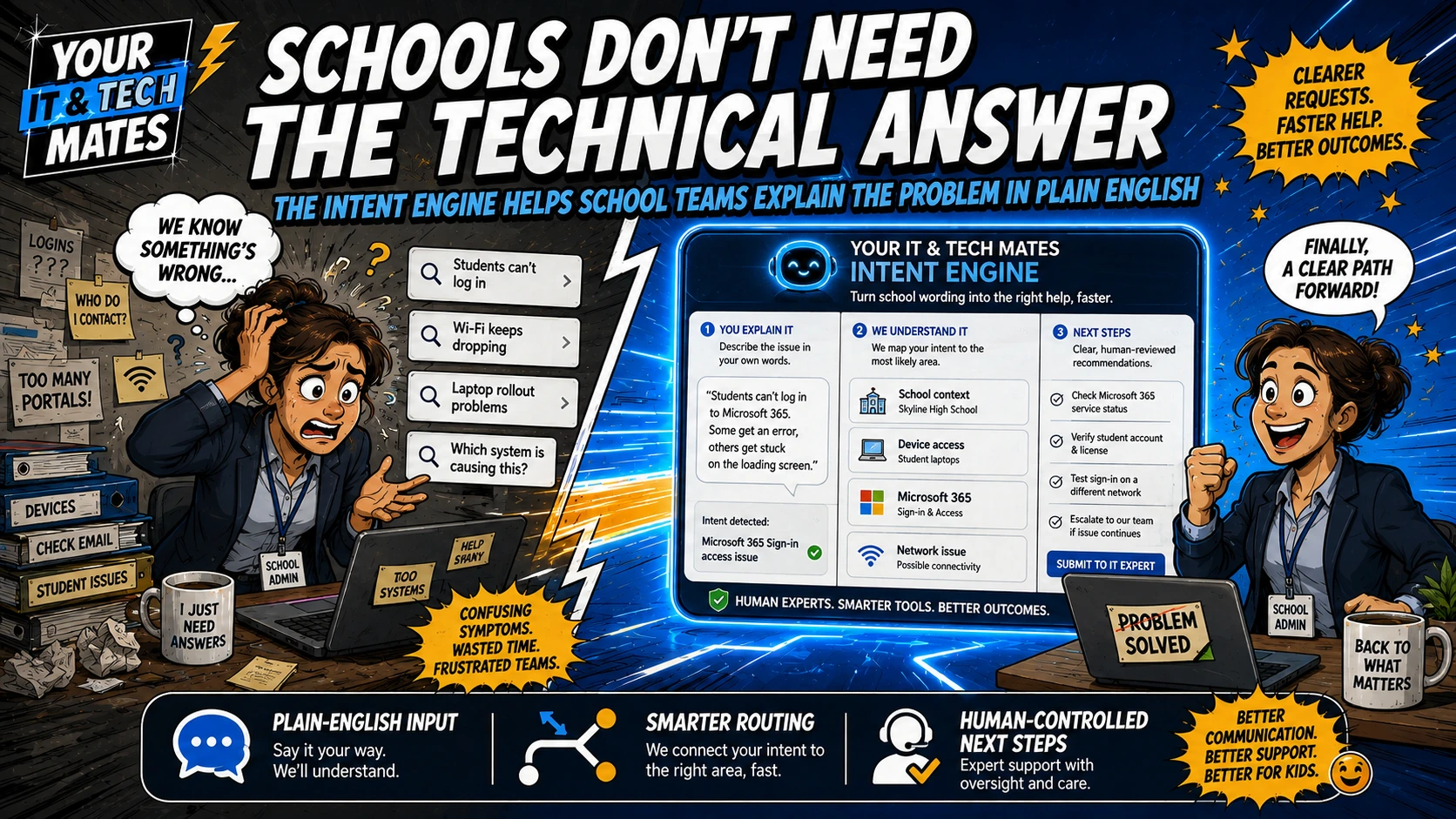
A school office manager, IT coordinator, teacher or business manager may say, “Students can’t log in”, “The Wi-Fi keeps dropping” or “The laptop rollout is a mess”. Those are clear problems, but they are not yet technical categories.
When a website forces the school to choose between menus like networking, Microsoft 365, device management, security or projects, the team has to guess. That slows things down and often sends the request to the wrong place.
An intent-driven website starts where the school already is: with the problem in front of them.
What a school team really needs
Most school teams want three things:
- a simple place to explain the issue
- a way to keep useful context such as device type, year level or platform
- a clear next step that does not make them repeat themselves
That is why the organisation pickup on the homepage matters. When the team chooses School, the website can carry that context into the next interaction. The same sentence can mean different things in a school, childcare service or business.
A plain-English example
Imagine a school writes: “Students can’t log in to Microsoft 365. Some get an error and others get stuck on the loading screen.”
A good intent engine can recognise that this is probably a sign-in and access issue. It can then surface useful checks and clearer next steps such as confirming the account state, checking licenses, testing network conditions and deciding whether the issue needs escalation.
The school does not need to know those categories first. The website helps translate the everyday wording into a more useful support path.
How the Intent Engine helps schools
- It listens to school wording. Staff can explain the problem as they see it.
- It uses school context. The environment, devices and users matter.
- It reduces menu guesswork. The team is not forced to choose a technical service too early.
- It supports faster human review. Better context means a clearer handoff.
- It keeps control in the right place. Final decisions, pricing and paid work still stay with the approved business workflow.
You can see the wider design principles in What Is an Intent-Driven Website? and the implementation logic in How We Built an AI Intent Engine That Learns What Customers Actually Mean.
Why this is good for SEO and AI search too
When a page uses the same wording that real school staff use, it becomes easier for search engines and AI answer systems to understand what the page is about. That improves the site’s chances of matching real questions such as “students cannot log in to Microsoft 365”, “school Wi-Fi keeps dropping” or “who helps when school laptops are not working”.
In other words, the same plain-English structure that helps the human visitor also helps modern search and answer engines.
What the system should not do
- It should not approve paid work automatically.
- It should not invent prices or project scope.
- It should not replace normal school approvals, organisation continuity or billing controls.
- It should not turn every question into a chatbot conversation.
At Your IT and Tech Mates, the intent layer helps the journey become clearer. The commercial and operational controls still remain in the approved workflow.
Where schools can start
The simplest starting point is to identify the recurring questions school teams already ask. Then build a customer journey that starts with those plain-English problems instead of a long technical service menu.
If you want to compare another setting, see our related guides on childcare technology friction, retirement village support and why organisation IT support should start with the problem.
Start with the full organisation Intent Engine guide
For the complete overview of how organisation context, plain-English intent and human-controlled next steps work together, read How an Intent-Driven Website Helps Schools and Organisations Find the Right IT Support Faster.
Continue exploring organisation intent in practice
- How schools can describe an IT problem without the technical answer
- How intent-driven IT support can reduce technology friction in childcare services
- Retirement village technology support: from “it isn’t working” to the right next step
- Why organisation IT support should start with the problem, not a service menu
Frequently asked questions
Do school staff need to know the technical service name first?
No. A better school support journey starts with the problem in plain English and only then maps that wording to the right support area.
Can an intent-driven page help with Microsoft 365, login and Wi-Fi issues?
Yes. It can group common school wording, keep useful school context and recommend the most relevant next step or escalation path.
Does the AI make the final decision?
No. Important operational and commercial decisions should stay in the approved human workflow.
Why does this help SEO and AI search?
Because the page uses the same natural language that real school teams use, which makes the content easier for search and answer engines to match.
Where can a school start the conversation?
The easiest path is the organisation support journey, where the school selects its context first and then describes the need in its own words.
Could your organisation use Intent Intelligence?
If staff, families, residents or managers already describe what they need through your website, forms, email or messages, those conversations may contain enough information to capture intent, keep useful context and send people to a safer next step.
Intent Intelligence is custom software built around your workflow, not another generic chatbot.
Want a clearer school IT support journey?
We help organisations design customer and staff journeys that understand plain-English problems, keep useful context and guide people to a safer next step.