How a Website Can Understand Business Problems, Not Just Keywords
Business owners rarely describe a problem using software categories. A useful website should understand the pain first, then connect that problem to a practical next step.
Quick answer
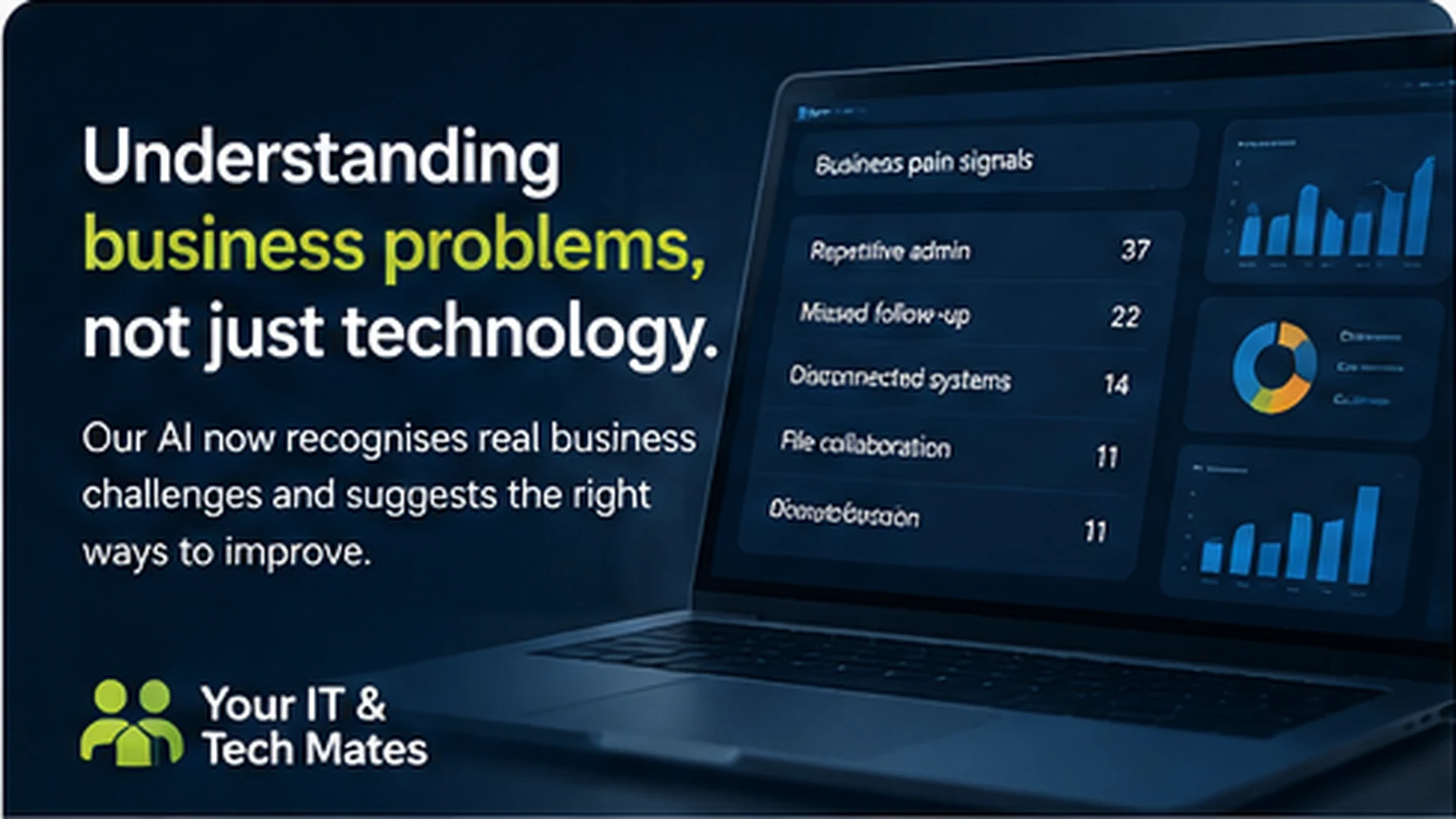
A smarter business website should recognise the problem a customer is trying to solve, such as repetitive admin, missed follow-ups or scattered files without requiring them to know the name of the software or service first.
Why this matters
This guide explains one part of the intent-driven customer journey we use on Your IT & Tech Mates and how the same design principle can help other service businesses reduce confusion while keeping important actions under customer and human control.
Why keywords are not enough
A business owner may say “we keep copying enquiries into spreadsheets” rather than “we need workflow automation”. They may say “quotes get forgotten” rather than “we need a CRM follow-up workflow”. If a website only looks for product names, some of the strongest commercial intent can be missed.
What business-pain understanding looks for
Useful signals include repetitive administration, manual data entry, missed leads, repeated customer questions, booking friction, disconnected systems and file-version problems. The goal is not to diagnose the business automatically. It is to recognise a likely problem category well enough to show a relevant guide, example or review pathway.
Example: from pain to pathway
A visitor writes: “Our staff save files in different places and nobody knows which version is current.” Instead of asking whether the computer will turn on, the website can recognise a file-collaboration problem and show information about shared file systems, Microsoft 365 or a workflow review.
Why this can improve lead quality
When the first step reflects the customer’s real problem, the next question can collect information that actually changes the route. That reduces repeated explanations and gives staff better context if the customer chooses to contact the business.
Keep the customer in control
Recognising business pain does not mean automatically creating a lead, approving work or deciding what software the business must buy. The website can suggest reviewed options while the customer chooses whether to continue.
Frequently asked questions
Is this the same as keyword matching?
No. Keywords can still help, but intent and business-pain recognition looks at the meaning and context of the request rather than relying on one exact phrase.
Does the website diagnose my business?
No. It identifies a likely problem area so it can show more relevant information or a suitable review pathway.
Can it understand non-technical wording?
That is the point. Customers should be able to describe the problem in ordinary language rather than learn your service catalogue first.
Does this automatically create a sales lead?
No. A lead is created only when the customer takes the normal explicit contact or QuoteMe action.
How this fits with Intent Intelligence
Intent Intelligence is most useful when it removes friction rather than adding another layer of technology for the customer to manage. The website can understand the likely need, show reviewed options and preserve context, while QuoteMe and the normal business processes remain responsible for real requests and commitments.
Could your website make this journey simpler?
See how customer intent, workflow automation and human-reviewed website logic can fit around the systems your business already uses.
Continue with the new intent-driven website feature guides
These guides cover business-pain understanding, context-aware clarification, privacy-safe lead qualification and privacy-safe local service-area detection.