AI Lead Routing for Small Business: Ask Less, Understand More
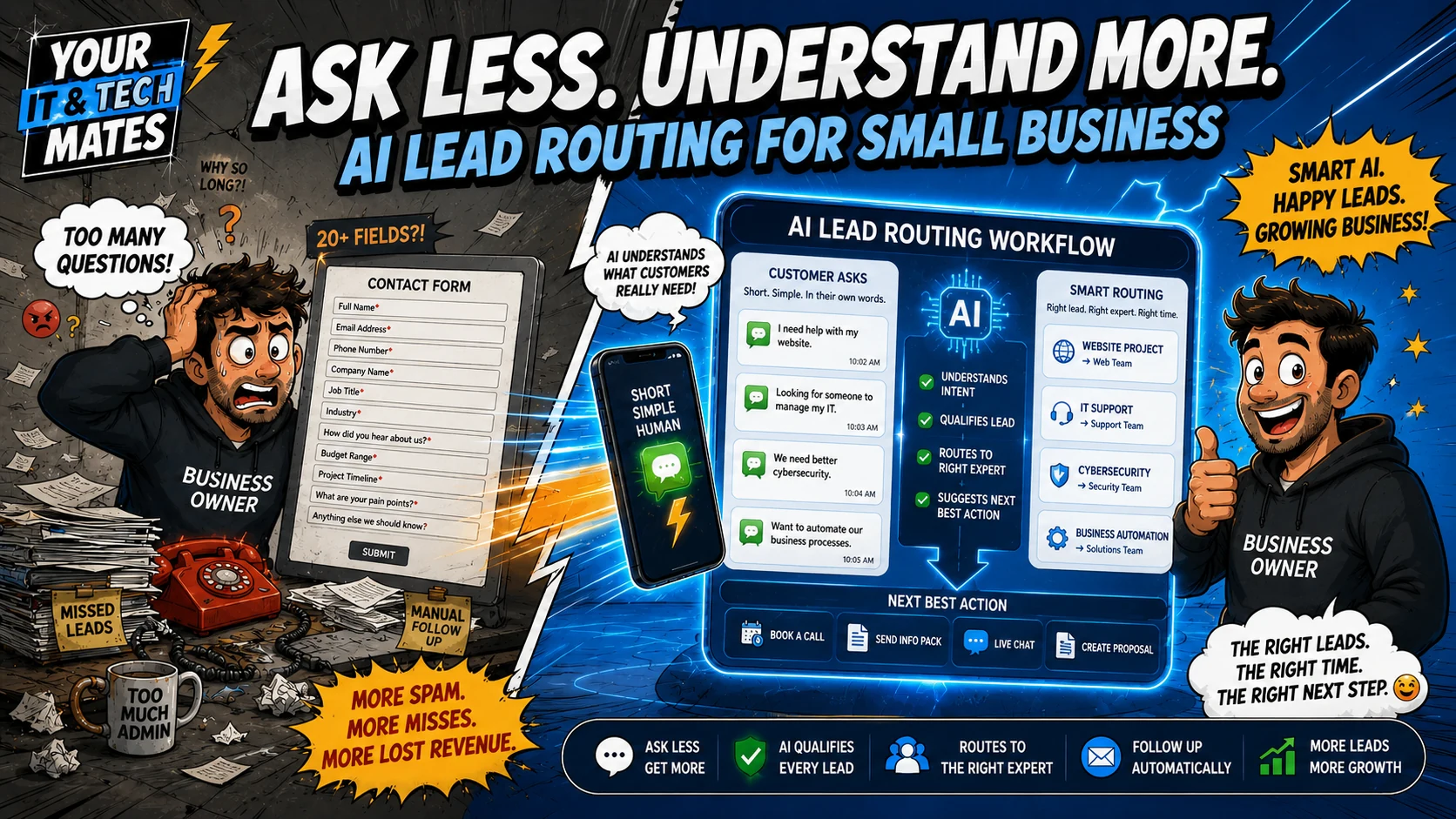
Many enquiry forms ask customers to understand the business before the business understands the customer. Intent-based lead routing flips that around: start with a short description, work out the likely need and ask only for information that changes the next step.
Quick answer
AI lead routing uses the meaning of a customer enquiry to choose an approved next path. For a small business, the biggest benefit is often fewer unnecessary questions at the start. The customer explains the problem in plain English; the system identifies the likely need, asks one useful follow-up if required and sends the customer into the existing booking, quote, support or sales workflow.
Why this matters to another small business
This article uses a real Your IT and Tech Mates website pattern as the example, but the lesson is broader. Customers usually describe a problem before they know the service name. A useful AI or automation layer should help translate that plain-English intent into an approved business workflow without forcing the customer to learn your internal categories.
For implementation options, see our Small Business Software & AI Solutions Melbourne hub. It explains how we approach workflow review, custom software and practical AI integration before recommending a build.
Why long forms lose useful context
A form with twenty fields can still miss the one detail that actually changes the decision. Customers may also abandon it because they do not know which service, department or project type to choose.
A better first question is often simply: what are you trying to get done, or what went wrong? The routing layer can then decide which detail matters next.
What lead routing should decide
Lead routing should answer a narrow operational question: where should this enquiry go next? It can identify the likely service, urgency band, missing detail and approved next action. It should not invent a binding price or accept work on behalf of the customer.
- Likely service or workflow
- Whether one clarification would improve the route
- Which approved form, booking path or team should receive the lead
- What context should travel with the lead
- Where a person needs to review before commitment
Example: four businesses, four different routes
A web agency may route “our website is slow and losing enquiries” to a website review. A plumber may route “hot water stopped this morning” to an urgent service path. An accountant may route “I received an ATO letter” to a document-review enquiry. A clinic may route “not sure which appointment I need” to a short triage question.
The technology pattern is similar, but the approved service knowledge and risk boundaries are different for every business.
Ask only when the answer changes something
Clarification should have a purpose. If knowing the device model changes pricing, ask for it. If knowing whether one person or the whole office is affected changes the support path, ask that. If the answer would not change the route, do not slow the customer down just because the field exists on an old form.
Keep the original enquiry attached to the lead
Routing should not strip away the customer’s own words. The short description is valuable context for staff and can reduce repeated explanations later.
In our own flow, useful intent context can continue toward QuoteMe while the customer still reviews and submits the real request. That is a better handoff than starting a separate AI conversation and then asking the customer to type everything again.
What to measure after launch
A useful lead-routing system should be measured by outcomes, not by how often the AI produces an answer. Watch clarification rate, customer corrections, abandonment, duplicate leads, response time and whether the final route actually matched the customer’s need.
A practical next step
Start with one customer journey and write down three things: what customers actually say, what the business needs to know next, and which existing system owns the final action. That makes it much easier to decide whether better copy, a shorter form, predefined rules, workflow automation or AI is the right tool.
See the latest intent-driven features in practice
Frequently asked questions
Is AI lead routing the same as a chatbot?
No. Lead routing can happen behind a normal website form or help box without requiring a chat interface.
Does lead routing replace a CRM?
Usually no. It can send cleaner context into the CRM or existing lead workflow rather than replacing it.
Should every enquiry be fully qualified by AI?
No. The goal is enough information for the next useful step, not maximum questioning.
Can AI route high-risk enquiries automatically?
It can identify a likely path, but higher-risk actions should use reviewed rules and human approval.
What is a good first use case?
Choose one enquiry type where customers frequently choose the wrong form, repeat information or wait for staff to interpret the request.
Could your business use Intent Intelligence?
If customers already describe what they need through your website, forms, email or messages, those conversations may contain enough information to identify intent, capture useful context and start the right controlled workflow.
Intent Intelligence is custom software built around your workflow, not another generic chatbot.
Could your enquiry form ask less and still capture better leads?
Explore our Small Business Software & AI Solutions service for intent routing, lead workflows, automation and custom software that fit the systems you already use.
Carry good context beyond the first form
Understanding intent is most useful when the customer does not have to start again on the next page. See how context can continue into an enquiry or quote while the customer stays in control.