How Smarter Websites Know When to Offer a Quote and When Not To
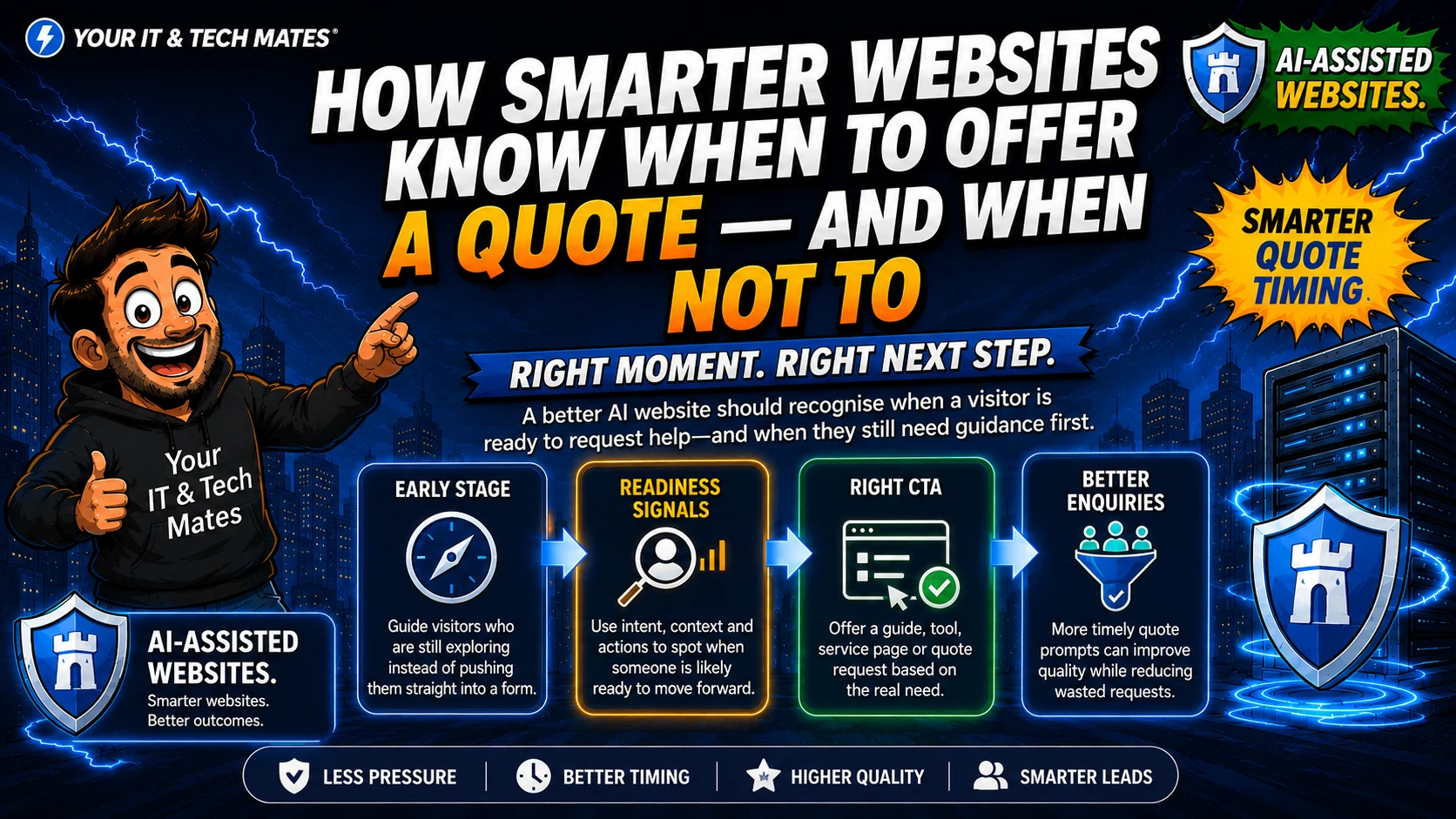
A better website recognises when someone is ready to request help and when a guide, tool or clarification is the more useful next step.
Quick answer
A smart website should not treat clear intent as automatic quote readiness. It can combine intent confidence, journey stage, explicit actions and missing information to decide whether to offer a guide, tool, service page or quote request.
Intent and readiness are different
A visitor can clearly need laptop repair but still be comparing options. Another visitor may be ready to book even though their description is vague. Separating “what they need” from “are they ready to act” prevents premature forms.
What readiness signals can look like
Signals may include viewing pricing after a service path, completing a relevant diagnostic, explicitly choosing help, returning to a service pathway or opening QuoteMe. Each signal should be bounded and combined rather than treated as proof.
Do not pressure early-stage visitors
Early-stage visitors often benefit from a decision guide, tool or concise explanation. Giving them a useful next step can build trust and improve later enquiry quality.
Make QuoteMe inherit useful context
When readiness becomes strong, carry forward appropriate context so the request pathway asks only for the missing information. The customer should still review and explicitly submit.
Measure timing quality
Compare quote prompt selection, completion, correction and downstream fit. A CTA that gets fewer clicks but produces much stronger enquiries may be the better business outcome.
Practical example: quote readiness is different from purchase intent
A customer saying 'my MacBook screen is cracked, it is a 2023 MacBook Air and I can bring it in' has given enough context for a repair enquiry to be useful. Someone asking 'why is my laptop screen dark?' may still be diagnosing the problem and could benefit from guidance first. Both users may be interested in help, but only one journey is clearly quote-ready.
Quote readiness should depend on the minimum information needed for the business to act: the likely service, enough device or environment detail, location where relevant, and no unresolved safety or eligibility question. The website can then offer QuoteMe without forcing it prematurely.
Where it can go wrong: Avoid using emotional wording, time on page or repeated visits as a proxy for quote readiness. The decision should be explainable from the customer's stated need and the approved service rules.
Related AI-assisted website guides
Continue with the guides that explain the underlying customer-experience, intent and governance ideas in more detail.
Three signals that make a quote invitation more useful
A quote should appear because the journey is ready for it, not because the customer has scrolled far enough. A practical decision can combine three controlled signals: the website has a reasonable understanding of the need, the service is relevant, and the customer has moved from general learning toward action.
For example, reading an article about cracked laptop screens is still an early signal. Choosing the screen-repair service or opening pricing is stronger. Describing the device and problem in the Intent Engine is stronger again. The quote invitation should become clearer as those signals line up.
When not to push QuoteMe
- the customer is still comparing unrelated topics;
- the website is unsure what the problem is;
- a safety path should take priority;
- the customer has already found successful self-help;
- the next useful step is diagnosis rather than a price promise.
This creates a calmer path and helps QuoteMe receive better context when the customer does choose to continue.
Frequently asked questions
When should an AI website offer a quote?
When the visitor shows sufficient readiness and the quote/request path is genuinely the next useful step, not simply because an intent was detected.
Is high intent confidence the same as booking readiness?
No. Confidence describes understanding of the need; readiness describes whether the visitor appears ready to act.
Should pricing pages automatically trigger a quote popup?
Not necessarily. Pricing can be a readiness signal, but it should be interpreted with the broader journey and customer actions.
Can quote timing improve lead quality?
Yes. Better timing can reduce premature or poorly matched requests and make the eventual enquiry more complete.
Could your website make customer journeys easier?
Tell us where customers get stuck, repeat themselves, choose the wrong path or submit poorly matched enquiries. We can review whether clearer content, website logic, automation, custom software or bounded AI fits the problem.