How to Add an AI Website Assistant Without Replacing Your Existing Systems
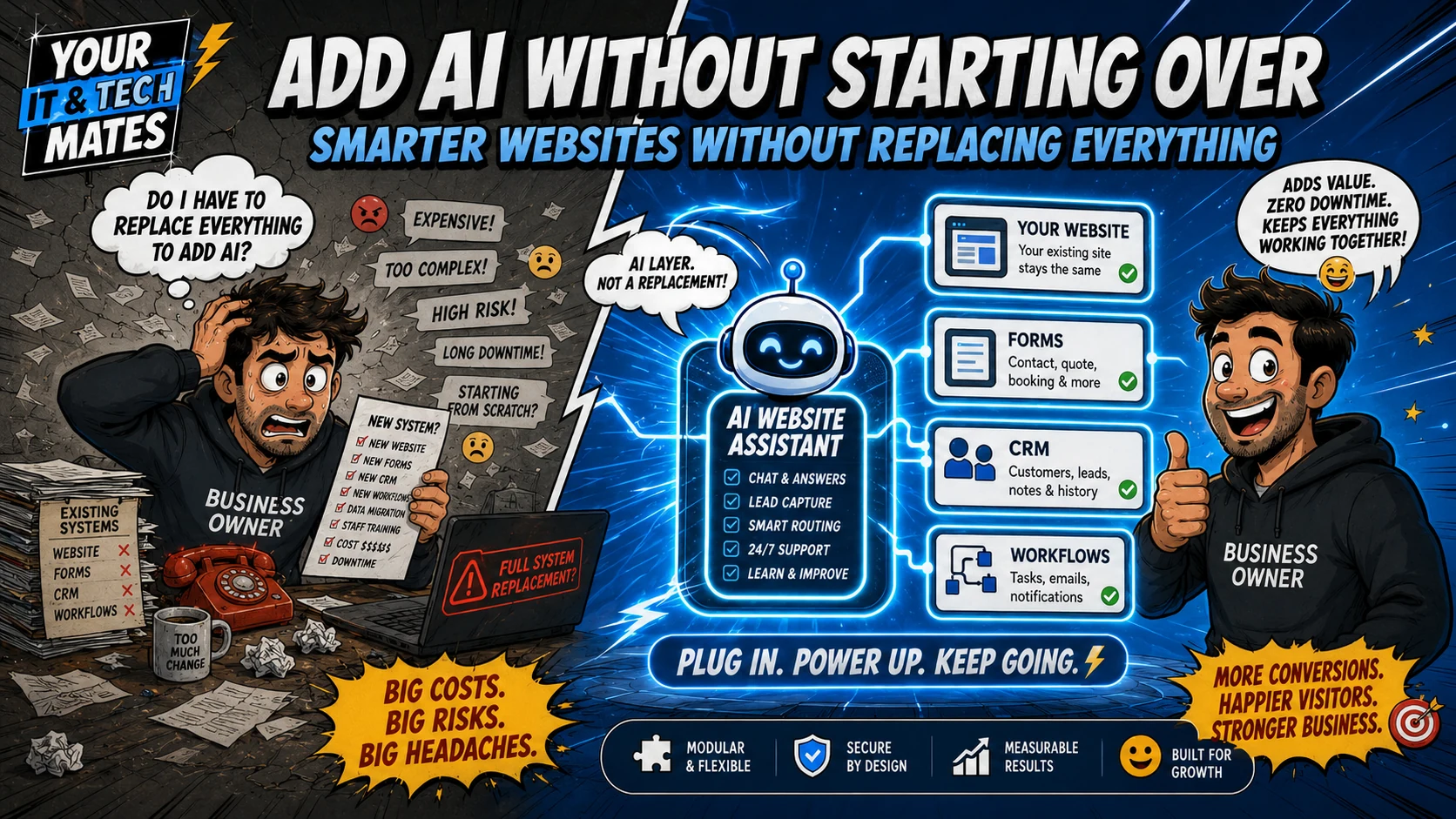
Adding AI does not have to mean replacing the website, forms, CRM, booking tool and customer workflow at the same time. A safer first project often adds one controlled assistance layer around systems that already work.
Quick answer
A small business can add AI without replacing everything by treating AI as an assistance layer. Keep existing systems as the owners of customer records, bookings, quotes and approved actions. Use AI where it adds value, such as understanding enquiries, summarising context or suggesting a next step, then pass the result into the existing workflow.
Why this matters to another small business
This article uses a real Your IT and Tech Mates website pattern as the example, but the lesson is broader. Customers usually describe a problem before they know the service name. A useful AI or automation layer should help translate that plain-English intent into an approved business workflow without forcing the customer to learn your internal categories.
For implementation options, see our Small Business Software & AI Solutions Melbourne hub. It explains how we approach workflow review, custom software and practical AI integration before recommending a build.
Start with the system that already owns the job
Before adding AI, identify the authoritative system for each business action. Which system owns customer records? Which creates bookings? Which issues quotes? Which stores approved service information? AI should connect to those owners rather than quietly becoming another source of truth.
Add a narrow layer first
A website assistant can start with one job: interpret incoming enquiries, suggest the right service page, prepare a summary for staff or answer repeat questions from approved knowledge. That is much easier to test than rebuilding the entire customer platform.
Keep transactions under explicit control
A useful assistant can prepare a booking request without confirming it, prepare quote context without setting the final price, or suggest a follow-up without sending a sensitive message automatically. The more consequence an action has, the clearer the approval boundary should be.
Connect through stable handoffs
Good integration means the next system receives structured, reviewed context. For example, the intent layer can pass device and problem information toward QuoteMe. A CRM assistant can attach a summarised enquiry to the existing lead record. A booking helper can collect preferred times before the booking system confirms availability.
What not to replace too early
Do not rebuild a working CRM just because the first AI feature needs customer context. Do not replace a booking platform before proving the customer intake is the real bottleneck. Do not create a second pricing database because an AI assistant needs to mention price guidance.
Reuse existing owners wherever possible. That keeps the project smaller and reduces conflicting data.
A practical rollout path
Choose one high-friction journey, document the current owner systems, define the approved AI task, add logging and human review, test with real low-risk enquiries, then expand only after the results are clear.
- Map the current workflow
- Choose one assistance task
- Define protected decisions
- Connect to existing owners
- Test with real enquiries
- Measure corrections and staff rework
- Expand only when the first layer proves useful
A practical next step
Start with one customer journey and write down three things: what customers actually say, what the business needs to know next, and which existing system owns the final action. That makes it much easier to decide whether better copy, a shorter form, predefined rules, workflow automation or AI is the right tool.
Frequently asked questions
Do I need a new website to add an AI assistant?
Often no. An assistant can be added as a layer to an existing website if the current platform and integrations are suitable.
Do I need to replace my CRM?
Usually not. The assistant can often send structured context into the CRM that already owns the lead record.
Can the assistant confirm prices automatically?
Only where the business has a controlled pricing rule and deliberately approves that behaviour. Otherwise it should show guidance or request human review.
What is the safest first AI website feature?
A narrow, low-risk task such as enquiry classification, approved FAQ assistance or summary preparation is often easier to test.
How do I know whether integration or replacement is better?
Map the bottleneck first. Replace a system only when the system itself is the constraint, not simply because AI is being added.
Could your business use Intent Intelligence?
If customers already describe what they need through your website, forms, email or messages, those conversations may contain enough information to identify intent, capture useful context and start the right controlled workflow.
Intent Intelligence is custom software built around your workflow, not another generic chatbot.
Want to add AI without throwing away systems that already work?
Our Small Business Software & AI Solutions service can map the existing workflow, identify the smallest useful integration and keep the current system owners intact wherever possible.