How Privacy-Safe Lead Qualification Can Work Without Tracking People
A website can learn which journeys convert without turning every visitor into a tracked identity. The useful part is the progression of the journey, not a hidden profile of the person.
Quick answer
Privacy-safe lead qualification separates “do we understand the request?” from “is this journey showing commercial readiness?” and only creates an identified lead when the customer deliberately starts contact.
Why this matters
This guide explains one part of the intent-driven customer journey we use on Your IT & Tech Mates and how the same design principle can help other service businesses reduce confusion while keeping important actions under customer and human control.
Understanding is not the same as buying intent
A 97% understanding score can mean the website is very confident about what the visitor needs. It does not mean the person is 97% likely to buy. Keeping those concepts separate avoids using interpretation confidence as a sales-pressure signal.
Use bounded journey signals instead of identity stitching
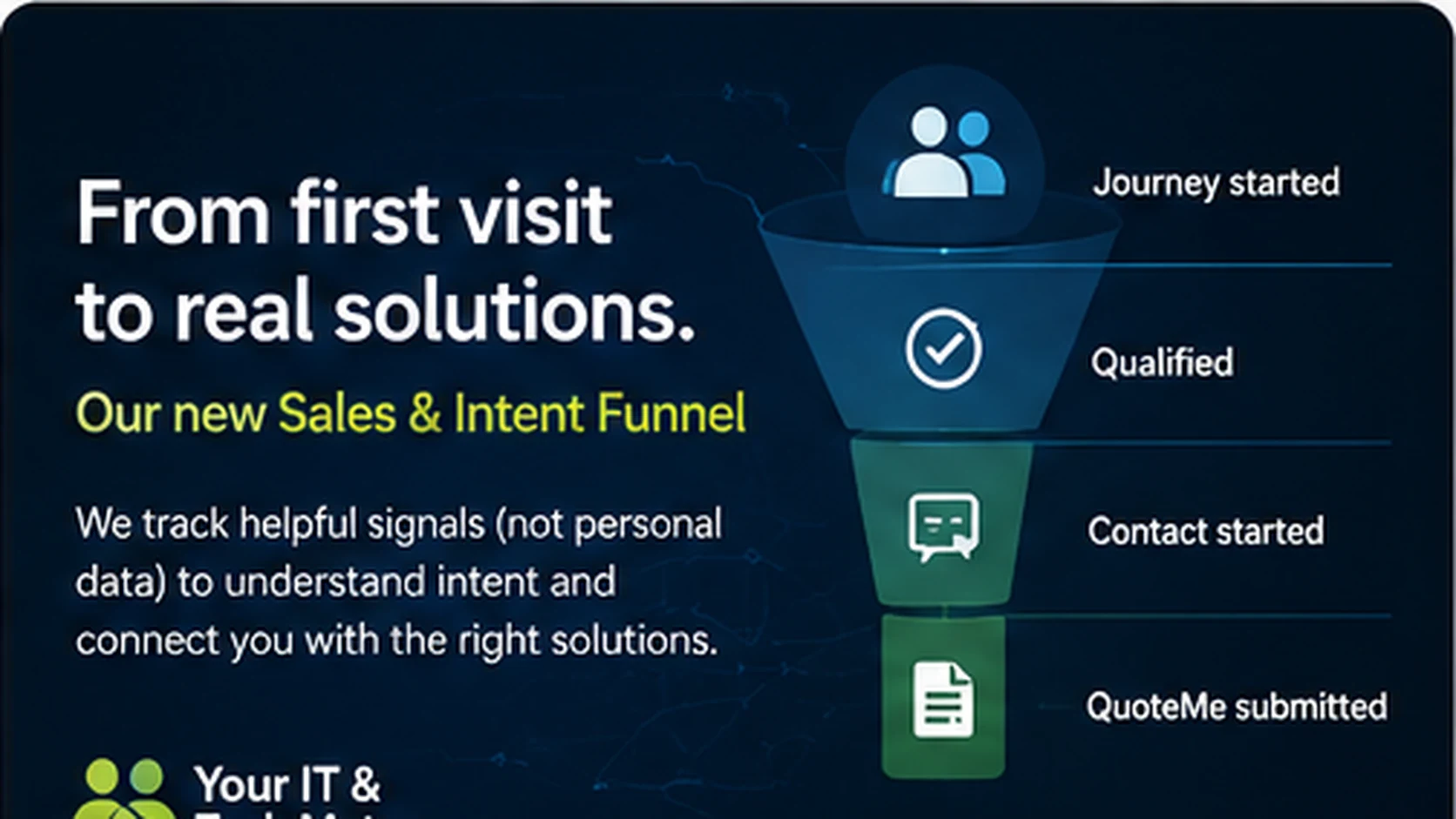
Useful first-party events can include viewing pricing, reading a relevant case study, opening request review, starting contact and submitting QuoteMe. These signals can be aggregated without fingerprinting a visitor or joining their activity across devices.
Keep the commercial score internal
Customers should see useful next steps, not labels such as “hot lead”. Internally, a readiness band can help the business understand which journeys are progressing and where people drop out.
Exclude journeys where sales pressure is inappropriate
Safety, scam, disability, senior-support and other sensitive or elevated-risk journeys should not be pushed through a commercial scoring model simply because the website understands them well.
Create the real lead only after deliberate contact
The anonymous journey can remain anonymous until the customer chooses to submit a request, ask for a callback or otherwise provide contact details through the normal business process.
Frequently asked questions
Is this the same as advertising tracking?
No. The approach described here uses bounded first-party journey events and does not require advertising identifiers, fingerprinting or cross-device identity stitching.
Can a customer see their lead score?
They do not need to. The customer-facing experience should focus on relevant help and clear choices.
When does someone become an identified lead?
Only when they deliberately provide contact information through the normal contact or request pathway.
Should sensitive journeys be sales scored?
No. Higher-risk and sensitive support areas should be excluded from commercial emphasis.
How this fits with Intent Intelligence
Intent Intelligence is most useful when it removes friction rather than adding another layer of technology for the customer to manage. The website can understand the likely need, show reviewed options and preserve context, while QuoteMe and the normal business processes remain responsible for real requests and commitments.
Could your website make this journey simpler?
See how customer intent, workflow automation and human-reviewed website logic can fit around the systems your business already uses.
Continue with the new intent-driven website feature guides
These guides cover business-pain understanding, context-aware clarification, privacy-safe lead qualification and privacy-safe local service-area detection.
New: Intent-Aware Website business series
These newer guides show how content semantics, customer corrections, journey context and readiness signals can work together without turning ordinary browsing into certainty.