How a Smart Website Knows When It Has Enough Information to Help
Intent Score and Booking Readiness answer different questions and together they tell the website when to stop asking.
Quick answer
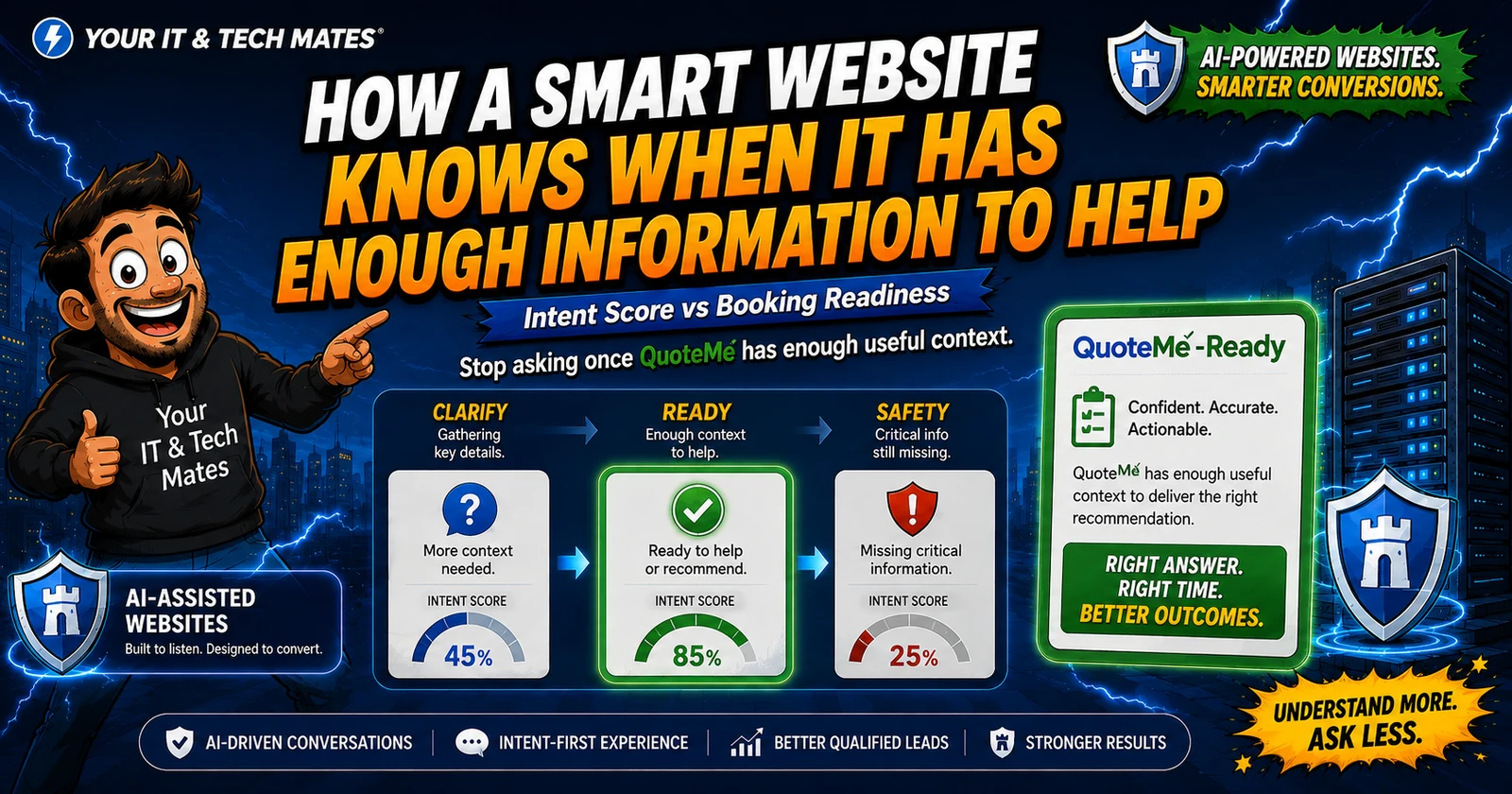
Intent Score measures how well the website understands the likely need. Booking Readiness asks a different question: is there enough safe, useful and customer-confirmed context to continue to QuoteMe without another diagnostic question?
Why this matters
This guide is part of our Adaptive Intent & Verified Evidence series. It explains a production design principle behind a website that tries to understand the customer with fewer questions while keeping safety, external evidence and real requests governed by predefined rules and customer or human confirmation.
Intent confidence is not the same as readiness
A website might be 95% confident that the customer has a battery problem but still need one safety confirmation before suggesting the next step. Conversely, a general assessment can sometimes be ready to book even when every technical detail is not known.
Three practical states
A simple controller can use Clarify, Ready and Safety. Clarify means one more answer could materially help. Ready means there is enough context for the customer to continue. Safety means ordinary commercial progression is suppressed or changed until the safety requirement is addressed.
Ready does not mean diagnosed
Booking readiness is deliberately narrow. It does not mean the problem is diagnosed, the work is approved or the price is final. It means the information is sufficient for the next human-controlled support step.
Low-value questions should not block QuoteMe
An exact model number may be helpful for a technician, but it should not automatically block a general assessment if device type, problem and safety state are already clear. Required-for-safety and required-for-routing facts should be distinguished from nice-to-have details.
The stopping rule matters
The same scoring engine that decides which question to ask should also be allowed to decide not to ask one. If the expected information gain of the next question is low and the request is already safe and useful, the right action is to stop.
QuoteMe remains the request controller
Once the Intent Engine returns Ready, QuoteMe can receive the reviewed journey context and collect transactional details such as contact preference and service option. QuoteMe still creates the real request only after the customer confirms it.
Frequently asked questions
Is Booking Readiness just another confidence score?
No. It is a governed state based on safety, required information, recommendation stability and whether another question would materially help.
Can a low Intent Score ever be ready?
Sometimes a general assessment can proceed with uncertainty, provided the required safety and routing information is complete and the uncertainty is clearly represented.
Does Ready automatically book a job?
No. Ready only means the journey can continue to QuoteMe. The customer still reviews and submits the request.
Why keep Intent Score at all?
It remains useful as a customer-facing understanding signal and as an internal measure of how confidently the system has interpreted the need.
How this fits with Intent Intelligence and QuoteMe
The Intent Engine is the decision controller: it interprets governed facts, decides whether another clarification materially helps and returns a readiness state. The QuoteMe Journey Controller carries approved context across the website. QuoteMe remains the only component that creates a real request after the customer reviews and submits it.
Could your website ask less and understand more?
Tell us where customers repeat themselves, choose the wrong service or need clearer evidence before the next step. We can review whether intent-driven logic, automation, structured evidence or something simpler fits the problem.