What Is an Intelligent Customer Journey?
A plain-English explanation of websites that understand the goal, keep useful context and coordinate the next step across more than one page.
Quick answer
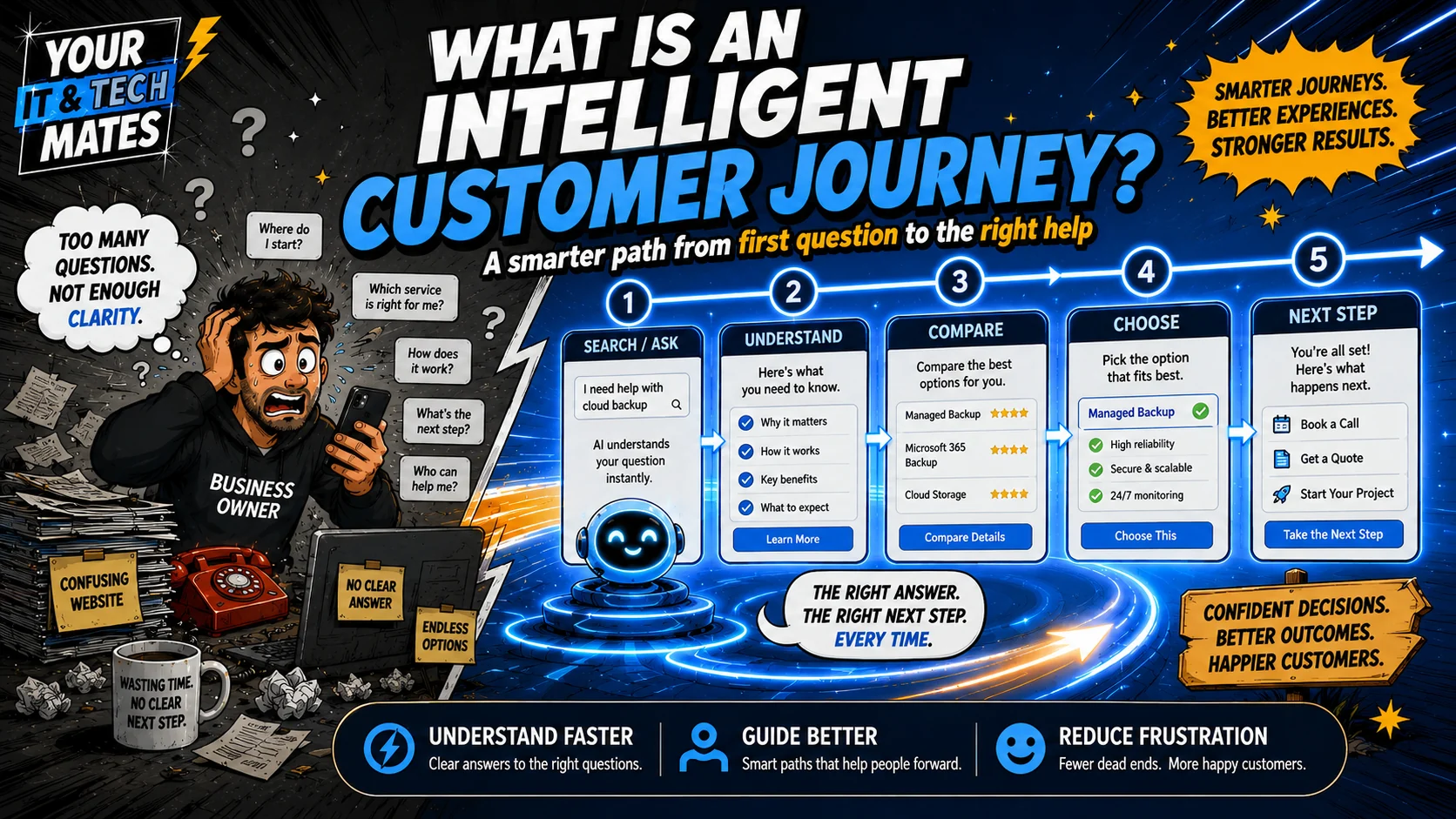
An intelligent customer journey is a connected website experience that uses the customer’s current need and journey state to decide what information, question or workflow should come next. Unlike a static funnel, it can adapt as the customer clarifies, changes or adds to the problem.
Static funnel vs intelligent journey
A static funnel expects people to follow a fixed order. An intelligent journey can start from different surfaces, interpret the current goal, ask only when necessary and keep the journey coherent when the person changes direction.
What makes the journey “intelligent”
The intelligence is not simply generative AI. It can include reviewed intent rules, confidence checks, risk handling, context continuity, approved content mappings and workflow rules. AI can assist where language is ambiguous, but the journey still needs deterministic boundaries.
Why context matters
Without context, each page behaves like a new conversation. A connected journey can preserve the useful parts of what has already been understood so the customer does not need to re-enter the same issue before moving to the next step.
Why human control matters
The journey may recommend or prepare an action, but important boundaries stay explicit: final diagnosis, fixed pricing, request submission, payment and paid work should remain with the customer and accountable staff.
A simple example from first question to next step
Imagine a customer arrives from Google and reads an article about a laptop that turns on but has a black screen. They then open a display-repair page and ask, “I can hear the laptop running but I cannot see anything.”
A connected journey can use the related page context as weak supporting evidence, interpret the customer's own description as the stronger signal, and ask one focused question if needed. If the result points to a display problem, the website can show the relevant service or prepare QuoteMe with that context.
The journey in plain English
- Discover: the customer learns about the symptom.
- Understand: the Intent Engine interprets the customer's words.
- Clarify: one useful question is asked only if needed.
- Choose: the customer sees an appropriate service, tool or self-help path.
- Continue: QuoteMe receives reviewed context only after the customer chooses to proceed.
The intelligence is in coordinating these steps while keeping uncertainty, safety and customer choice visible.
Frequently asked questions
Can a normal website become intent-aware without being rebuilt from scratch?
Often, yes. Existing pages and forms can remain owners while a controlled journey layer coordinates how customers move between them.
Does every step need AI?
No. Many journey decisions can be handled with reviewed rules, structured context and known workflows.
What happens when the system is unsure?
A safer journey asks a focused clarification or hands over for human review instead of pretending to know.
Can the customer change their mind?
They should be able to. A robust journey updates when the customer corrects, removes or re-adds a need.
Related Your IT and Tech Mates guidance
Could a similar customer journey help your business?
Tell us where customers repeat themselves, choose the wrong path or get stuck between your website and your real workflow. We can review whether better software, automation, AI or a simpler process change, would help. A person confirms scope and pricing before paid work starts.
Connect this guide to the wider Software & AI library
This topic is part of a wider customer-journey system. Use these related guides and first-party implementation examples for the next layer of detail.