How We Measure Whether an AI Receptionist Is Actually Helpful
Which AI receptionist metrics matter? YITM explains intent accuracy, real follow-up speed, handovers, cost and customer enquiry conversion.
Quick answer
A large number of chatbot conversations is not proof that customers are getting help. We would rather know whether somebody explained their problem once, received a useful next step and could reach a real technician when needed.
Evidence note: YITM build experience and labelled tests are distinguished from unverified live-customer savings or conversion outcomes.
The customer problem behind this workflow
Dashboards can overcount success by treating model replies, opened forms and actual submitted enquiries as the same thing. They are different stages. A successful validation of an AI plan also says little about whether a customer completed the browser journey.
For a small business, tracking too many raw events creates work without insight. The metrics need to explain what should change next week.
How we designed the YITM workflow
YITM’s staff AI intelligence design separates deterministic answers from model attempts, provider rejections, timeouts, clarifications and human handovers. We also look at enquiry-to-QuoteMe progression and estimated model spend, with privacy-safe aggregate reporting.
We would compare actual response time and conversion by enquiry source, not assume that an automated acknowledgement saved the job. Corrections and repeated questions deserve their own review: the customer may still be stuck even when the chatbot sounds confident.
What we built, tested and learned
During the build we reported explicit offline suite counts and bounded real-Azure probes. We did not convert them into a claimed production intent-accuracy percentage. A browser failure after passing tests showed exactly why separate test and customer metrics matter.
The proposed scorecard should identify its observation period, sample size, exclusions and whether each measurement comes from synthetic QA, real provider tests or consented production operation.
What this could improve for YITM and other businesses
If a particular clarification causes abandonment, YITM can rewrite that question. If a routine hours enquiry consumes paid tokens, the routing rule can be improved. If staff respond too late, the fix may be notification handling, not another model.
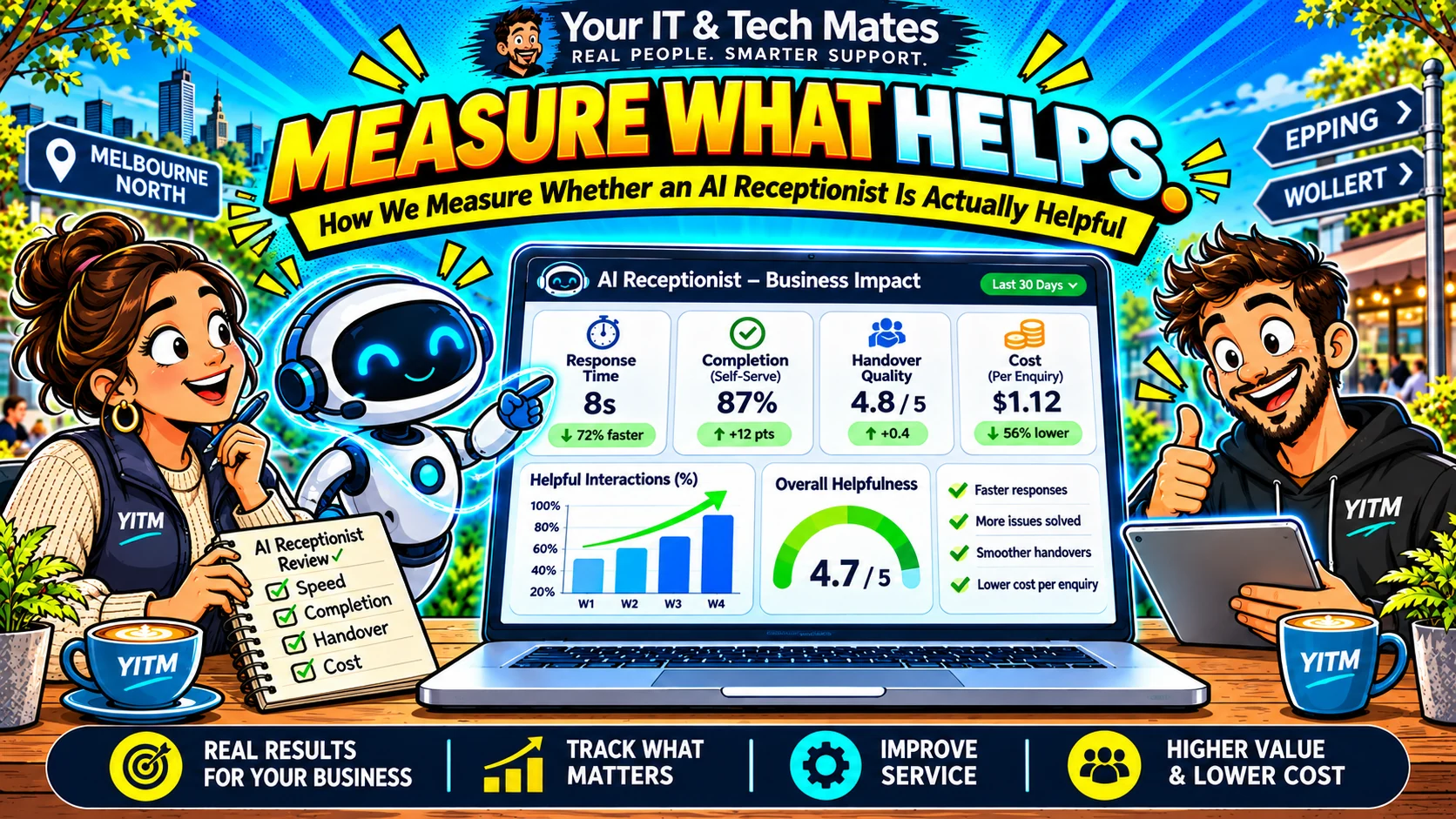
A small Melbourne business can start with just four numbers: time to first meaningful reply, completed enquiry rate, avoidable handovers and monthly automation spend.
Local business perspective: Epping, Wollert and Melbourne North
Our own service work in Melbourne’s northern suburbs provides a practical test bed: customers want a clear next step, especially when they cannot describe a technical problem. This article is a first-party YITM workflow example, not a claim that an identical automation suits every local business. A café, clinic or trade service should map its own permissions, customer journey and response expectations before copying the pattern.
Four metrics and what they actually tell you
First meaningful response time: how long the customer waits for information they can act on, excluding a generic instant acknowledgement. Completed enquiry rate: the share of eligible visits that lead to a submitted request, not merely a clicked form.
Correction or re-question rate: how often the receptionist makes people repeat known facts or reclassifies the enquiry incorrectly. AI cost per useful enquiry: eligible model spend divided by reviewed, completed enquiry outcomes, with provider failures disclosed separately.
How to avoid a misleading dashboard
Use consistent reporting windows and separate synthetic tests from real visitors. A model call rejected by the evidence validator is a guardrail event, not a successful answer; a submitted enquiry is not automatically a paid job.
When a metric worsens, inspect a small privacy-safe sample of the actual workflow and decide whether better knowledge, faster staff notification or a clearer question is the appropriate fix.
Frequently asked questions
Is chatbot accuracy the same as customer satisfaction?
No. Accuracy is one input; task completion, clarity, human availability and customer feedback matter too.
Can you calculate ROI from test cases?
No. Synthetic test passes are engineering evidence, not measured time or revenue savings.
Keep exploring YITM's workflow automation work
Start with our virtual receptionist overview, then follow the engineering details below.
- small business ai automation case study melbourne
- quoteme customer conversation workflow automation
- How our website works as a virtual front desk
- Our wider small-business workflow lessons
Behind the Build · all ten articles
- Part 1 — How We Built an AI Receptionist That Asks Better Questions
- Part 2 — Why Our AI Receptionist Needs to Remember the Conversation
- Part 3 — AI or Rules? How We Keep Our Virtual Receptionist Practical and Affordable
- Part 4 — From AI Conversation to QuoteMe: A Safer Customer Handover
- Part 5 — When AI Gets It Wrong: How We Test and Improve Our Receptionist
- Part 6 — One Customer, Two Problems: Designing AI for Multiple Service Requests
- Part 7 — Why Our AI Receptionist Cannot Book Work or Approve Prices on Its Own
- Part 8 — How We Connect Website Enquiries, QuoteMe and Staff Follow-Up
- Part 9 — How We Measure Whether an AI Receptionist Is Actually Helpful
- Part 10 — Start With One AI Workflow: What Our Small Business Learned
Could your business use a clearer customer workflow?
Tell us which enquiry, follow-up or handover consumes time for your team. We can discuss a small, human-reviewed workflow that fits your current tools. Please do not send passwords, API keys or private customer records. We confirm scope and pricing before any paid work.