From AI Conversation to QuoteMe: A Safer Customer Handover
How YITM connects website questions to reviewable QuoteMe drafts, human-approved repair work and more useful service enquiries in Melbourne North.
Quick answer
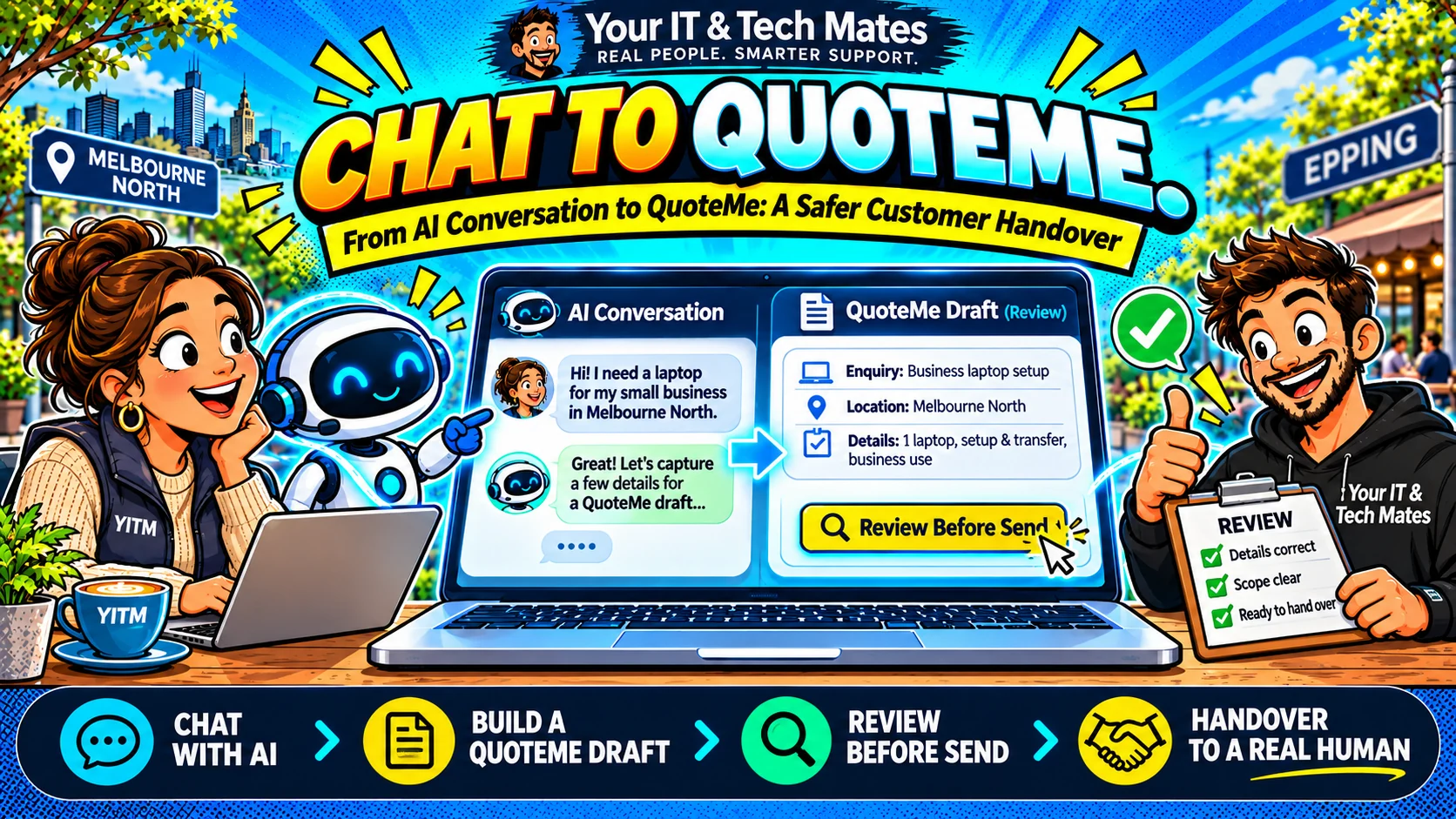
A helpful receptionist should not end with “Please fill in this form” after the customer has already explained the problem. But sending that explanation automatically would also be wrong. We designed the next step around a reviewable customer draft.
Evidence note: YITM build experience and labelled tests are distinguished from unverified live-customer savings or conversion outcomes.
The customer problem behind this workflow
The friction between chat and forms is familiar: a customer describes a laptop issue, follows a guide, then repeats everything in a separate quote request. Staff receive fragmented context or no context at all.
The opposite failure is more serious. An assistant might treat “Sounds good” as approval to book work, set a price or contact someone. That is not enough authority.
How we designed the YITM workflow
Our workflow captures supported enquiry facts, differentiates general questions from service requests and prepares a QuoteMe continuation for the customer to check. Clarifications and corrections should travel with the draft; unnecessary private history should not.
The customer decides whether to send the enquiry. A technician reviews the request, asks for any remaining information, provides scope and confirms pricing or arrangements. Existing bookings, invoices and private status requests require secure verification rather than public-chat shortcuts.
What we built, tested and learned
The YITM acceptance harness checks unsent handovers, same-case identity, draft preservation and duplicate receipt replay. In one recovery round, 50 synthetic cases per lane were used to catch routing and context defects before deployment.
Those checks demonstrate engineering guardrails within the test harness; they are not evidence that every customer journey or staff review screen has passed live acceptance. We continue to separate offline proof from real browser behaviour.
What this could improve for YITM and other businesses
If the draft is useful, a technician can spend less time requesting facts the customer already gave. The real success measure is whether an enquiry reaches the team complete enough to act on, not the number of automated messages.
Small businesses can copy the principle with simpler systems: capture the problem once, let the customer edit it and keep human approval at the point where money, bookings or personal records are involved.
Local business perspective: Epping, Wollert and Melbourne North
Our own service work in Melbourne’s northern suburbs provides a practical test bed: customers want a clear next step, especially when they cannot describe a technical problem. This article is a first-party YITM workflow example, not a claim that an identical automation suits every local business. A café, clinic or trade service should map its own permissions, customer journey and response expectations before copying the pattern.
Questions that require a human decision
Whether a device can be repaired economically depends on diagnosis, parts, condition and customer priorities. Whether a booking slot is available depends on actual scheduling systems. A conversational answer alone cannot establish either fact.
Similarly, a customer asking for help with a family member’s account does not grant permission to disclose that person’s information. The safe workflow is to explain verification or seek the account holder’s consent through the appropriate channel.
A missed-call versus web-form example
Imagine a technician is replacing a laptop screen when a new message arrives. An automatic acknowledgement may help, but the team still needs a clear queue item showing who must reply and which details are already known.
If the customer then opens QuoteMe, the system should not create two unrelated jobs silently. Staff need a way to see the enquiry history, avoid duplicate work and respond in the right channel.
Frequently asked questions
Does QuoteMe send the enquiry automatically?
No. The customer must review and choose to submit the enquiry.
Can the assistant promise a fixed repair price?
No. Price and scope need the approved business rules and, where required, a technician’s confirmation.
Keep exploring YITM's workflow automation work
Start with our virtual receptionist overview, then follow the engineering details below.
- quoteme customer conversation workflow automation
- ai website virtual front desk melbourne
- How our website works as a virtual front desk
- Our wider small-business workflow lessons
Behind the Build · all ten articles
- Part 1 — How We Built an AI Receptionist That Asks Better Questions
- Part 2 — Why Our AI Receptionist Needs to Remember the Conversation
- Part 3 — AI or Rules? How We Keep Our Virtual Receptionist Practical and Affordable
- Part 4 — From AI Conversation to QuoteMe: A Safer Customer Handover
- Part 5 — When AI Gets It Wrong: How We Test and Improve Our Receptionist
- Part 6 — One Customer, Two Problems: Designing AI for Multiple Service Requests
- Part 7 — Why Our AI Receptionist Cannot Book Work or Approve Prices on Its Own
- Part 8 — How We Connect Website Enquiries, QuoteMe and Staff Follow-Up
- Part 9 — How We Measure Whether an AI Receptionist Is Actually Helpful
- Part 10 — Start With One AI Workflow: What Our Small Business Learned
Could your business use a clearer customer workflow?
Tell us which enquiry, follow-up or handover consumes time for your team. We can discuss a small, human-reviewed workflow that fits your current tools. Please do not send passwords, API keys or private customer records. We confirm scope and pricing before any paid work.