
One Customer, Two Problems: Designing AI for Multiple Service Requests
How YITM approaches compound customer enquiries, changing intentions and multiple device problems without losing the original request.
Quick answer
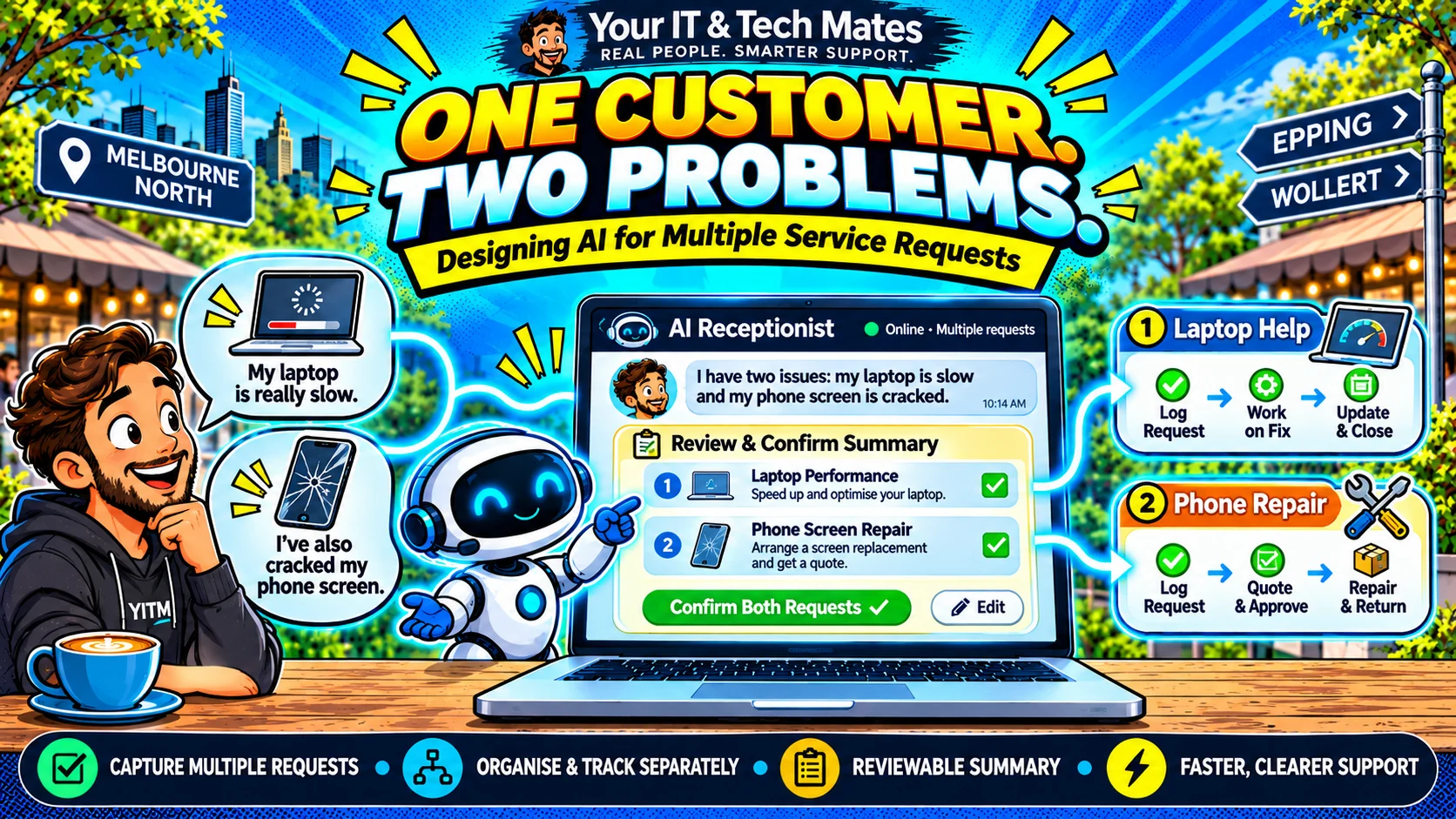
A customer might tell us, “My laptop is slow and I also need help setting up email for Mum.” They have two needs, not a single vague “computer problem”. If an automated receptionist collapses them into one category, somebody has to discover the missing work later.
Evidence note: YITM build experience and labelled tests are distinguished from unverified live-customer savings or conversion outcomes.
The customer problem behind this workflow
Single-keyword routing is built for neat menus. Real household and small-business enquiries are rarely so neat. Customers add problems as they remember them, change devices, or switch from troubleshooting to asking about cost.
A system that creates a brand-new case for every sentence can be just as confusing. We need to tell an additional issue from a correction and a genuinely separate request.
How we designed the YITM workflow
YITM’s shared intent approach represents the customer’s purpose and, where supported, multiple concerns. We distinguish “also my phone screen is cracked” from “actually it’s a desktop, not a laptop”. The first adds an issue; the second corrects a fact.
The receptionist should ask only for critical missing details, keep human-readable summaries and invite the customer to review before submitting. In a business context, a website plus booking form and follow-up automation may be one project with several deliverables rather than three unrelated sales requests.
What we built, tested and learned
The Stage 1 acceptance scenarios include adding a cracked phone screen, explicitly starting a separate Wi-Fi enquiry, correcting the device brand and describing both broken email and a slow laptop. These are useful regression cases precisely because they test relationships between messages.
We treat them as engineering scenarios, not evidence of a deployed production accuracy rate. The browser and QuoteMe handover still need verification for the particular live release.
What this could improve for YITM and other businesses
A properly organised summary can make job allocation and quoting easier for the YITM team. It can also help customers check that both problems are included before sending their request.
The same pattern suits trades and local services: an electrician may need to separate a failed light fitting from a new outdoor power point while retaining one customer's conversation.
Local business perspective: Epping, Wollert and Melbourne North
Our own service work in Melbourne’s northern suburbs provides a practical test bed: customers want a clear next step, especially when they cannot describe a technical problem. This article is a first-party YITM workflow example, not a claim that an identical automation suits every local business. A café, clinic or trade service should map its own permissions, customer journey and response expectations before copying the pattern.
Compound intent: a practical example
“My laptop runs slowly, and Mum’s email has stopped working.” A helpful assistant recognises that the laptop performance problem and the email problem need distinct details. It should not infer they share the same cause.
A concise follow-up could be: “I can note both. Is Mum’s email failing on the same laptop or on another device?” One question can resolve an important relationship without making the customer fill out two lengthy forms.
Why reviewable summaries matter
Before submission, display both issues in plain language. The customer can remove one, correct a device or choose to discuss them together. Staff may later schedule separate work; the receptionist does not need to decide that in advance.
For a business enquiry such as a website, booking form and follow-up automation, retain the combined customer objective first. A human can break the work into phases and price it after scoping.
Frequently asked questions
Can one QuoteMe enquiry describe two issues?
The goal is to preserve both concerns clearly for customer review and staff triage; each job's scope is still decided by a person.
What if the customer corrects an earlier answer?
The corrected fact should replace the superseded detail, not remain as a conflicting instruction.
Keep exploring YITM's workflow automation work
Start with our virtual receptionist overview, then follow the engineering details below.
- quoteme customer conversation workflow automation
- ai website virtual front desk melbourne
- How our website works as a virtual front desk
- Our wider small-business workflow lessons
Behind the Build · all ten articles
- Part 1 — How We Built an AI Receptionist That Asks Better Questions
- Part 2 — Why Our AI Receptionist Needs to Remember the Conversation
- Part 3 — AI or Rules? How We Keep Our Virtual Receptionist Practical and Affordable
- Part 4 — From AI Conversation to QuoteMe: A Safer Customer Handover
- Part 5 — When AI Gets It Wrong: How We Test and Improve Our Receptionist
- Part 6 — One Customer, Two Problems: Designing AI for Multiple Service Requests
- Part 7 — Why Our AI Receptionist Cannot Book Work or Approve Prices on Its Own
- Part 8 — How We Connect Website Enquiries, QuoteMe and Staff Follow-Up
- Part 9 — How We Measure Whether an AI Receptionist Is Actually Helpful
- Part 10 — Start With One AI Workflow: What Our Small Business Learned
Could your business use a clearer customer workflow?
Tell us which enquiry, follow-up or handover consumes time for your team. We can discuss a small, human-reviewed workflow that fits your current tools. Please do not send passwords, API keys or private customer records. We confirm scope and pricing before any paid work.