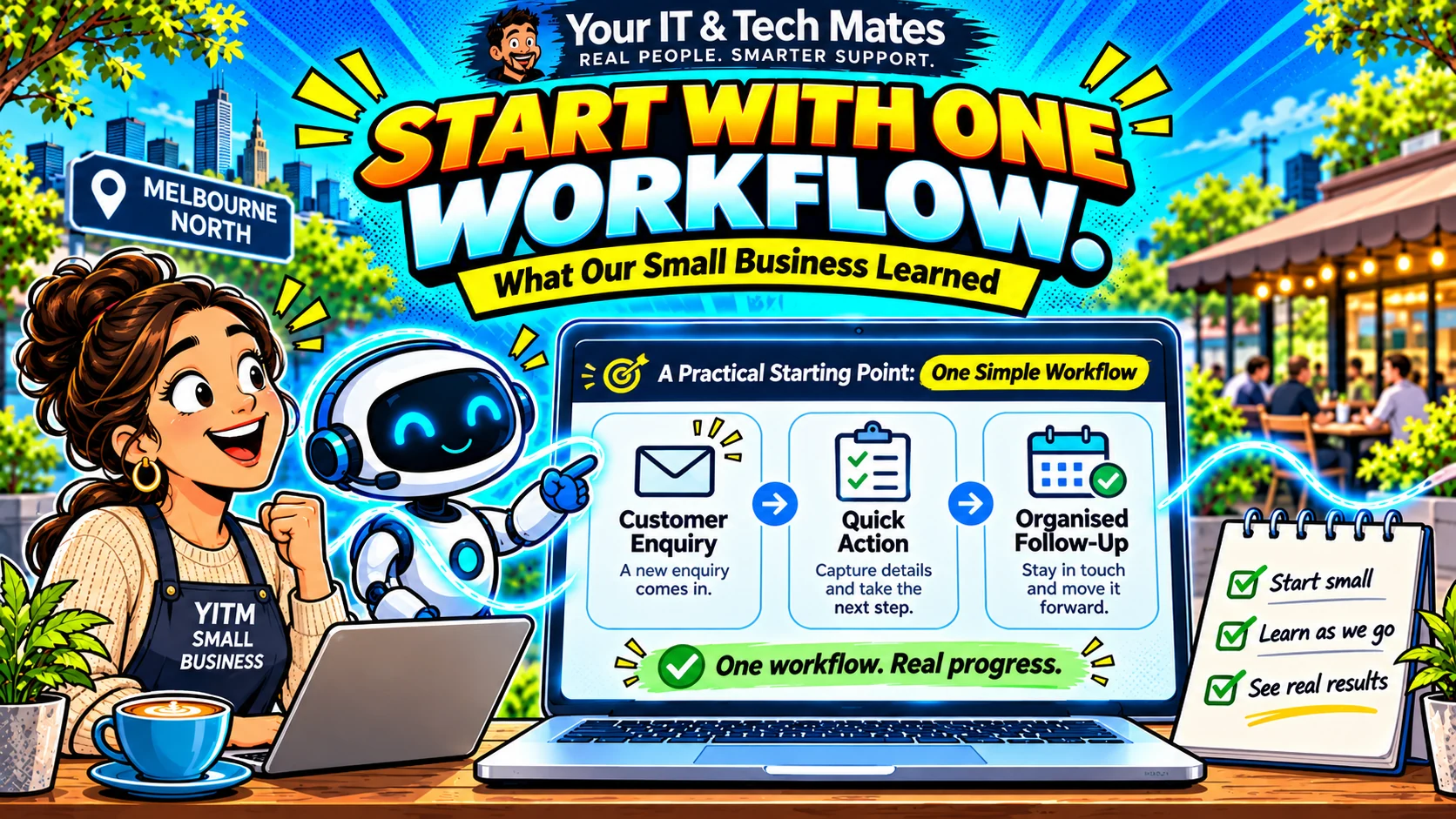
Start With One AI Workflow: What Our Small Business Learned
A practical Melbourne small-business guide using YITM’s own virtual receptionist, QuoteMe and follow-up work to plan a sensible first AI automation.
Quick answer
The best first automation is usually a repeated inconvenience with a clear handoff, not a sweeping project to replace the entire office. At YITM, the recurring problem was simple: someone needs help while our technician is already helping somebody else.
Evidence note: YITM build experience and labelled tests are distinguished from unverified live-customer savings or conversion outcomes.
The customer problem behind this workflow
Business owners often buy software before they understand where their workflow breaks. They end up with a chat widget, a form, an inbox and another dashboard that nobody has time to check.
The starting question should be: what information does the next person need, when do they need it, and how do we know the work was handed over?
How we designed the YITM workflow
We mapped the YITM journey from first website question to QuoteMe draft and staff reply. We reused existing PHP rules and reviewed service content, added model interpretation only where ambiguity justified it and protected customer consent at submission.
Development was iterative. Some tests passed while the live browser still took the wrong route; that led us to restrict rollout, reproduce the error and separate staff testing from public activation. A useful workflow is built as much through correction as through its first design.
What we built, tested and learned
Our system includes a shared intent model, controlled AI gateway, short-lived conversation context, regression scenarios and staff analytics plans. Some components have passed offline tests; full public adaptive reception and every operational dashboard pathway still require their own live acceptance.
That distinction matters when selling a solution. We can demonstrate actual code and engineering choices without claiming unverified savings, conversion growth or perfect automated understanding.
What this could improve for YITM and other businesses
For YITM, the intended business benefits are clearer enquiries, reduced double handling and fewer missed follow-ups when staff are busy. Whether these materialise will be assessed using real response, submission and cost data.
For another business, try a four-week pilot: choose one enquiry type, define the human owner, automate a safe information-gathering step, test failures, and review what customers actually do. Add complexity only after the first workflow is dependable.
Local business perspective: Epping, Wollert and Melbourne North
Our own service work in Melbourne’s northern suburbs provides a practical test bed: customers want a clear next step, especially when they cannot describe a technical problem. This article is a first-party YITM workflow example, not a claim that an identical automation suits every local business. A café, clinic or trade service should map its own permissions, customer journey and response expectations before copying the pattern.
A four-week pilot a small business can actually run
Week one: pick one repeated enquiry—such as booking requests, service-area questions or quote preparation—and map the current customer and staff steps. Week two: implement reviewed answers and one safe route to a person.
Week three: test unclear wording, corrections, duplicates, model failure and privacy boundaries. Week four: review real customer behaviour with a small, defined sample and compare response times and unfinished requests against the baseline.
What to prepare before speaking to a workflow developer
Bring three anonymised example enquiries, the software used by the team, who approves prices or bookings and where current handovers fail. Define what you do not want the system to do automatically.
At YITM, this is the difference between selling an abstract chatbot and discussing a useful customer journey. You should be able to explain what the customer sees, what staff receive and how either party corrects a mistake.
Frequently asked questions
Do I need a custom AI model to begin?
Usually not. Good routing, approved content and one reliable handover can create value before extensive model integration.
Can this work for businesses outside IT repairs?
The pattern can suit many appointment or enquiry-led services, although each business needs its own approvals, privacy checks and scope.
Keep exploring YITM's workflow automation work
Start with our virtual receptionist overview, then follow the engineering details below.
- ai website virtual front desk melbourne
- small business ai automation case study melbourne
- How our website works as a virtual front desk
- Our wider small-business workflow lessons
Behind the Build · all ten articles
- Part 1 — How We Built an AI Receptionist That Asks Better Questions
- Part 2 — Why Our AI Receptionist Needs to Remember the Conversation
- Part 3 — AI or Rules? How We Keep Our Virtual Receptionist Practical and Affordable
- Part 4 — From AI Conversation to QuoteMe: A Safer Customer Handover
- Part 5 — When AI Gets It Wrong: How We Test and Improve Our Receptionist
- Part 6 — One Customer, Two Problems: Designing AI for Multiple Service Requests
- Part 7 — Why Our AI Receptionist Cannot Book Work or Approve Prices on Its Own
- Part 8 — How We Connect Website Enquiries, QuoteMe and Staff Follow-Up
- Part 9 — How We Measure Whether an AI Receptionist Is Actually Helpful
- Part 10 — Start With One AI Workflow: What Our Small Business Learned
Could your business use a clearer customer workflow?
Tell us which enquiry, follow-up or handover consumes time for your team. We can discuss a small, human-reviewed workflow that fits your current tools. Please do not send passwords, API keys or private customer records. We confirm scope and pricing before any paid work.