What Can an AI Website Learn From “Not Quite” and Customer Corrections?
“Not quite” is valuable evidence: it shows where a website interpretation was close but wrong and where future matching or wording may need review.
Quick answer
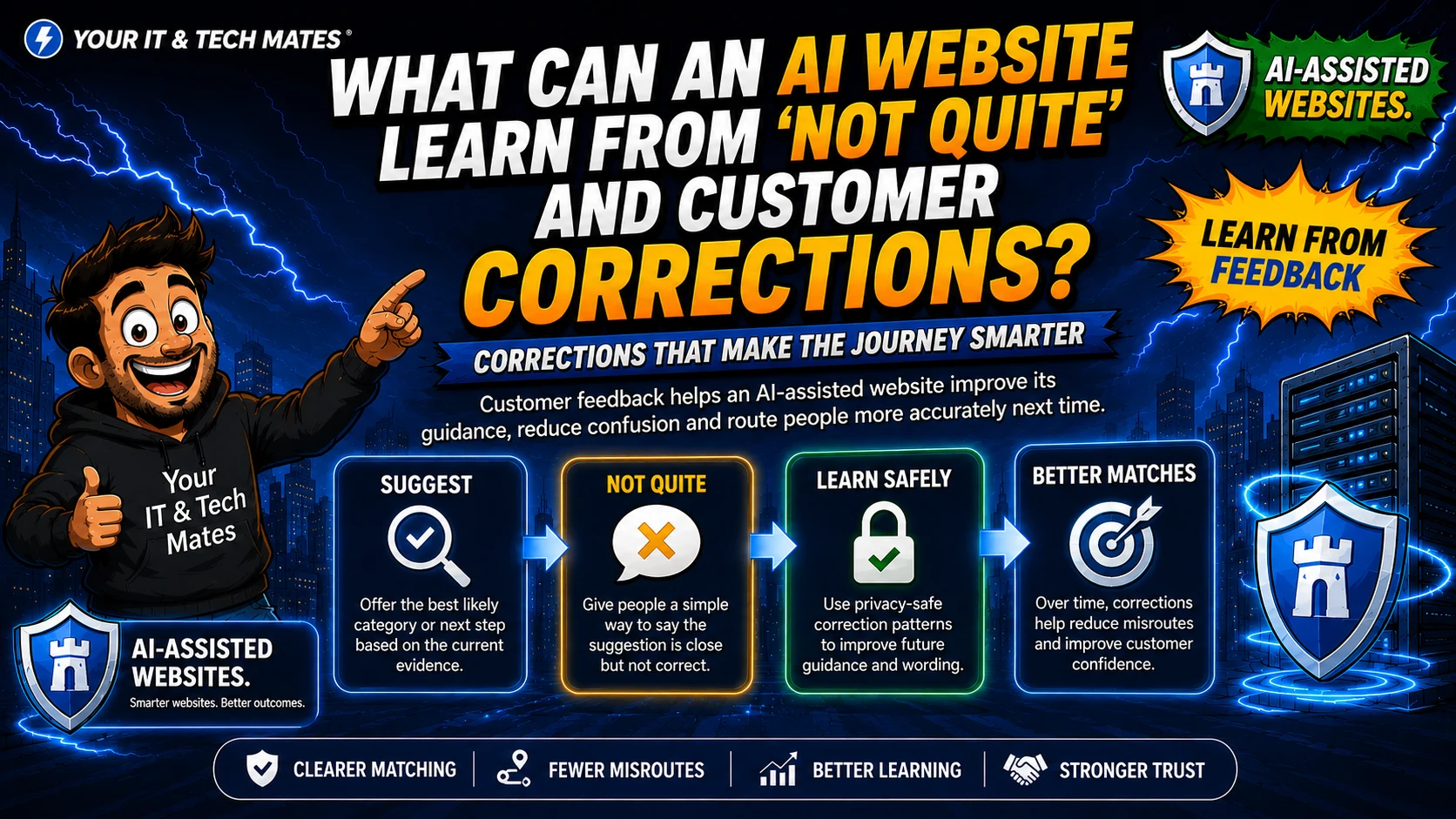
A simple Not quite correction can tell a business where an AI-assisted website is misinterpreting customer needs. The safest systems store privacy-minimised correction patterns, review them in aggregate and require human approval before changing production behaviour.
Why corrections are more useful than silent failure
If a visitor simply leaves, the business does not know why. A controlled correction creates a stronger signal: the recommendation was not right, and the customer can indicate the better help area.
Store the minimum evidence needed
Correction learning does not require saving every raw sentence forever. Useful evidence can often be represented as before/after categories, confidence bands, phrase-family aggregates and outcome counts.
Look for recurring patterns
One correction is anecdotal. Dozens of similar corrections can reveal a real mismatch: a phrase family that is routed incorrectly, a category label customers misunderstand or a confidence threshold that is too aggressive.
Keep changes governed
The learning system can recommend a synonym, routing adjustment or wording change, but the production website should change through review, testing and a controlled release.
Business benefits
Correction evidence can reduce repeated misroutes, improve customer confidence and help website language better match how real customers describe their problems.
Practical example: a correction is useful evidence
A customer might describe 'my laptop is slow' and then reject a performance-tune suggestion because the real issue is that it freezes only when connected to a dock. That correction is valuable because it shows where the first interpretation was too broad. The website does not need the customer's identity to learn that the phrase 'slow laptop' can hide a docking or display-related problem.
Useful corrections should be grouped into reviewable patterns: wrong service, wrong urgency, missing option, unclear wording or insufficient context. Staff can then decide whether to improve content, add a clarifying question or adjust an approved intent phrase.
Where it can go wrong: Do not treat a single correction as proof that the system is wrong. Look for repeated evidence and preserve the ability to say 'not sure' when the customer's wording remains ambiguous.
Related AI-assisted website guides
Continue with the guides that explain the underlying customer-experience, intent and governance ideas in more detail.
Why “not quite” is valuable evidence
A correction is often more useful than a successful first guess because it shows exactly where the system's interpretation was too broad, too narrow or simply wrong. The website should capture that correction as controlled evidence and use it to improve reviewed rules later.
Suppose a customer says “my internet is not working” and the website assumes a whole-home outage. The customer then chooses “only my laptop”. That correction tells the system to shift toward a device Wi-Fi problem. It also gives the team a useful test case for future tuning.
What should happen after a correction
- update the current journey immediately;
- do not keep repeating the rejected suggestion;
- record the correction using a safe category or phrase reference;
- review repeated correction patterns before changing production rules;
- keep the customer in control of the final request.
The important principle is simple: learn from the mistake without turning one person's correction into an automatic global rule.
Frequently asked questions
What does Not quite feedback tell an AI website?
It provides controlled evidence that the current recommendation or intent interpretation did not match the customer.
Does correction learning require storing the full conversation?
No. Privacy-minimised before/after categories and aggregate patterns can often provide useful learning evidence.
Can corrections automatically change the live website?
They should not. Repeated correction patterns are better reviewed and tested before becoming a production change.
Why are corrections useful for business?
They reveal misrouting and language mismatches that can otherwise create wasted enquiries and customer frustration.
Could your website make customer journeys easier?
Tell us where customers get stuck, repeat themselves, choose the wrong path or submit poorly matched enquiries. We can review whether clearer content, website logic, automation, custom software or bounded AI fits the problem.