
How Confidence Scores Make AI Website Recommendations Safer and More Useful
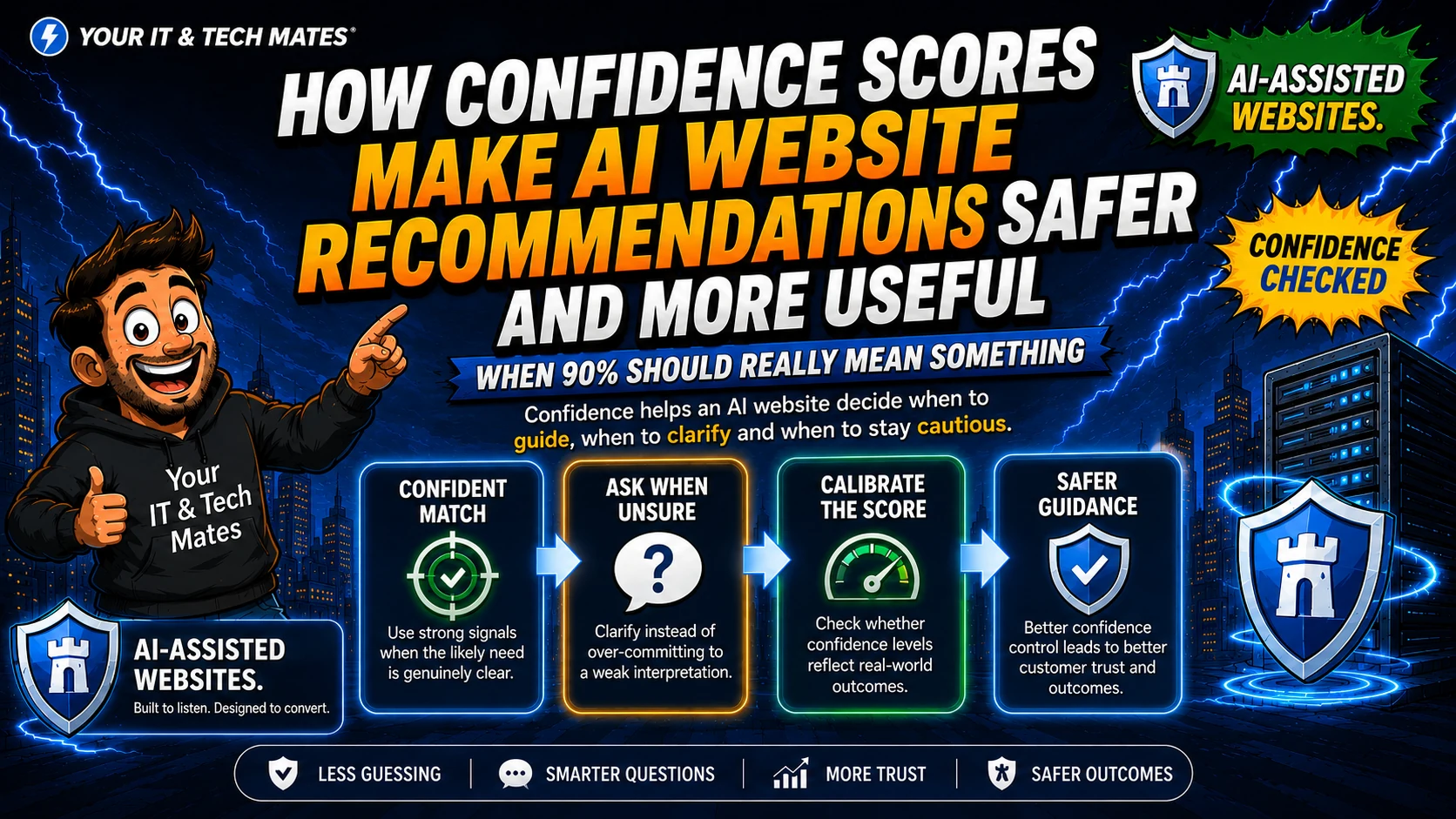
A confidence score is useful only when it is connected to real-world outcomes and used to decide when the website should guide, clarify or stay cautious.
Quick answer
Confidence scores help a website decide how strongly to act on an interpretation. But a displayed 90% should be checked against later confirmations and corrections. If high-confidence predictions are often wrong, the system needs calibration, not more confident language.
Confidence is a decision aid, not certainty
A confidence score summarises the strength of available evidence. It should not be presented as proof. The score is most useful for deciding whether to continue, ask one useful question or fall back to a safer option.
What calibration means
Calibration compares predicted confidence bands with later governed outcomes. If 90, 100% predictions are confirmed only 70% of the time, the system is overconfident. If 50, 60% predictions are confirmed 85% of the time, it may be underconfident.
Use corrections as calibration evidence
Explicit Confirm and Not quite feedback is especially useful because it provides a controlled signal about whether the website interpretation matched the customer. This can be combined with completed journeys and final intent outcomes.
Do not let confidence override safety
Safety rules, approved information and explicit customer statements should outrank confidence. A high score should never unlock risky advice or automatic action that the business has not approved.
Business benefits
Better-calibrated confidence can reduce unnecessary questions when the need is clear, avoid overconfident misrouting when it is not and make the website feel more consistent and trustworthy.
Practical example: confidence should change behaviour
If a customer writes 'screen flickers after I dropped the laptop', the website may have strong evidence for a display-related path. If they write only 'computer weird', confidence should be much lower. A confidence score is useful only when it changes what happens next: high confidence may support a direct recommendation, while lower confidence should trigger a clarifying question or a broader safe fallback.
Keep confidence tied to defined customer decisions rather than presenting a percentage as if it were a diagnosis. For technical support, the website can be confident about the next useful step while remaining explicit that a technician may still need to inspect the device.
Where it can go wrong: The biggest risk is false confidence. Test high-confidence errors separately, set conservative thresholds for safety-sensitive topics and keep an 'I am not sure' route available.
Related AI-assisted website guides
Continue with the guides that explain the underlying customer-experience, intent and governance ideas in more detail.
What a confidence score should and should not do
A confidence score is most useful when it controls how carefully the website behaves. If the system is highly confident that a customer is asking about a cracked laptop screen, it may show the relevant repair information. If confidence is lower, it should ask one useful question or present a small set of safe options instead.
The score should not become a hidden label about the person. It should describe the quality of the system's current understanding. That distinction matters because customers change direction, add a second problem and sometimes use words that can mean several things.
Safer decision pattern
- Low confidence: clarify before routing.
- Medium confidence: show a likely path but make alternatives easy.
- High confidence: reduce repetition and prepare the next useful step.
- Safety-sensitive issue: use protected rules even when commercial confidence is high.
In our approach, passive page movement can only provide a small supporting adjustment. The customer's own confirmed problem and controlled workflow signals remain more important.
Frequently asked questions
What does an AI website confidence score mean?
It represents how strongly the available evidence supports a likely interpretation; it is not proof or certainty.
What is confidence calibration?
Calibration checks whether confidence bands correspond to later confirmations, corrections and other governed outcomes.
Can high confidence remove all questions?
Only when the remaining information is genuinely unnecessary and safety or business rules do not require confirmation.
Should customers see internal confidence scores?
Usually the important customer experience is appropriate wording and next steps, not exposing internal scoring mechanics.
Could your website make customer journeys easier?
Tell us where customers get stuck, repeat themselves, choose the wrong path or submit poorly matched enquiries. We can review whether clearer content, website logic, automation, custom software or bounded AI fits the problem.