How an AI Website Can Learn From Customer Journeys Without Tracking People
A practical guide to using anonymous page, tool and action context as weak evidence while keeping explicit customer choices, privacy and human control stronger than passive browsing.
Quick answer
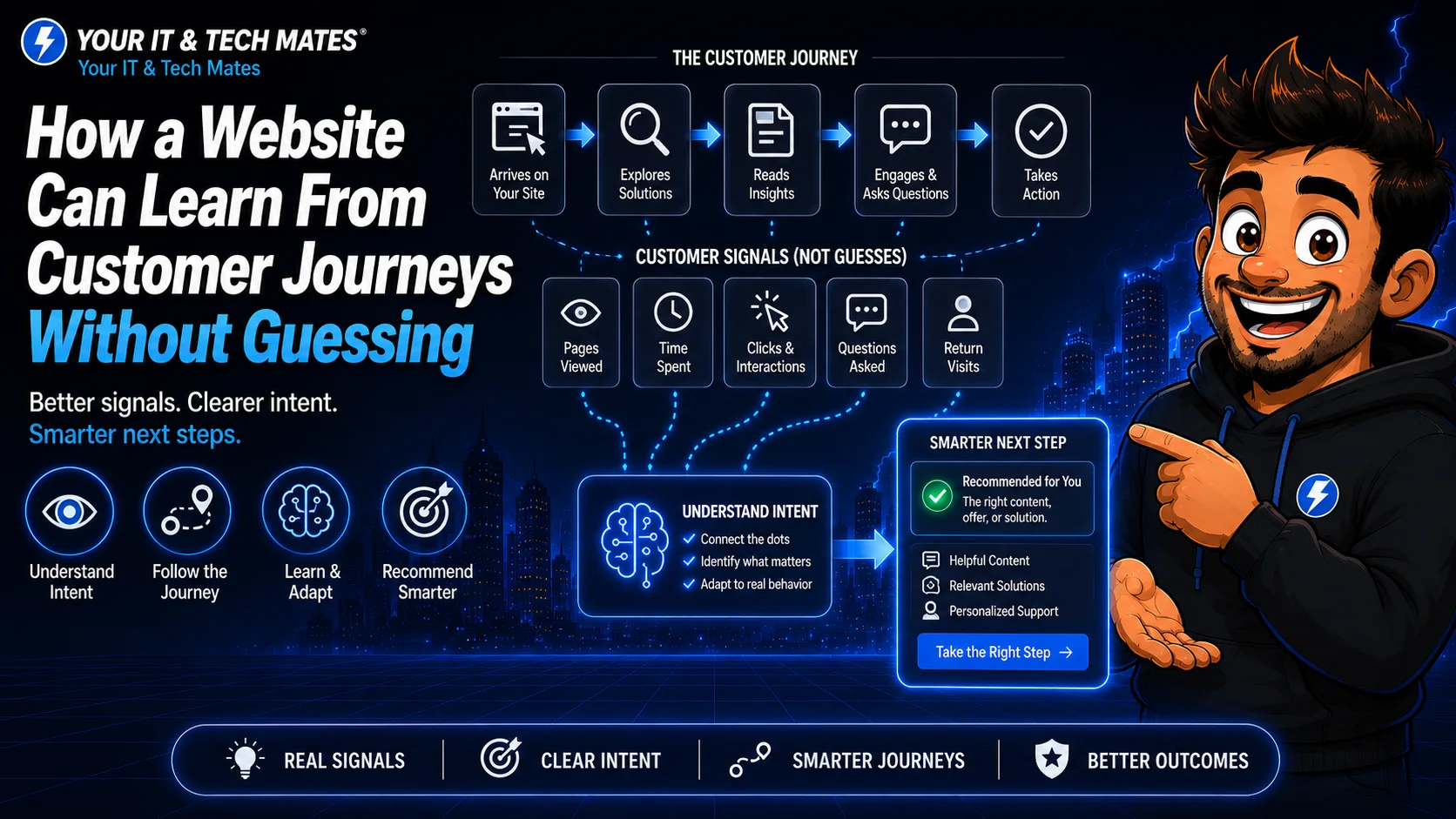
A website can learn useful patterns from how anonymous visitors move between related pages, tools and actions without treating browsing as a confirmed customer fact. The safest approach uses page activity as weak evidence, keeps identity tracking out of the learning loop and lets explicit customer input outrank inference.
From journey signals to evidence you can actually trust
The difficult part is not collecting more activity. It is deciding what different signals are allowed to mean. Our website now keeps a governed event contract for important journey actions, checks whether confidence matches later confirmed outcomes, monitors customer corrections and looks for repeated journey anomalies such as a confident recommendation followed by an immediate correction.
That means a page view is not treated as proof. A customer correction can outweigh an earlier assumption. A repeated pattern can be surfaced for review without identifying the person behind it. The goal is to learn which journeys are useful while keeping the evidence explainable and bounded.
- Governed events: stable names and controlled attributes make analytics easier to interpret consistently.
- Confidence reliability: predicted confidence can be compared with what customers later confirm.
- Customer corrections: explicit corrections are stronger than passive browsing signals.
- Drift and anomaly review: changing patterns are surfaced to people rather than silently rewriting the system.
Why businesses care
Traditional analytics tell you that a visitor opened three pages. They rarely tell you whether those pages formed a coherent help journey. A journey-aware website can recognise that a visitor moved from a laptop-repair guide to a slow-computer tool and then to repair-versus-replace advice. That pattern can help the site offer a more relevant next step without assuming who the visitor is.
What the website can learn without tracking a person
Useful journey learning can be built from privacy-minimised signals such as page category, tool started or completed, explicit CTA selection, clarification outcome and whether a visitor later reaches a useful service or enquiry path. The design does not need advertising IDs, cross-site tracking or a permanent behavioural profile to learn which sequences tend to help.
Keep passive browsing weaker than explicit intent
A visitor may open a page for research, for a family member or simply out of curiosity. That is why a page view should never silently become a confirmed requirement. Explicit wording, a customer correction and governed tool evidence should carry more authority than passive navigation. This distinction is central to trustworthy personalisation.
Business benefits
When journey context is used carefully, customers can see fewer repetitive questions, more relevant tools, smoother hand-offs and better-timed calls to action. Businesses gain clearer enquiry context and less misrouting while retaining a privacy story they can explain in plain English.
What to measure
Track whether journey-aware guidance reduces repeated questions, improves correct routing, increases completion of useful tools or requests and reduces explicit correction. Measure successful self-service too, not every good journey needs to end in a lead form.
Related AI-assisted website guides
Continue with the guides that explain the underlying customer-experience, intent and governance ideas in more detail.
Journey learning can be anonymous and still be useful
A business often needs to know where a journey works or fails, not who the individual visitor is. Privacy-aware journey learning can therefore focus on short-lived, coarse signals such as the type of page visited, whether related pages were viewed, whether a useful tool was completed and whether the customer chose to continue to a service or request.
For example, the system may learn that people reading about laptop display problems often continue to a screen-repair guide and then QuoteMe. It does not need a permanent cross-device identity to see that pattern.
Good boundaries
- keep anonymous continuity short and purpose-limited;
- do not use names, contact details or IP addresses as scoring inputs;
- treat page movement as weak evidence, not a customer fact;
- separate sensitive support journeys from ordinary sales scoring;
- give customers a clear way to forget optional return-journey memory.
This gives the website enough context to reduce repetition while avoiding the much broader tracking model used by advertising platforms.
Frequently asked questions
Does journey-aware AI require tracking individual people?
No. Useful learning can come from privacy-minimised, first-party journey signals and aggregated outcomes without creating an invasive personal profile.
Can page visits be treated as confirmed customer needs?
They should not be. Passive browsing is best treated as weak supporting evidence until the customer explicitly confirms what they need.
Can journey context improve QuoteMe or contact forms?
Yes. It can help the website avoid repetition and present more relevant questions, while the customer still reviews and submits the request.
What is the business benefit?
Better continuity can reduce friction, misrouting and wasted enquiries while preserving a clearer privacy boundary.
Could your website make customer journeys easier?
Tell us where customers get stuck, repeat themselves, choose the wrong path or submit poorly matched enquiries. We can review whether clearer content, website logic, automation, custom software or bounded AI fits the problem.
New: Intent-Aware Website business series
These newer guides show how content semantics, customer corrections, journey context and readiness signals can work together without turning ordinary browsing into certainty.