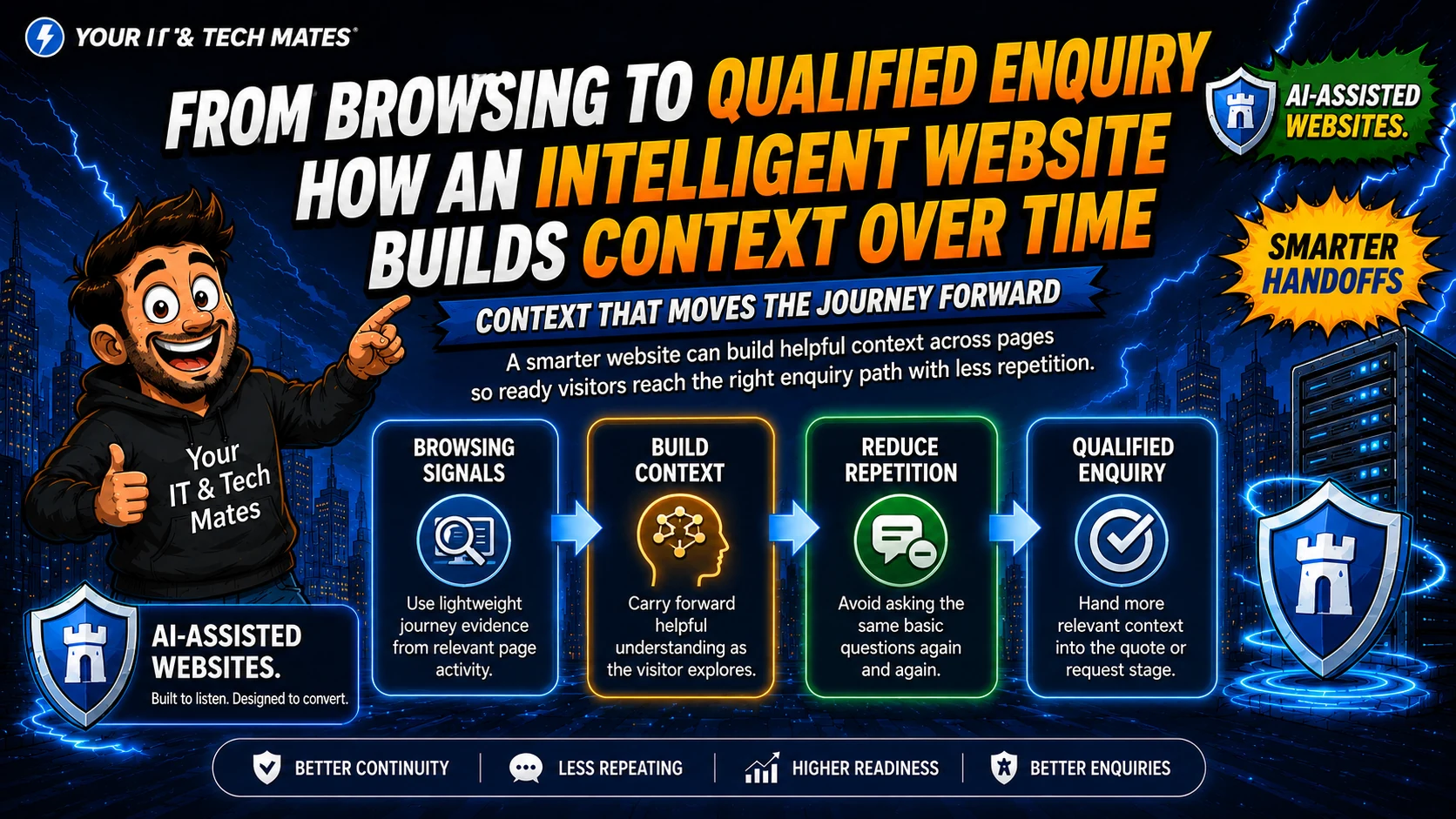
From Browsing to Qualified Enquiry: How an Intelligent Website Builds Context Over Time
Carry forward useful understanding across related pages without turning passive browsing into confirmed facts or making customers repeat themselves.
Quick answer
An intelligent website can carry bounded context from relevant pages, tools and explicit choices so the next step starts with what is already reasonably known. This can improve qualification and reduce repetition, while customer-confirmed information remains more authoritative than browsing signals.
Why context matters
Traditional websites often reset the journey on every page. A visitor reads a service guide, completes a tool and then reaches a form that asks them to explain everything again. Context continuity reduces that waste.
Build context progressively
Start with weak page semantics, then strengthen understanding when the customer uses a tool, selects a service, answers a clarification or confirms a suggestion. The context becomes more useful as stronger evidence arrives.
Keep inference separate from customer facts
The system can remember that the visitor has been exploring laptop performance content without pre-filling “my laptop is slow” as a confirmed statement. This distinction protects accuracy and trust.
Use context to shorten the handoff
When QuoteMe opens, the website can focus on genuinely missing information instead of asking the customer to repeat the entire journey. The customer still reviews what is submitted.
Business benefits
Better context can produce more complete enquiries, shorter forms, fewer abandoned requests and a smoother transition from self-service to human support.
Practical example: carry useful context into the enquiry
If a customer has already explained that a Windows laptop will not charge and the guided journey has identified a likely power or battery issue, QuoteMe should not make them choose 'computer problem' again from the beginning. It can carry the approved service context, source page and relevant answers forward while still letting the customer review or correct them.
A qualified enquiry is not one with the most fields completed. It is one that gives staff the information needed to understand the likely job and choose the next action. Carry context selectively: service category, device type, relevant symptoms and chosen support method can help; unrelated browsing history does not.
Where it can go wrong: Context must never become a hidden assumption. Show customers what will be submitted, keep editable fields editable and do not transfer sensitive information merely because it was typed elsewhere on the site.
Related AI-assisted website guides
Continue with the guides that explain the underlying customer-experience, intent and governance ideas in more detail.
How browsing context becomes useful without becoming surveillance
Context becomes useful when several related actions point in the same direction. A customer may read about a laptop symptom, open a matching repair service and then describe the problem in their own words. Together those steps make the enquiry easier to understand than any one page view on its own.
The website should still treat passive movement as weak evidence. It can use the pattern to reduce repetition or choose a more relevant next question, but it should not silently convert browsing into confirmed facts about the customer.
From weak to strong evidence
- Page view: possible interest.
- Engaged related reading: stronger topic coherence.
- Service, pricing or tool action: clearer journey stage.
- Customer description or correction: direct intent evidence.
- Reviewed request submission: explicit action.
A qualified enquiry is therefore built progressively, with the customer supplying the strongest evidence at the points that matter.
Frequently asked questions
Can an intelligent website remember context across pages?
Yes, within defined privacy and retention boundaries it can carry useful journey context across related pages and tools.
Does browsing automatically become a customer fact?
It should not. Passive browsing is weaker evidence than explicit customer wording or confirmed choices.
Can context shorten a quote form?
Yes. It can help the form focus on missing details, while the customer still reviews and submits the request.
What is the business benefit?
Less repetition can improve completion, enquiry quality and customer experience while reducing unnecessary admin.
Could your website make customer journeys easier?
Tell us where customers get stuck, repeat themselves, choose the wrong path or submit poorly matched enquiries. We can review whether clearer content, website logic, automation, custom software or bounded AI fits the problem.