
How to Improve Lead Quality Without Aggressive Tracking
Better customer context does not require a website to behave like an advertising surveillance platform.
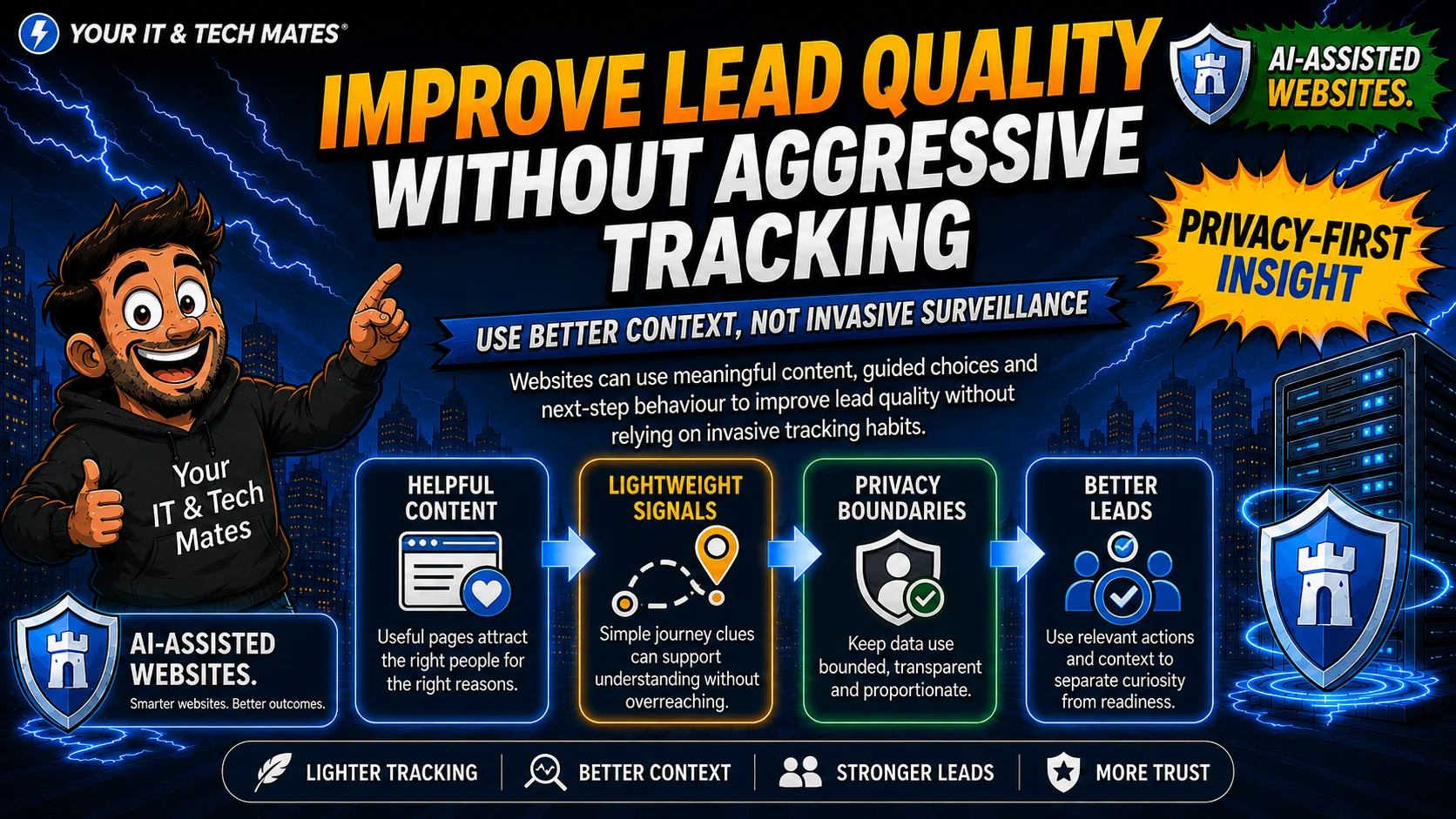
Quick answer
A business can improve lead quality with lightweight first-party context: what page the customer is using, the choices they deliberately make, the service they select and the information they choose to submit. The system does not need cross-device identity, fingerprinting or an unlimited behavioural profile to make the next step more relevant.
Why this matters for businesses
Most websites still measure success mainly through traffic, clicks and form submissions. Those numbers are useful, but they do not explain whether the customer understood the problem, followed a sensible path or reached the right service. Intent-aware design adds meaning to the journey while keeping important decisions under customer and human control.
Start with the customer-help purpose
Before collecting a signal, ask what customer problem it solves. Knowing that someone deliberately chose “compare repair or replace” can improve the next step. Knowing dozens of unrelated behavioural details often does not.
A privacy-first design minimises data because the goal is useful routing, not building the richest possible profile.
Use lightweight session context
Recent topic, journey stage and explicit choices can often be held only for the current session or a short bounded return period. Raw article text, personal identity and detailed cross-site history are unnecessary for most customer-help journeys.
This makes the system easier to explain: “We use what you are looking at during this visit to make the next question more relevant. You can correct us at any time.”
Keep sensitive journeys out of ordinary sales scoring
A person reading scam recovery, cybersecurity incident, senior-support or supported-help content may be seeking urgent or vulnerable assistance. Treating that reading as a hot sales signal would be inappropriate.
Those topics can still improve safety routing, but commercial scoring should remain zero or heavily restricted unless the customer later takes an explicit ordinary service action.
Make stronger signals deliberate
The strongest readiness evidence should come from actions the customer understands: opening pricing, selecting a service, using a diagnostic tool, starting QuoteMe or submitting a request.
This makes the score more defensible because it reflects customer choices rather than hidden inferences.
Explain what the system is doing
Trust improves when customers can understand the role of context and memory. Provide a clear privacy/memory control, explain that browsing alone does not decide the problem, and offer a way to forget remembered help suggestions.
Transparency is not only a compliance exercise. It is part of good customer experience.
How this fits with the Your IT & Tech Mates Intent Engine
Our current design separates four jobs. Content declares what a page is for. The journey layer records recent interaction and checks whether it is coherent. The Intent Engine interprets what the customer appears to need, with explicit customer wording taking priority. Commercial readiness is assessed separately from intent confidence. Keeping those responsibilities separate makes the system easier to explain, test and improve.
We also deliberately avoid the rule “more browsing equals more confidence”. Passive reading stays weak evidence, repeated behaviour has diminishing returns, and sensitive support or security topics are not treated as ordinary sales signals.
Practical takeaway for another business
Start with one high-friction customer journey. Write down the real questions customers ask, the pages that help answer them, the small number of decisions that change the next step, and the service or human handoff that should follow. Make the content useful first. Then add automation only where it removes repetition or confusion.
The result should feel less like “AI watching the customer” and more like a well-trained staff member who remembers the relevant part of the conversation, asks a sensible next question and accepts correction without argument.
Frequently asked questions
Do you need third-party tracking to understand customer journeys?
No. Many useful customer-help signals can come from first-party page context and explicit actions.
Should browsing history be stored permanently?
Usually not. Use the shortest retention that supports the customer-help purpose.
What data is unnecessary for intent routing?
Cross-device fingerprinting, unrelated browsing history and detailed personal profiles are generally unnecessary for this kind of first-party routing.
Can privacy-first systems still qualify leads?
Yes, when qualification focuses on relevant, deliberate actions rather than invasive tracking volume.
How should sensitive content be handled?
Use it for safer routing where needed, but exclude it from ordinary commercial readiness scoring.
What should the customer be told?
Explain that recent context may be used to make the next step more relevant, that browsing is not treated as certainty, and that the customer can correct or clear it.
Continue the Intent-Aware Website series
Could this approach help your business website?
If customers regularly choose the wrong form, repeat themselves, struggle to find the right service or arrive with incomplete context, an intent-aware journey may help. The first step is usually a workflow and content review, not replacing your whole website.