
How Our AI Matches Customer Problems to the Right Tech Help
Connect customer meaning to approved support categories using safe PHP rules first and governed AI when genuinely unclear.
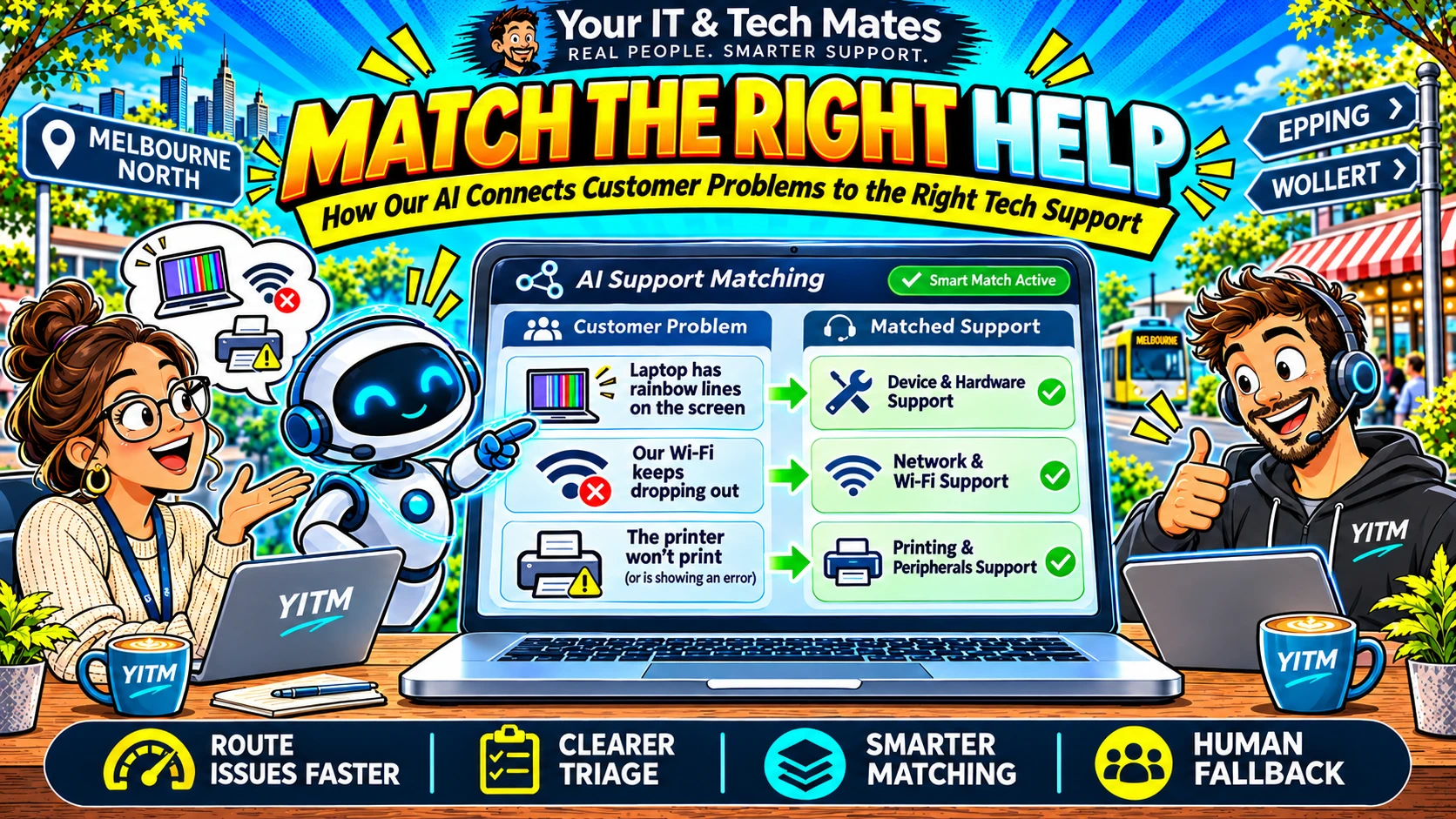
Quick answer
Connect customer meaning to approved support categories using safe PHP rules first and governed AI when genuinely unclear. This article is part of a five-part development series showing how Your IT & Tech Mates is improving its Virtual Receptionist, Intent Engine and QuoteMe. It explains the design and intended benefits; These planned improvements are still subject to engineering, regression testing and release approval. Examples are illustrative, not claims about a real customer or a completed repair.
Why we're building this
Imagine three messages: ‘The display has coloured stripes’, ‘the laptop will not start’, and ‘the Wi-Fi disappears every afternoon’. They are not three service names; they are observations. The matching engine must connect each observation to an appropriate support category without asserting the underlying cause.
An inaccurate match can send a customer through the wrong questionnaire, omit important data precautions or create an expectation about price. That is why The matching workflow treats matching as evidence-led routing rather than an automated diagnosis.
Deterministic rules first, AI for ambiguity
Clear service requests should use existing, reviewed PHP rules. A customer saying ‘My printer has a paper jam’ has already supplied a recognisable symptom. There is no benefit in spending a model call simply to restate it. When someone says ‘It goes funny only when I connect the other thing’, the context is different. The system may need a clarification or a bounded AI interpretation of the conversation.
Your IT & Tech Mates already uses a governed architecture with approved routing and controlled AI assistance for unclear language. The next stage aims to reuse that infrastructure, not add a second chatbot, promise unlimited AI or let a model decide business policy.
A real-world-style matching example
A hypothetical customer in Mernda writes ‘My screen’s got rainbow lines’. The likely category is a display problem. The system could ask whether the laptop still turns on, if that fact has not already been supplied. It should not announce ‘you need a new screen’ or automatically generate a fixed repair price.
Another customer writes ‘My laptop is slow and my internet keeps cutting out’. This can contain two separate needs. A matching engine must retain both, ask which is most urgent when that matters, and avoid silently treating the message as one generic laptop complaint.
What a good match needs to remember
The system should distinguish explicitly reported facts, facts confirmed by the customer, tentative interpretations and information that is simply unknown. It must recognise an explicit correction such as ‘Actually it’s an iPad, not a laptop’ and avoid carrying a stale laptop route into QuoteMe.
Matching is also a question of customer intention. Asking how much a repair might cost is not the same as authorising paid work. A returning customer checking a private request belongs on a verified account pathway. These safeguards remain outside any language model's discretion.
How we will assess the matching engine
Synthetic tests will include short phrases, spelling mistakes, informal descriptions, multiple devices, changes of mind, and cases with no reliable match. We will compare routing accuracy and the number of unnecessary questions with the existing baseline. We will also test what happens when the AI provider is unavailable or the budget is exhausted.
The goal for Melbourne households and small businesses is a faster route to the right human help, with clarity about what is confirmed and what still requires assessment. The engineering goal is measurable matching quality, not an impressive-looking confidence number unsupported by testing.
How Your IT & Tech Mates designs a safe matching workflow
An intelligent match must connect a customer’s observed words to an approved support category without authorising work or declaring the root cause. The existing PHP Intent Engine and EnquiryPlanner supply the foundation: known tasks use reviewed routes, while genuinely ambiguous language can be considered by the bounded AI planner, subject to evidence, cost and fallback controls.
The new matching approach will compare candidate matches with an approved semantic taxonomy, preserve multiple reported problems and record whether a route rests on explicit customer evidence or an unconfirmed interpretation. That separation matters when building software automation for other service businesses, where a bad match can create the wrong workflow.
Related reading: See how customer wording maps to approved service categories · Review the existing AI Virtual Receptionist workflow.
See the customer experience behind this development
Matching language to an approved support route begins with knowing what a customer actually said. Our earlier example, building an AI receptionist that asks better questions, explains the clarification process; here we examine the separate step of matching the answer safely.
How this connects to the existing customer journey
The Virtual Receptionist helps visitors begin with ordinary language. The existing Intent Engine interprets likely requests, and QuoteMe provides a structured, reviewable way to send an enquiry. This improvement work extends those systems rather than replacing them with a separate chatbot or uncontrolled AI agent.
For a household in Epping or Wollert, that should mean clearer technical help. For a small-business team across Melbourne’s north, it demonstrates the software design, conversational automation and controlled AI integration skills Your IT & Tech Mates is developing in its own day-to-day operations. Learn about small-business software and AI solutions.
Customer contact details, consent, private account information, diagnosis and final pricing retain their existing human and system safeguards. We will not describe a proposed improvement as live until it passes testing and release approval.
Frequently asked questions
Does matching mean a confirmed diagnosis?
No. Matching suggests an approved support category using reported evidence; the cause still needs technical assessment.
When is Azure AI used?
Only when the existing governed planner decides it is justified, and subject to provider availability, timeouts, budgets and validation.
Can the customer correct the device?
The intended workflow should preserve explicit corrections and retire stale facts rather than force an earlier guess.
Read the other articles in this series
- Part 1: Beyond Keywords: Teaching Our AI Receptionist to Understand Everyday Problems
- Part 3: You Already Told Us: Why QuoteMe Shouldn't Ask the Same Question Twice
- Part 4: How We Measure Whether Our AI Receptionist Is Actually Getting Smarter
- Part 5: Can an AI Receptionist Learn From Customers Without Making Risky Decisions?
Also see A Friendlier First Step: AI Virtual Receptionist and the related customer-language guide.
Technology help with a person behind it
Describe what is happening in your own words. Our team can review your enquiry and confirm suitable next steps; no repair or price is authorised merely by using the website assistant.