
Why Customers Shouldn’t Have to Repeat Themselves Across a Website
A customer journey should carry trusted context from page to page instead of making people start again every time they open a new tool.
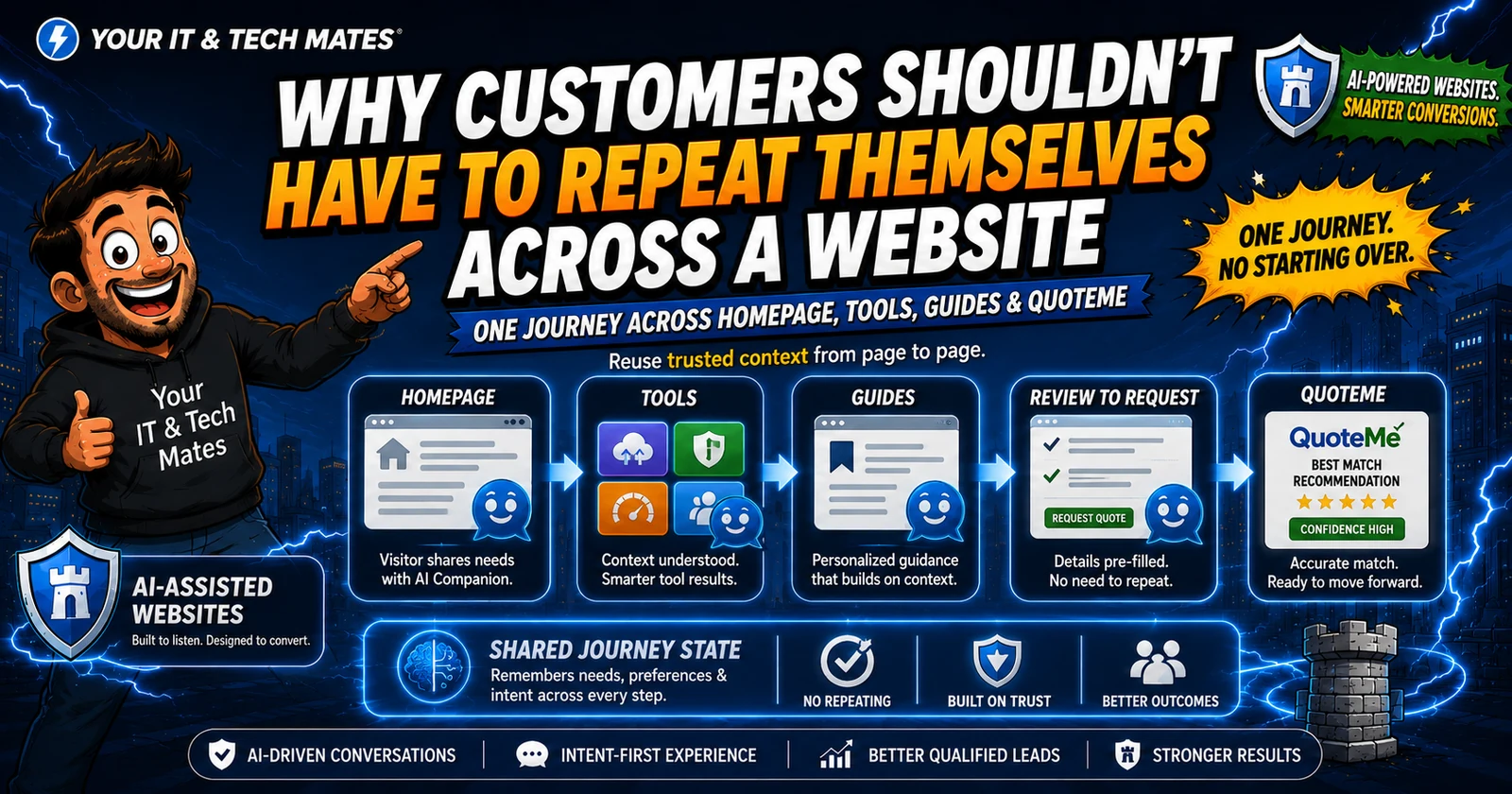
Quick answer
If a customer has already confirmed the device, problem or goal, the next page should reuse that fact instead of asking again. A shared journey state can make the website feel continuous without storing an unrestricted conversation transcript.
Why this matters
This guide is part of our Adaptive Intent & Verified Evidence series. It explains a production design principle behind a website that tries to understand the customer with fewer questions while keeping safety, external evidence and real requests governed by predefined rules and customer or human confirmation.
Why repetition breaks trust
People notice quickly when a website forgets what they just told it. Repeating “MacBook”, “charging problem” and “already tried another charger” across three pages makes the system feel disconnected even if each individual page works correctly.
Use a controlled fact ledger, not a transcript
The reusable state should store bounded facts such as device = macbook or issue = charging, together with provenance and confidence. It does not need to copy entire customer sentences or contact details into every page.
One state across the customer journey
The same journey context can be consulted by the homepage companion, governed tools, guides, Review-to-Request and QuoteMe. Each surface adds only what it genuinely learns.
Authority prevents accidental overwrites
A lower-authority inference should not replace something the customer explicitly confirmed. If the customer later reviews QuoteMe and corrects the device or issue, that reviewed correction can supersede the earlier value.
Safety can still be rechecked
No-repeat logic must not become a blanket rule. A safety policy can explicitly require a fresh confirmation when circumstances may have changed or when the previous fact is not sufficient for the current action.
The result is a calmer QuoteMe handoff
By the time the customer reaches QuoteMe, the request summary can already contain the known device, issue, relevant checks and approved evidence. QuoteMe then focuses on the information required to create the request rather than restarting the diagnosis.
Frequently asked questions
Does journey continuity mean tracking people around the web?
No. It can operate as short-lived first-party session context containing controlled service facts rather than advertising profiles or cross-site tracking.
Should the website store the whole conversation?
Not for this purpose. Bounded facts and question IDs are usually safer and easier to govern than an unrestricted transcript.
Can the customer correct remembered information?
Yes. Customer-reviewed corrections should have higher authority than earlier inferred or derived context.
What information should stay out of the reusable state?
Contact details, unnecessary identifiers and raw sensitive text should stay in the systems that genuinely require them.
How this fits with Intent Intelligence and QuoteMe
The Intent Engine is the decision controller: it interprets governed facts, decides whether another clarification materially helps and returns a readiness state. The QuoteMe Journey Controller carries approved context across the website. QuoteMe remains the only component that creates a real request after the customer reviews and submits it.
Could your website ask less and understand more?
Tell us where customers repeat themselves, choose the wrong service or need clearer evidence before the next step. We can review whether intent-driven logic, automation, structured evidence or something simpler fits the problem.