Why Smarter Websites Ask Fewer Questions as They Learn More
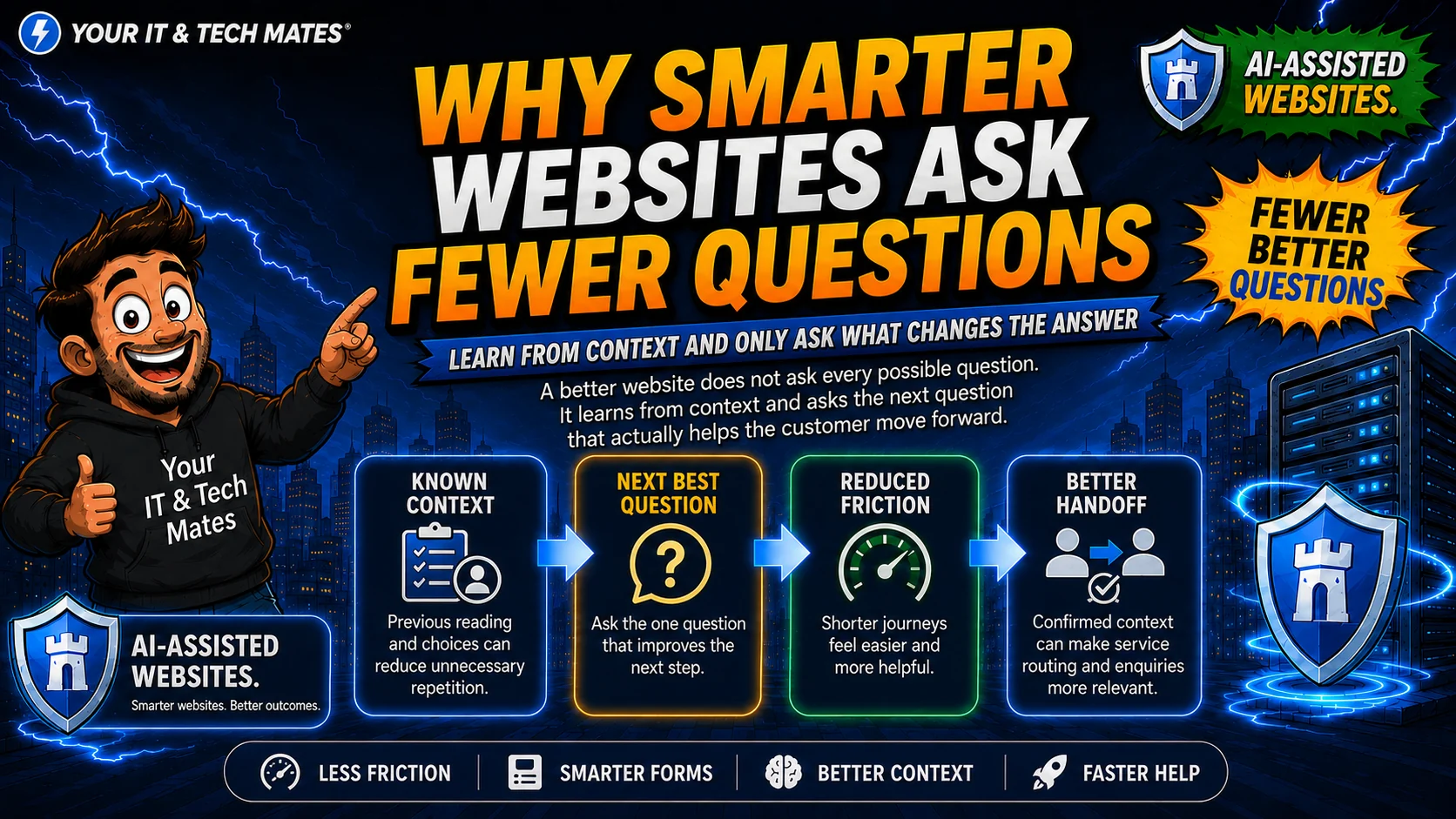
A good website should not ask everything it could ask. It should ask the one missing question that changes the next useful step.
Quick answer
As a customer journey becomes clearer, the website should reduce unnecessary questions. It can reuse confirmed context, avoid asking what is already obvious, and ask only for information that changes routing, advice, pricing guidance or the next step. Important assumptions still require confirmation.
Why this matters for businesses
Most websites still measure success mainly through traffic, clicks and form submissions. Those numbers are useful, but they do not explain whether the customer understood the problem, followed a sensible path or reached the right service. Intent-aware design adds meaning to the journey while keeping important decisions under customer and human control.
Long forms often collect information that does not change anything
Businesses add fields because the information might be useful later, but every extra question increases effort. If the answer does not change the next step, it may not belong at that stage of the journey.
A smarter workflow separates “nice to know” from “need to know now”.
Use confirmed context before asking again
If the customer has already selected a laptop display problem, the next question might be the model only if model information affects parts or pricing. Asking again whether the issue is about a laptop wastes effort.
Likewise, a business workflow enquiry should not be sent through generic device questions once the business problem is clear.
Ask the next best question, not every possible question
The best question is the one whose answer meaningfully changes the outcome. Examples include whether a Wi-Fi problem affects one device or the whole property, whether a quote already exists, or whether a customer wants repair or replacement guidance.
This principle works with deterministic rules, AI assistance or a combination of both. The intelligence comes from disciplined decision design, not from generating more conversation.
Know when to stop asking
Once the system has enough information to show a safe and useful next step, it should stop interrogating the customer. More questions can be deferred until the customer chooses to proceed.
This is especially important on mobile and for customers who prefer simple interfaces.
What businesses should audit first
Take your highest-friction enquiry form and mark every field as required for routing, required for fulfilment, optional or unnecessary. Move fulfilment questions later where possible.
Then look at what the website already knows from the customer’s explicit choices. Reusing that confirmed context is often the simplest way to shorten the journey.
How this fits with the Your IT & Tech Mates Intent Engine
Our current design separates four jobs. Content declares what a page is for. The journey layer records recent interaction and checks whether it is coherent. The Intent Engine interprets what the customer appears to need, with explicit customer wording taking priority. Commercial readiness is assessed separately from intent confidence. Keeping those responsibilities separate makes the system easier to explain, test and improve.
We also deliberately avoid the rule “more browsing equals more confidence”. Passive reading stays weak evidence, repeated behaviour has diminishing returns, and sensitive support or security topics are not treated as ordinary sales signals.
Practical takeaway for another business
Start with one high-friction customer journey. Write down the real questions customers ask, the pages that help answer them, the small number of decisions that change the next step, and the service or human handoff that should follow. Make the content useful first. Then add automation only where it removes repetition or confusion.
The result should feel less like “AI watching the customer” and more like a well-trained staff member who remembers the relevant part of the conversation, asks a sensible next question and accepts correction without argument.
Frequently asked questions
Does asking fewer questions reduce lead quality?
Not if you keep the questions that genuinely change routing or service delivery. Removing unnecessary fields can improve completion and clarity.
Should AI decide which questions are required?
AI can assist, but the business should define the approved decision logic and customer-safety boundaries.
Can previous browsing remove a question?
Only when the browsing context is sufficiently clear and the consequence is low risk. Important assumptions should still be confirmed.
What is a next-best question?
It is the smallest useful question whose answer changes the next recommendation, route or required information.
When should the website stop asking questions?
When it has enough confirmed information to provide a safe, relevant next step.
Is this useful outside AI websites?
Yes. The same principle improves ordinary forms, booking flows, support portals and service qualification.
Continue the Intent-Aware Website series
Could this approach help your business website?
If customers regularly choose the wrong form, repeat themselves, struggle to find the right service or arrive with incomplete context, an intent-aware journey may help. The first step is usually a workflow and content review, not replacing your whole website.