You Already Told Us: Why QuoteMe Shouldn't Ask the Same Question Twice
Reuse confirmed facts across the receptionist and QuoteMe, avoid duplicate questions and ask the most helpful missing question.
Quick answer
Reuse confirmed facts across the receptionist and QuoteMe, avoid duplicate questions and ask the most helpful missing question. This article is part of a five-part development series showing how Your IT & Tech Mates is improving its Virtual Receptionist, Intent Engine and QuoteMe. It explains the design and intended benefits; These planned improvements are still subject to engineering, regression testing and release approval. Examples are illustrative, not claims about a real customer or a completed repair.
Why we're building this
Suppose a customer has already written: ‘My Dell laptop has rainbow lines, but it still turns on’. They have reported a device, brand, symptom and power state. Asking again ‘What device do you have?’ makes the conversation feel forgetful. Asking ‘Does it switch on?’ is worse, because the answer has already been volunteered.
Part of good customer service is listening. This approach applies that principle to software: validated answers should follow the enquiry from Virtual Receptionist to QuoteMe, so the customer can continue rather than start over.
Reuse facts without making unsafe assumptions
Customer words are stored separately from an interpretation. A message such as ‘it seems to power on’ can support a power-state observation, but it should not be treated as a professional diagnostic test. An answer should only skip a required question when it satisfies the existing field rules and its source is trustworthy for that purpose.
Some questions still matter even when they feel repetitive. Consent, safety warnings, a material contradiction and final review cannot be silently skipped. The smarter process is selective rather than careless.
Choose the question that changes the next decision
When screen lines are known, asking their colour again adds little. Asking whether the problem happens constantly or only after a particular action may help a technician understand the situation. If the customer has already explained that too, QuoteMe should move on to another relevant fact or the review screen.
Question selection should consider relevance, uncertainty, what is known and the effort required from the customer. The system must not ask for an exact model just because a long form contains a field if a useful assessment can proceed without it.
One conversation, not duplicate forms
The intended customer journey is one visible conversation. The customer can tap an approved answer, type naturally, correct an earlier response or check the unsent summary before choosing to send a request. Staff should receive a concise, customer-reviewed description rather than a series of duplicate fragments.
For a family in Epping arranging help with a laptop, or a small-business operator in Wollert sending an IT enquiry between appointments, less repetition matters. It is a practical customer experience improvement, not just an AI feature.
How we will know it works
Planned tests will count repeated questions, fact preservation, explicit corrections, incomplete answers and whether the final QuoteMe review accurately represents the conversation. We will deliberately test ‘Not sure’, missing brands, changed devices and two issues in one message.
The result we are working towards is straightforward: customers should only be asked for information they have not already provided, unless it genuinely needs confirmation. A technician remains responsible for the final assessment and any work or pricing agreement.
How Your IT & Tech Mates designs fewer, better questions
QuoteMe already has a NextQuestionResolver for approved missing fields, and CaseMemory retains validated enquiry answers. The development challenge is making those existing parts cooperate with receptionist conversations so the same device, brand or symptom is not collected twice. This is a shared-state and validation problem, not a reason to create yet another question bank.
Your IT & Tech Mates is designing question selection around information value: a question should resolve a meaningful uncertainty, respect answers already supplied and stay within the approved intake policy. Synthetic multi-turn tests will check whether a customer can correct an earlier answer, say “Not sure” or change topic without losing genuine facts.
Related reading: Read how an AI website chooses the next useful question · See the existing AI Virtual Receptionist customer journey.
See the customer experience behind this development
Read the practical introduction, How We Built an AI Receptionist That Asks Better Questions, for the earlier customer journey. This article extends that story to remembering answers between the receptionist and QuoteMe, without claiming that an enquiry is already booked.
How this connects to the existing customer journey
The Virtual Receptionist helps visitors begin with ordinary language. The existing Intent Engine interprets likely requests, and QuoteMe provides a structured, reviewable way to send an enquiry. This improvement work extends those systems rather than replacing them with a separate chatbot or uncontrolled AI agent.
For a household in Epping or Wollert, that should mean clearer technical help. For a small-business team across Melbourne’s north, it demonstrates the software design, conversational automation and controlled AI integration skills Your IT & Tech Mates is developing in its own day-to-day operations. Learn about small-business software and AI solutions.
Customer contact details, consent, private account information, diagnosis and final pricing retain their existing human and system safeguards. We will not describe a proposed improvement as live until it passes testing and release approval.
Frequently asked questions
Will QuoteMe remember what I already said?
The existing workflow already has controlled case memory. The next improvement aims to improve consistent fact reuse and question deduplication, subject to testing.
Does continuing mean my repair is booked?
No. Preparing and reviewing an enquiry does not authorise work or confirm a booking.
What if I do not know my laptop model?
Use the provided uncertainty option or explain what you know; a technician can review the details.
Read the other articles in this series
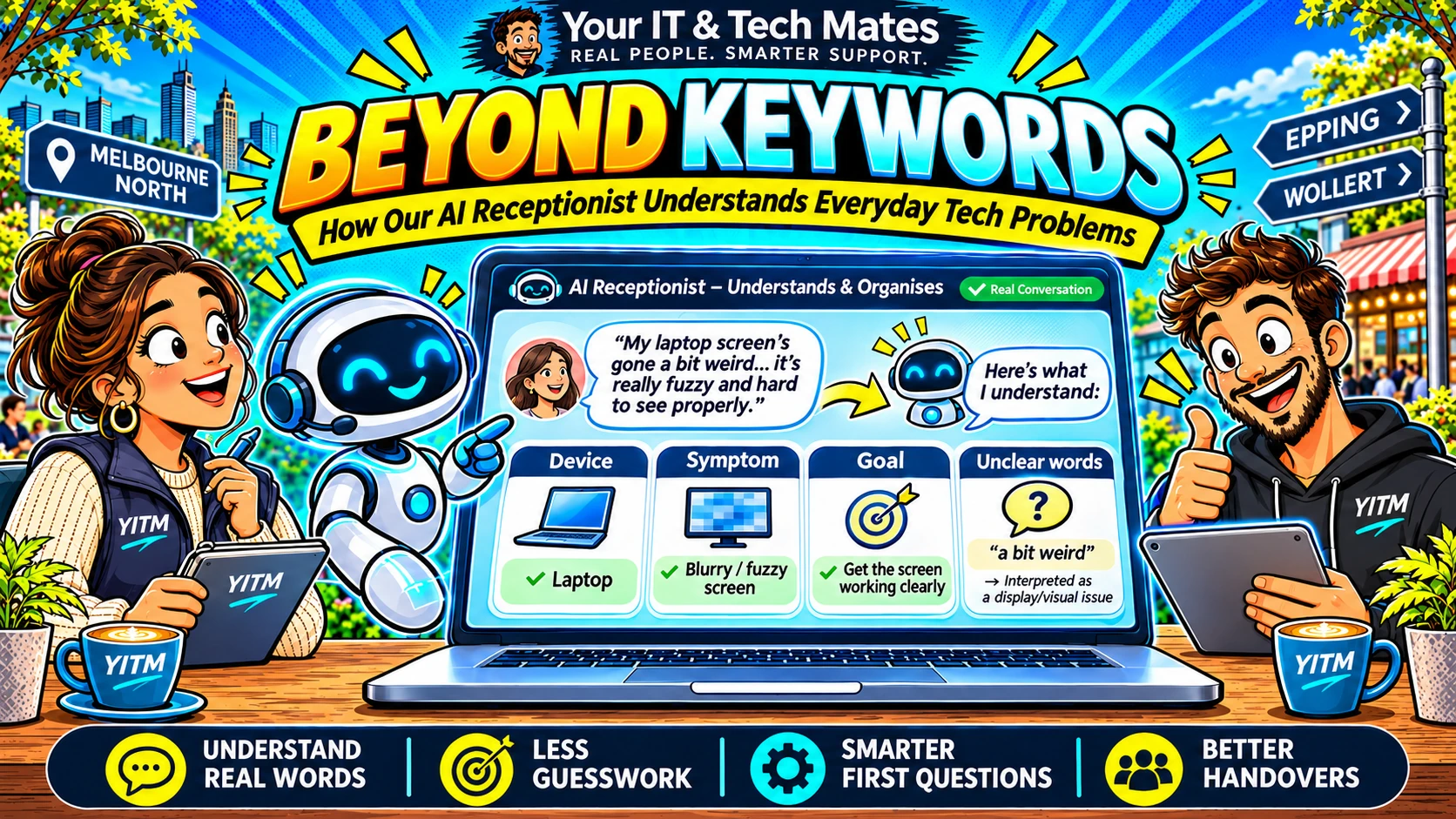
- Part 1: Beyond Keywords: Teaching Our AI Receptionist to Understand Everyday Problems
- Part 2: How Our AI Matches Customer Problems to the Right Tech Help
- Part 4: How We Measure Whether Our AI Receptionist Is Actually Getting Smarter
- Part 5: Can an AI Receptionist Learn From Customers Without Making Risky Decisions?
Also see A Friendlier First Step: AI Virtual Receptionist and the related customer-language guide.
Technology help with a person behind it
Describe what is happening in your own words. Our team can review your enquiry and confirm suitable next steps; no repair or price is authorised merely by using the website assistant.