
How We Keep AI Website Advice Current Without Letting AI Browse the Web Freely
Current external information should enter through a governed evidence pipeline, not through an LLM browsing arbitrary pages during a customer request.
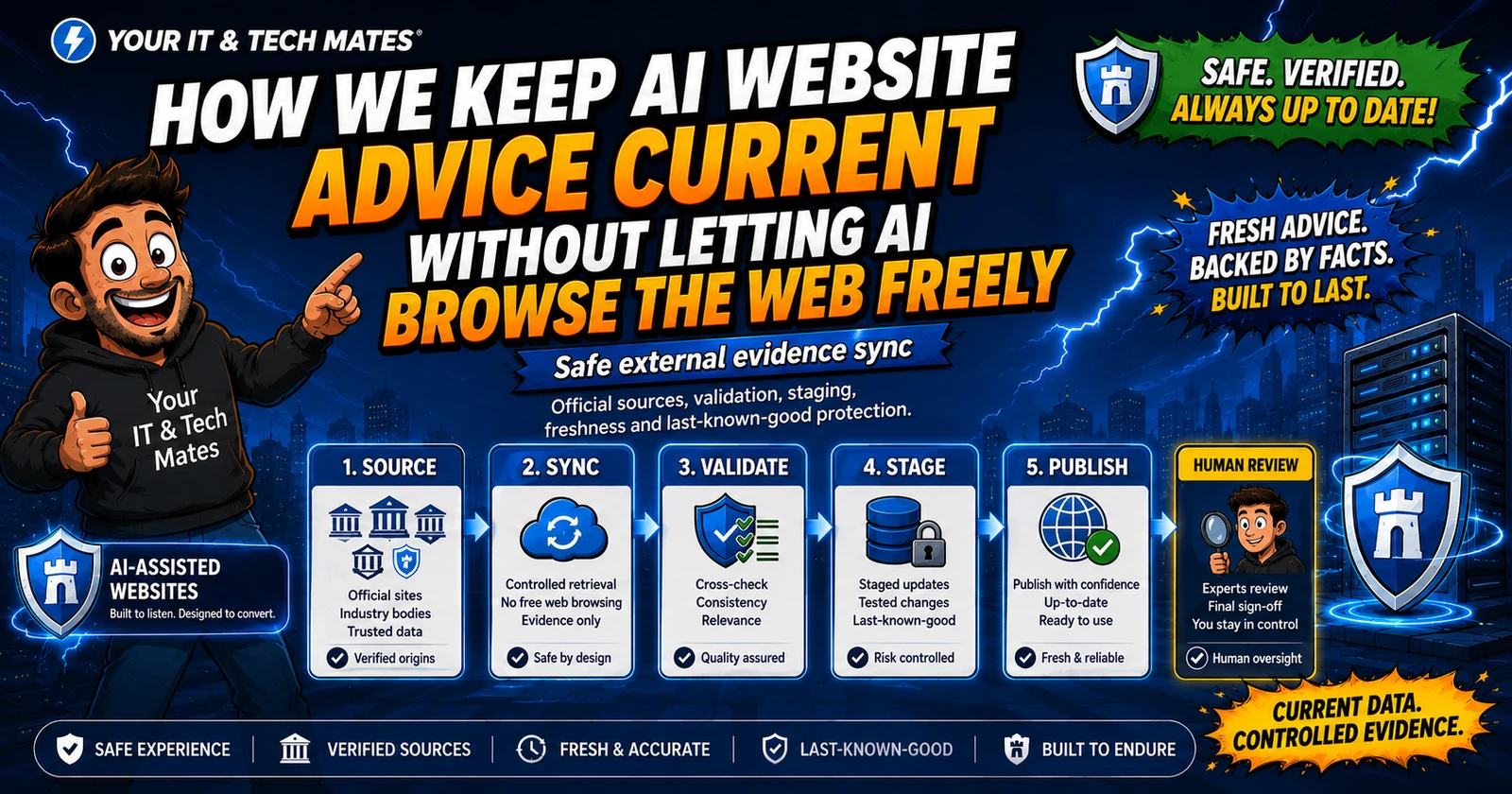
Quick answer
The safer pattern is not “customer asks → AI searches the web.” It is “approved source → scheduled server sync → validation → staging/publish → verified evidence → Intent Engine.” That keeps information current without making an LLM the source of truth.
Why this matters
This guide is part of our Adaptive Intent & Verified Evidence series. It explains a production design principle behind a website that tries to understand the customer with fewer questions while keeping safety, external evidence and real requests governed by predefined rules and customer or human confirmation.
Why live browsing is a poor source-of-truth layer
Live page retrieval during a customer request introduces latency, source outages, parser changes, inconsistent answers and weak auditability. It also makes it harder to reproduce exactly what evidence supported a recommendation.
Use scheduled server-side synchronisation
Approved sources can be refreshed by a server job on their own schedule. Microsoft or Apple lifecycle data may need a different cadence from exploited-vulnerability feeds or recall notices. The customer browser does not need to contact those sources directly.
Normalise before customer use
Each source has its own format. The sync controller converts allowed fields into a stable internal schema, validates required fields and checks that an unexpected parser failure has not suddenly reduced a feed from thousands of records to a handful.
Stage surprising changes
Some structured feeds can be published automatically after strict validation. Other sources are safer to stage for human review. A dramatic or unexpected change should not silently become customer evidence just because a fetch succeeded.
Keep the last-known-good version
If a source is unavailable or a parser fails, the system should retain the previous validated cache and mark its freshness state. Failed retrieval should not turn a working customer journey into an empty evidence registry.
Customer-facing facts remain bounded
The Verified External Facts layer decides which synced records can become customer-facing evidence, what confirmation is required and what wording is allowed. The LLM receives selected facts for explanation only; it does not get the raw feeds or authority to declare a diagnosis.
Frequently asked questions
Does the customer browser call Microsoft, Apple or CISA directly?
No. The preferred design uses scheduled server-side refreshes and a validated local evidence cache.
What happens if an external source is down?
The system can retain the last-known-good validated record and downgrade its freshness status rather than deleting it.
Can every source auto-publish?
No. Publication policy can differ by source. Structured official feeds may be suitable for strict automated validation, while changed webpage content may require human review.
Does the LLM read the entire external feed?
No. Only selected structured facts that passed matching, freshness and policy checks should reach the explanation layer.
How this fits with Intent Intelligence and QuoteMe
The Intent Engine is the decision controller: it interprets governed facts, decides whether another clarification materially helps and returns a readiness state. The QuoteMe Journey Controller carries approved context across the website. QuoteMe remains the only component that creates a real request after the customer reviews and submits it.
Could your website ask less and understand more?
Tell us where customers repeat themselves, choose the wrong service or need clearer evidence before the next step. We can review whether intent-driven logic, automation, structured evidence or something simpler fits the problem.