How a Website Can Check Product Recalls Without Claiming Your Device Is Recalled
A recall checker should distinguish evidence confidence clearly instead of jumping from a brand or product family to a definitive safety claim.
Quick answer
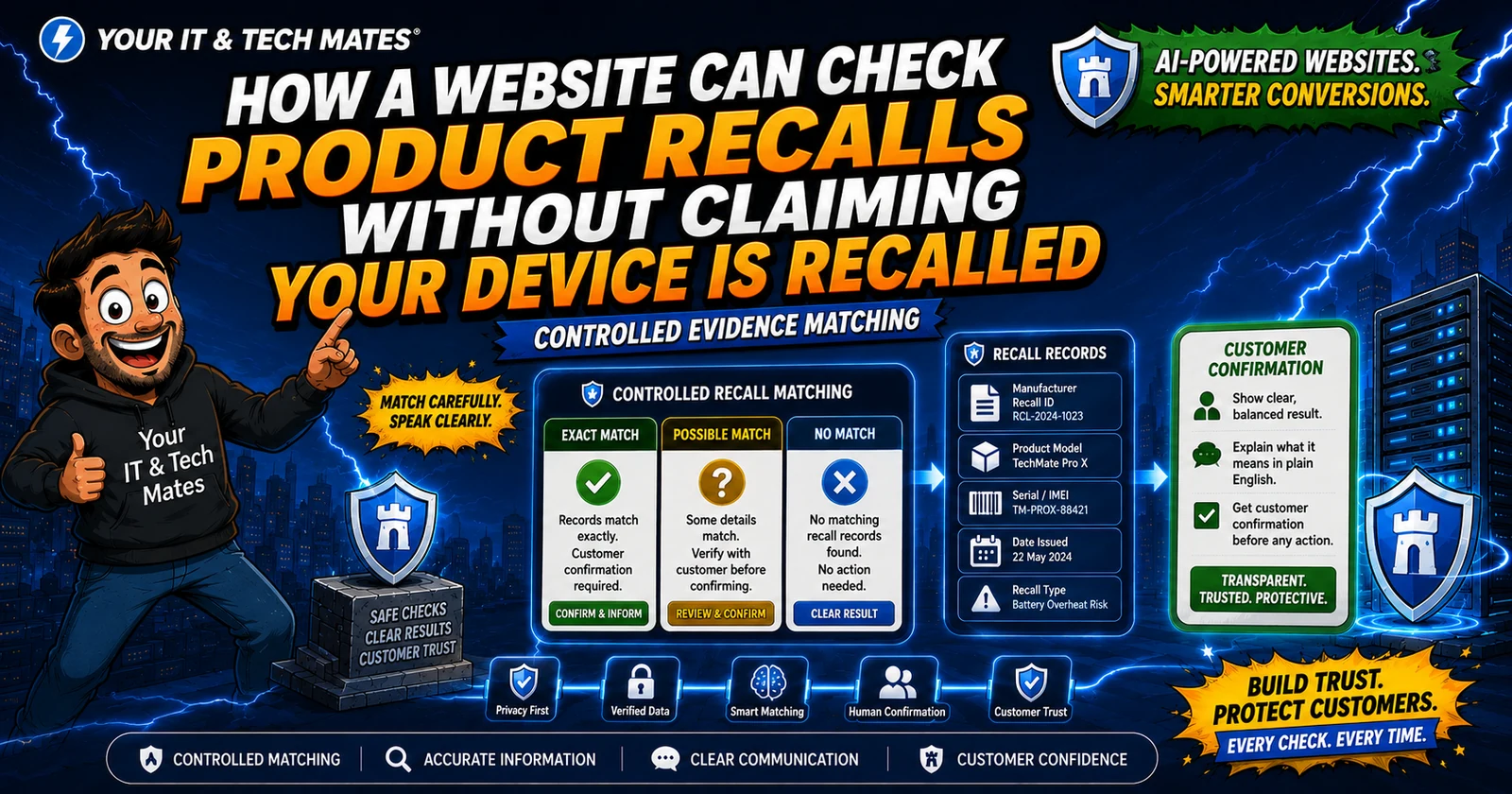
A brand or product-family similarity should not become “your device is recalled.” Controlled matching can use three outcomes: exact controlled match, possible controlled match and no controlled match, each with wording appropriate to the evidence.
Why this matters
This guide is part of our Adaptive Intent & Verified Evidence series. It explains a production design principle behind a website that tries to understand the customer with fewer questions while keeping safety, external evidence and real requests governed by predefined rules and customer or human confirmation.
Start with official recall evidence
Recall data should come from approved official sources such as Product Safety Australia and pass through the same freshness and validation controls as other external evidence.
Exact match needs an exact identifier
A customer-confirmed model, serial or batch identifier that appears in the recall record can support an exact controlled match. The important word is confirmed: the website should not infer an exact model from browser data or a generic product name.
Brand or family similarity is only possible
If the customer confirms a brand or product family and the recall appears related, that can be useful as a possible match. The wording should tell the customer to check the official model details rather than presenting the recall as fact.
No controlled match has a narrow meaning
It means the governed matcher found no approved matching record using the information currently available. It does not mean the product is safe, fully checked or free from unrelated faults.
Matching does not change lead score
Safety and recall evidence should not increase sales qualification. It exists to improve safe next steps, not to make a customer look like a better commercial lead.
The LLM explains; predefined rules match
The matching engine compares structured customer-confirmed fields with approved records. An LLM can rewrite the resulting bounded fact in plain English, but it cannot decide that something is an exact recall match.
Frequently asked questions
What makes a recall match exact?
A customer-confirmed exact identifier such as a listed model, serial or batch value must match the approved recall record under predefined rules.
Can a brand match be called a recall?
No. Brand or family similarity should remain a possible match until the official identifying details are confirmed.
Does no controlled match mean the device is safe?
No. It only means the current governed data and confirmed identifiers did not produce a match.
Can recall evidence automatically create a service request?
No. It can change safety guidance, but QuoteMe remains the customer-controlled request creator.
How this fits with Intent Intelligence and QuoteMe
The Intent Engine is the decision controller: it interprets governed facts, decides whether another clarification materially helps and returns a readiness state. The QuoteMe Journey Controller carries approved context across the website. QuoteMe remains the only component that creates a real request after the customer reviews and submits it.
Could your website ask less and understand more?
Tell us where customers repeat themselves, choose the wrong service or need clearer evidence before the next step. We can review whether intent-driven logic, automation, structured evidence or something simpler fits the problem.