
Why “No Match Found” Does Not Mean “Safe”
No controlled match is useful information, but it is not a guarantee that every relevant source, identifier or risk has been ruled out.
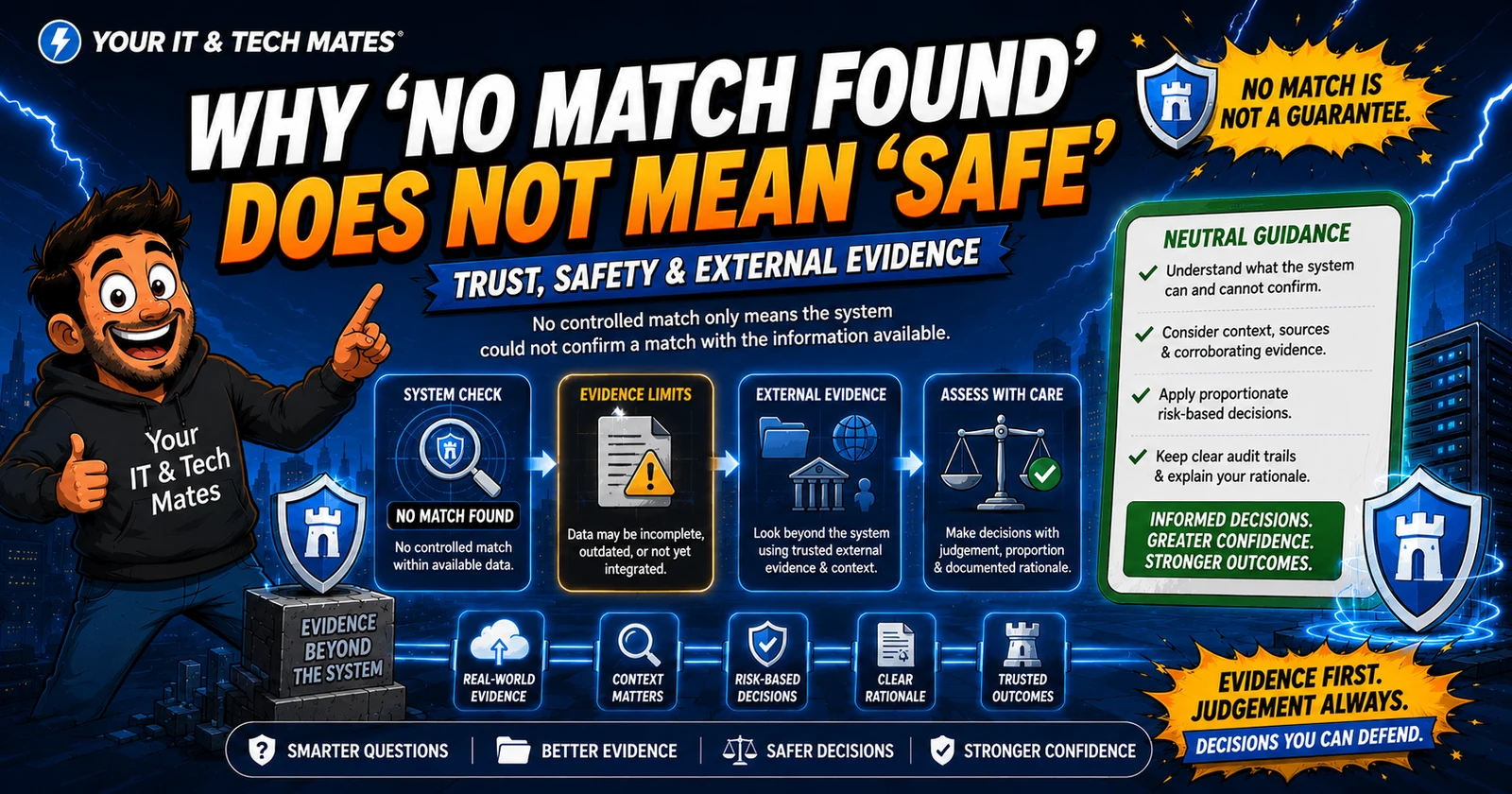
Quick answer
“No controlled match” means the governed matcher could not confirm a relevant approved record from the information available. It does not mean safe, genuine, uncompromised or fault-free.
Why this matters
This guide is part of our Adaptive Intent & Verified Evidence series. It explains a production design principle behind a website that tries to understand the customer with fewer questions while keeping safety, external evidence and real requests governed by predefined rules and customer or human confirmation.
Absence of evidence is not evidence of absence
A matcher only knows about the sources it has integrated, the records currently published and the identifiers the customer confirmed. A missing match can therefore reflect missing or incomplete information rather than the absence of risk.
External datasets have scope
A recall feed covers published recalls. A known-exploited-vulnerability catalogue covers specific vulnerabilities. Neither is a universal diagnostic system for every possible hardware, software or security problem.
Freshness matters
Even a high-quality official source can be temporarily unavailable, newly updated or awaiting the next sync. The evidence layer should expose freshness internally and use neutral guidance when a record is stale or unavailable.
Customer identifiers matter
A generic product family may be insufficient to decide whether a specific model is included. In those cases a no-match result should not be presented as stronger than the customer-confirmed evidence supports.
Neutral wording protects trust
Useful wording is “we did not find a controlled match using the information currently confirmed.” Risky wording is “your device is safe” or “there is no vulnerability.” Clear limits help customers and technicians understand what the result does and does not establish.
Safety rules still operate independently
If the customer reports swelling, smoke, burning smells, active scam activity or another safety trigger, those deterministic safety rules should take precedence regardless of whether an external evidence matcher found a record.
Frequently asked questions
Why not just say safe when nothing matches?
Because the matcher has a defined scope and may not have enough identifying information to rule out every relevant issue.
What should the website say instead?
It should describe the bounded result: no controlled match was found using the currently confirmed information and approved evidence.
Can a stale source still be used?
That depends on policy. A stale source may require neutral guidance, a visible checked date or complete suppression until refreshed.
What if the customer reports an immediate hazard?
Safety rules should take precedence over a no-match result and provide the appropriate reviewed safety pathway.
How this fits with Intent Intelligence and QuoteMe
The Intent Engine is the decision controller: it interprets governed facts, decides whether another clarification materially helps and returns a readiness state. The QuoteMe Journey Controller carries approved context across the website. QuoteMe remains the only component that creates a real request after the customer reviews and submits it.
Could your website ask less and understand more?
Tell us where customers repeat themselves, choose the wrong service or need clearer evidence before the next step. We can review whether intent-driven logic, automation, structured evidence or something simpler fits the problem.