How to Measure Whether Your AI Website Is Actually Improving Lead Quality
A practical measurement framework for businesses that want better-fit enquiries, clearer routing and stronger conversion quality, not simply more form submissions.
Quick answer
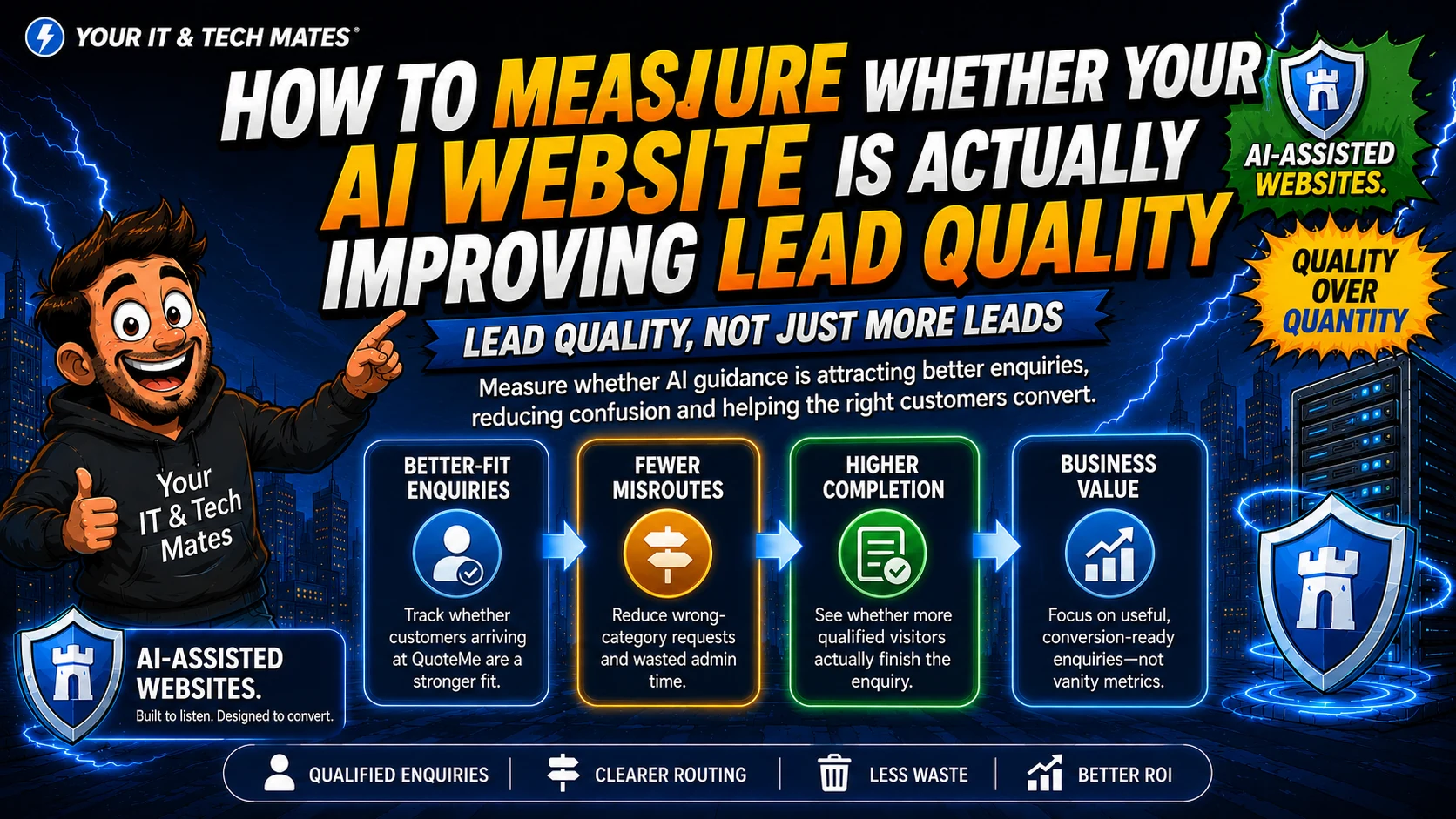
An AI-assisted website is improving lead quality when more enquiries match the right service, customers arrive with useful context, fewer requests are misrouted and completion improves without increasing pressure or unnecessary questions. Raw lead count alone is not enough.
Start with lead quality, not lead volume
A website can increase form submissions by showing a quote button everywhere. That does not mean it is helping the business. Better measurement asks whether the right customers are reaching the right request path with enough useful information for the business to respond efficiently.
Four practical lead-quality measures
Measure service fit, routing accuracy, request completion and usable context. Service fit asks whether the request matches what the business actually offers. Routing accuracy looks at whether the correct team or service receives it. Completion shows whether qualified visitors can finish. Usable context asks whether the request contains information that helps the next human action.
Add customer-effort signals
A high-quality lead journey should not require endless questions. Track clarification count, repeated questions, corrections and time to a useful next step. A small increase in qualification is not valuable if it creates a large increase in friction.
Separate intent confidence from readiness
Knowing what someone likely needs is different from knowing whether they are ready to request help. A visitor can have a clear intent and still be researching. Another visitor can be ready to act while their problem description remains vague. Measuring these separately produces better-timed CTAs.
Turn measurement into improvement
Review patterns by journey and intent. If a particular tool-to-quote path produces stronger, more complete enquiries, make that path easier to find. If a CTA gets clicks but later produces corrections or abandonment, test a better next step rather than optimising the click itself.
Practical example: a smaller number of better enquiries can be a win
If a website change reduces QuoteMe submissions from 100 to 85 but cuts clearly mismatched enquiries from 25 to 5, staff may receive fewer leads yet spend much less time correcting them. Lead quality should therefore include service match, enough actionable information, correct location or eligibility, and whether the proposed next step made sense.
A practical scorecard can separate customer fit, information completeness and routing correctness instead of hiding everything inside one opaque score. Staff feedback should remain part of the loop because an enquiry that looks complete to software may still be difficult to action.
Where it can go wrong: Do not optimise for expensive jobs or exclude customers merely because a model predicts low commercial value. Quality in a support context means appropriate and actionable, not simply profitable.
Related AI-assisted website guides
Continue with the guides that explain the underlying customer-experience, intent and governance ideas in more detail.
Frequently asked questions
What is AI website lead quality?
Lead quality is the usefulness and fit of an enquiry: whether it reaches the right service, contains relevant context and is actionable for the business.
Should I optimise for more QuoteMe submissions?
Not by itself. More submissions can create more waste if the visitors are poorly matched or the request lacks useful context.
What should I compare over time?
Compare routing accuracy, correction rate, completion, customer effort and downstream usefulness alongside lead volume.
Can successful self-service count as a positive outcome?
Yes. A visitor who gets the right answer without needing a request can still represent a successful customer journey.
Could your website make customer journeys easier?
Tell us where customers get stuck, repeat themselves, choose the wrong path or submit poorly matched enquiries. We can review whether clearer content, website logic, automation, custom software or bounded AI fits the problem.
New: Intent-Aware Website business series
These newer guides show how content semantics, customer corrections, journey context and readiness signals can work together without turning ordinary browsing into certainty.