Why More Page Views Don’t Mean Hotter Leads
A visitor who reads ten pages is not automatically a better lead than someone who reads one useful page and takes a clear next step.
Quick answer
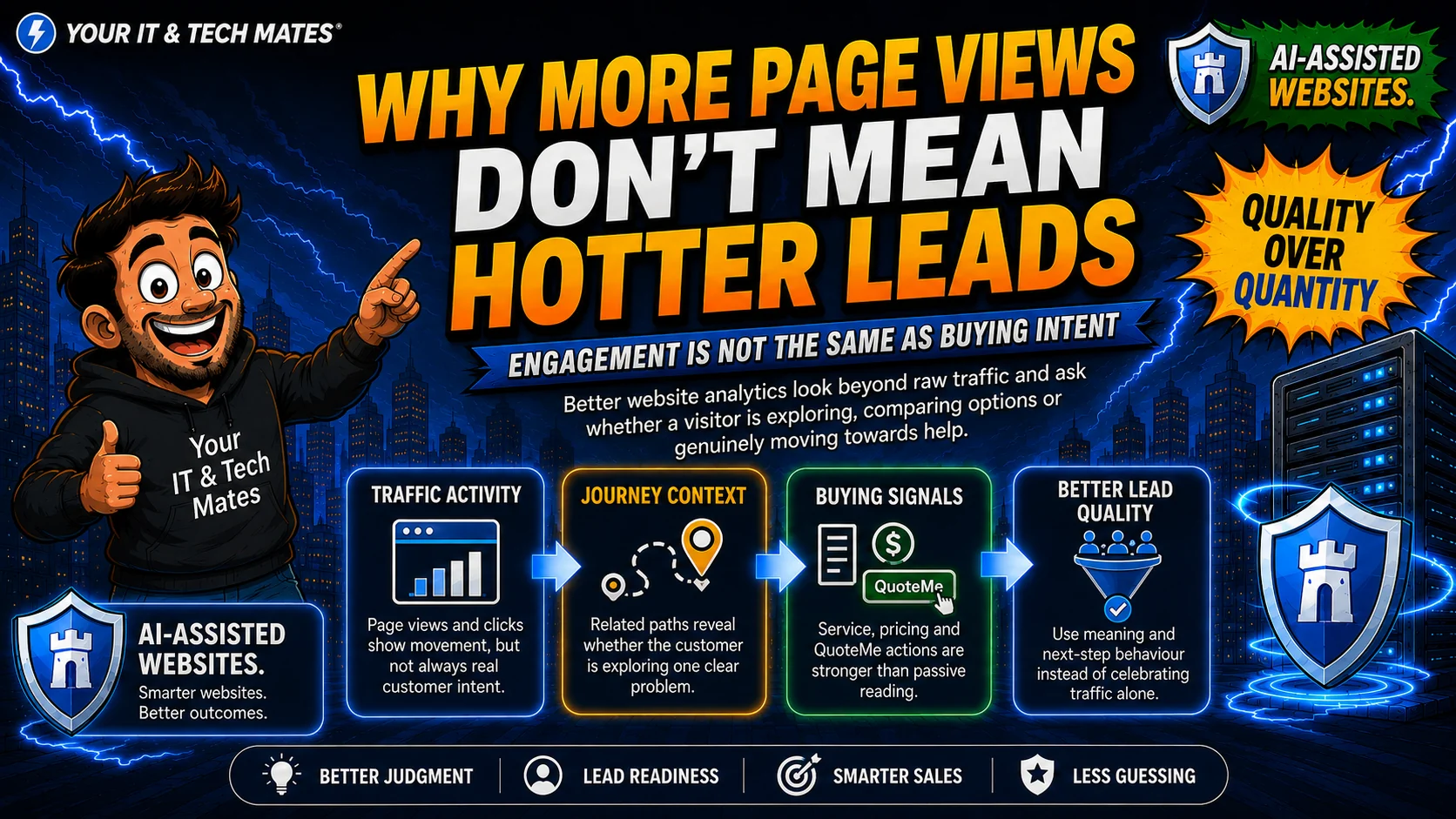
Page views measure activity, not readiness. Better lead qualification looks at whether recent actions are relevant to the customer’s current need, whether the journey is coherent, and whether the customer has moved from reading into deliberate comparison, service selection or enquiry behaviour.
Why this matters for businesses
Most websites still measure success mainly through traffic, clicks and form submissions. Those numbers are useful, but they do not explain whether the customer understood the problem, followed a sensible path or reached the right service. Intent-aware design adds meaning to the journey while keeping important decisions under customer and human control.
Why “more engagement” can be misleading
A visitor may open many pages because they are confused, researching a school assignment, comparing competitors, or helping someone else. High engagement can be useful, but it is not the same as commercial intent.
If a website automatically turns page count into a “hot lead” score, staff may chase the wrong enquiries while missing customers who took a small number of high-value actions.
Separate intent confidence from readiness
There are two different questions. First: what does this person appear to need? Second: are they ready to act on that need? An intent engine helps with the first. Readiness scoring helps with the second.
A visitor can have a very clear need but still be researching. Another visitor can be ready to request help after one service page because they already know what they want. Keeping the scores separate makes staff action more sensible.
Use an evidence hierarchy instead of a page counter
Passive article views should contribute little or nothing to commercial readiness. Engaged reading can add a small amount when it is relevant. Deliberate “compare options” choices, tool completion, service visits, pricing checks and QuoteMe progression are progressively stronger.
The system should also apply diminishing returns. Reading a fourth article on the same topic can confirm a pattern, but reading another twenty should not keep increasing the score.
Relevance matters more than volume
If the current need is Wi-Fi support, a visit to a Wi-Fi service page is meaningful. A visit to a careers page is not. Semantic relevance prevents unrelated activity from inflating readiness.
This is where content metadata helps. When each page declares its topic, goal and journey stage, the scoring authority can judge whether the action supports the current customer need rather than merely counting clicks.
What staff should see
A useful staff view should show a plain-English band such as Exploring, Interested, Considering Help or Ready for Help, plus the reasons behind it. “Viewed pricing, chose compare options and opened QuoteMe” is more useful than a mysterious score of 73.
Explainability also makes tuning safer because you can see which behaviours are actually moving people toward a confirmed enquiry.
How this fits with the Your IT & Tech Mates Intent Engine
Our current design separates four jobs. Content declares what a page is for. The journey layer records recent interaction and checks whether it is coherent. The Intent Engine interprets what the customer appears to need, with explicit customer wording taking priority. Commercial readiness is assessed separately from intent confidence. Keeping those responsibilities separate makes the system easier to explain, test and improve.
We also deliberately avoid the rule “more browsing equals more confidence”. Passive reading stays weak evidence, repeated behaviour has diminishing returns, and sensitive support or security topics are not treated as ordinary sales signals.
Practical takeaway for another business
Start with one high-friction customer journey. Write down the real questions customers ask, the pages that help answer them, the small number of decisions that change the next step, and the service or human handoff that should follow. Make the content useful first. Then add automation only where it removes repetition or confusion.
The result should feel less like “AI watching the customer” and more like a well-trained staff member who remembers the relevant part of the conversation, asks a sensible next question and accepts correction without argument.
Frequently asked questions
Are page views useless?
No. They can provide weak context and help identify coherent journeys, but they should not be treated as direct buying intent.
What is a stronger readiness signal?
Relevant service, pricing, tool and QuoteMe actions are stronger because they represent more deliberate progress.
Should every business use lead scoring?
No. It is most useful when staff need help prioritising or understanding a larger enquiry flow.
Can the score be wrong?
Yes. That is why it should remain explainable, bounded and secondary to explicit customer information.
Should safety or scam content increase a sales score?
No. Safety and supported-help content can improve routing but should not be treated as ordinary commercial readiness.
What is the best first metric to improve?
Start with the quality of confirmed enquiries and the actions that consistently happen before those enquiries, not raw traffic volume.
Continue the Intent-Aware Website series
Could this approach help your business website?
If customers regularly choose the wrong form, repeat themselves, struggle to find the right service or arrive with incomplete context, an intent-aware journey may help. The first step is usually a workflow and content review, not replacing your whole website.