How AI Can Find Where Customers Get Stuck Between Website Pages
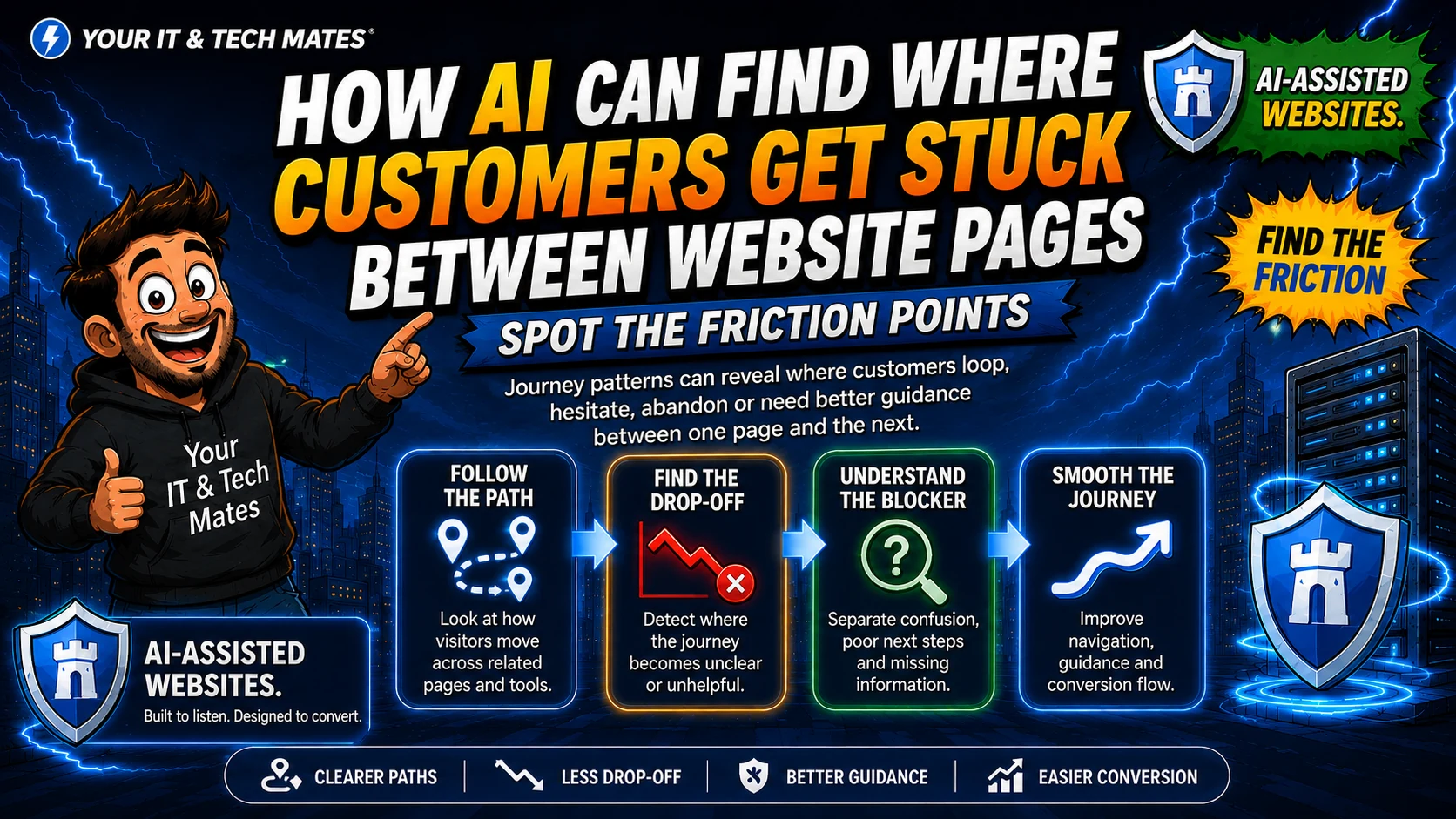
The problem is often not one bad page. It is the transition between pages, tools and next steps where customers lose context or confidence.
Quick answer
AI-assisted journey analysis can identify repeated loops, corrections, clarification failures and explicit abandonment around page transitions. That evidence helps businesses find where navigation or next-step guidance is creating friction.
Look at transitions, not isolated pages
A service page can be perfectly written and still send visitors into an unhelpful next step. Journey analysis examines the edges between pages: service → tool, guide → pricing, tool → QuoteMe and other transitions.
Find the signals of friction
Useful signals include repeated back-and-forth movement, correction after a transition, multiple clarifications, an explicitly abandoned workflow or a tool result followed by an unrelated branch. No single signal proves a problem, but repeated patterns deserve review.
Understand the blocker before redesigning
Friction can come from unclear labels, missing information, the wrong CTA, excessive questions or a mismatch between the page promise and the destination. The fix depends on the cause.
Use qualitative and quantitative evidence together
Journey analytics can show where problems cluster. Customer feedback and support conversations can explain why. Combining both produces better redesign decisions than relying on bounce rate alone.
Business benefits
Smoother transitions can reduce customer effort, increase successful self-service and improve conversion quality because visitors arrive at the right action with better context.
Practical example: friction between pages
A customer may begin on a laptop repair page, move to pricing, open QuoteMe and then go back to the repair page because they still do not know whether pickup is available. Each page can look fine in isolation while the journey as a whole is confusing. A useful friction signal is not simply that the customer changed pages; it is that they repeatedly moved between the same decision points without getting closer to a clear next step.
A better review groups journeys by customer need, then looks for repeated loops, abandoned handoffs and unnecessary questions. The fix may be content rather than AI: for example, showing pickup eligibility earlier, carrying the known service context into QuoteMe, or adding one plain-English sentence that answers the uncertainty before the customer leaves the page.
Where it can go wrong: Do not treat every back click or long visit as failure. People compare options and reread information for good reasons. Use aggregated journey patterns, confirmed outcomes and customer feedback together, and avoid building individual profiles just to measure friction.
Related AI-assisted website guides
Continue with the guides that explain the underlying customer-experience, intent and governance ideas in more detail.
A practical way to read movement between pages
A useful journey signal is not simply that somebody opened two pages. The important question is whether the movement makes sense. For example, a customer who reads about a slow laptop, then opens a repair guide, then checks pricing is showing a coherent path from learning to considering help. A customer who jumps between unrelated pages may simply be browsing.
That is why page movement should be treated as supporting evidence, not as proof of intent. A good system combines the path with stronger signals such as the customer describing the problem, choosing a relevant service, opening a quote flow or correcting the website's understanding.
What to look for
- repeated movement around the same problem area;
- a move from education to a matching service or tool;
- where people repeatedly go backwards or abandon the path;
- whether the next page answers the question created by the previous page.
This helps a business improve navigation and wording without pretending that every page view means a customer is ready to buy.
Frequently asked questions
Can analytics show exactly why a customer left?
Not reliably from an exit alone. Stronger analysis combines repeated journey patterns with explicit feedback or controlled outcome signals.
What is a journey transition?
It is the move from one page, tool or workflow step to another, such as a service page to a diagnostic tool.
What are common website friction points?
Unclear labels, irrelevant next steps, repeated questions, missing information and broken context between pages are common causes.
How can AI help?
AI can help group repeated journey patterns and surface likely friction areas for human review and testing.
Could your website make customer journeys easier?
Tell us where customers get stuck, repeat themselves, choose the wrong path or submit poorly matched enquiries. We can review whether clearer content, website logic, automation, custom software or bounded AI fits the problem.