
Why the Same Question Can Be Useful for One Customer and Unnecessary for Another
A question is not universally useful. Its value depends on the customer’s actual journey, the decision being made and what is already known.
Quick answer
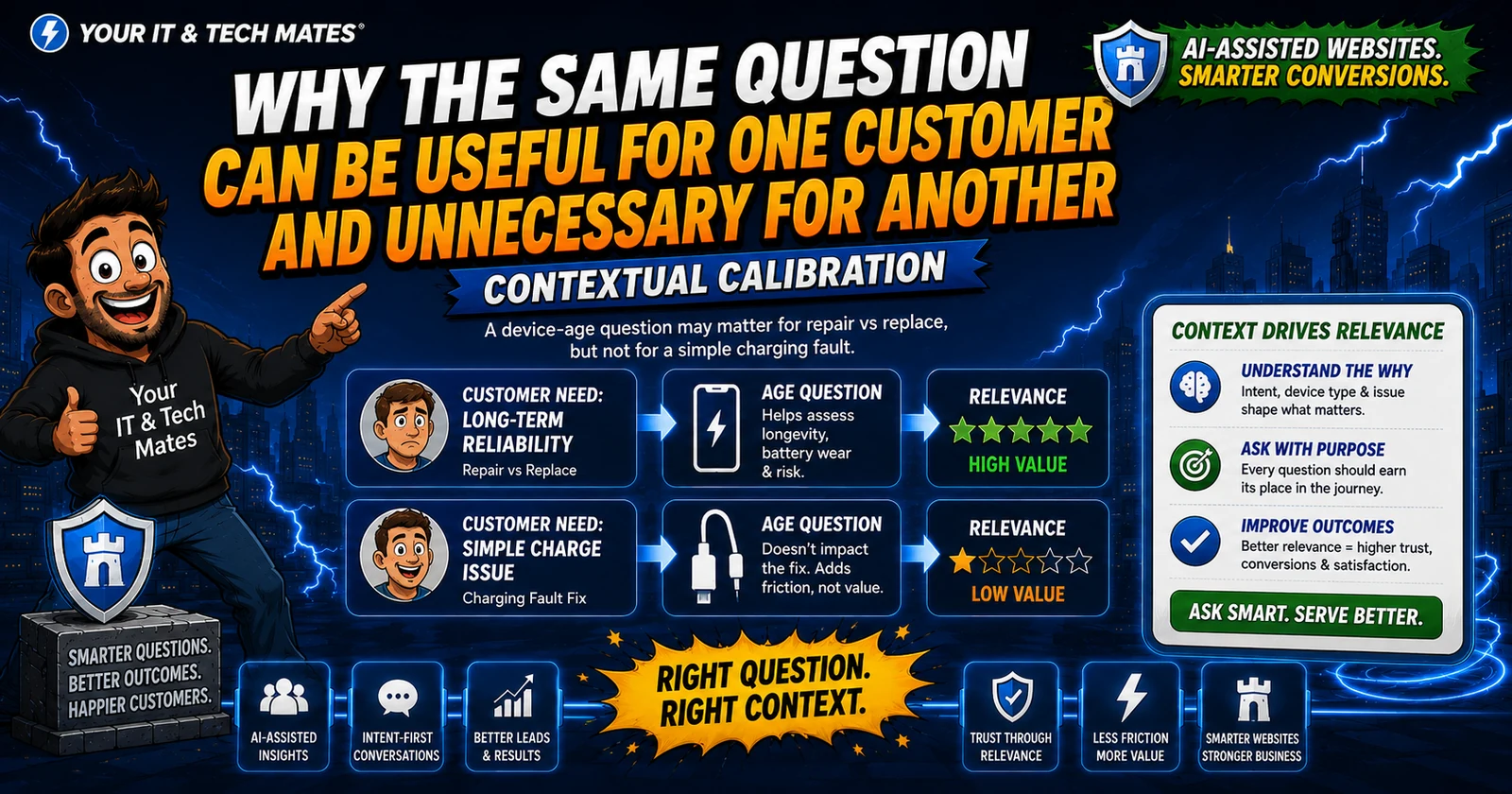
A global question score can hide important differences. Device age may strongly affect a repair-versus-replace decision while adding very little to a simple charging fault. Contextual calibration lets the same governed question carry different evidence-based value in different journeys.
Why this matters
This guide is part of our Adaptive Intent & Verified Evidence series. It explains a production design principle behind a website that tries to understand the customer with fewer questions while keeping safety, external evidence and real requests governed by predefined rules and customer or human confirmation.
Global averages can mislead
Imagine half your customers use a device-age question for replacement decisions and half use it for simple charger faults. One global average can make the question look moderately useful everywhere, even if it is excellent in the first journey and mostly friction in the second.
Use controlled journey contexts
A practical system can group evidence into bounded contexts such as repair/replace, battery charging, storage performance, device lifecycle, network connectivity, data recovery and scam/security. These are controlled categories, not arbitrary AI-generated labels.
Context-specific evidence needs enough traffic
Smaller segments create noisier statistics. The system should use context-specific calibration only after that context reaches its own minimum sample threshold.
Use hierarchical fallback
When a context has insufficient evidence, fall back to the approved global calibration. If no global calibration is approved, fall back again to the original governed question weight. This makes the system more precise without becoming unstable.
Context changes ranking, not authority
A contextual multiplier can refine the decision and booking value used to rank ordinary questions. It does not override safety, introduce new questions or let analytics bypass the controlled question registry.
The customer experiences less friction
The technical benefit is calibration. The customer benefit is simpler: fewer irrelevant questions. A charging customer should not be asked repair-value questions simply because those questions are useful somewhere else on the site.
Frequently asked questions
What is contextual calibration?
It means calibrating a question’s predicted value within a controlled journey context rather than assuming one global value fits every customer need.
What happens when there is not enough context data?
The system falls back to the global approved calibration or the original governed weight.
Can contexts be generated freely by an LLM?
They should not be. Controlled contexts are easier to audit and keep stable across analytics and production routing.
Does contextual calibration add more customer questions?
The aim is the opposite: improve ranking precision so fewer low-value questions are asked.
How this fits with Intent Intelligence and QuoteMe
The Intent Engine is the decision controller: it interprets governed facts, decides whether another clarification materially helps and returns a readiness state. The QuoteMe Journey Controller carries approved context across the website. QuoteMe remains the only component that creates a real request after the customer reviews and submits it.
Could your website ask less and understand more?
Tell us where customers repeat themselves, choose the wrong service or need clearer evidence before the next step. We can review whether intent-driven logic, automation, structured evidence or something simpler fits the problem.