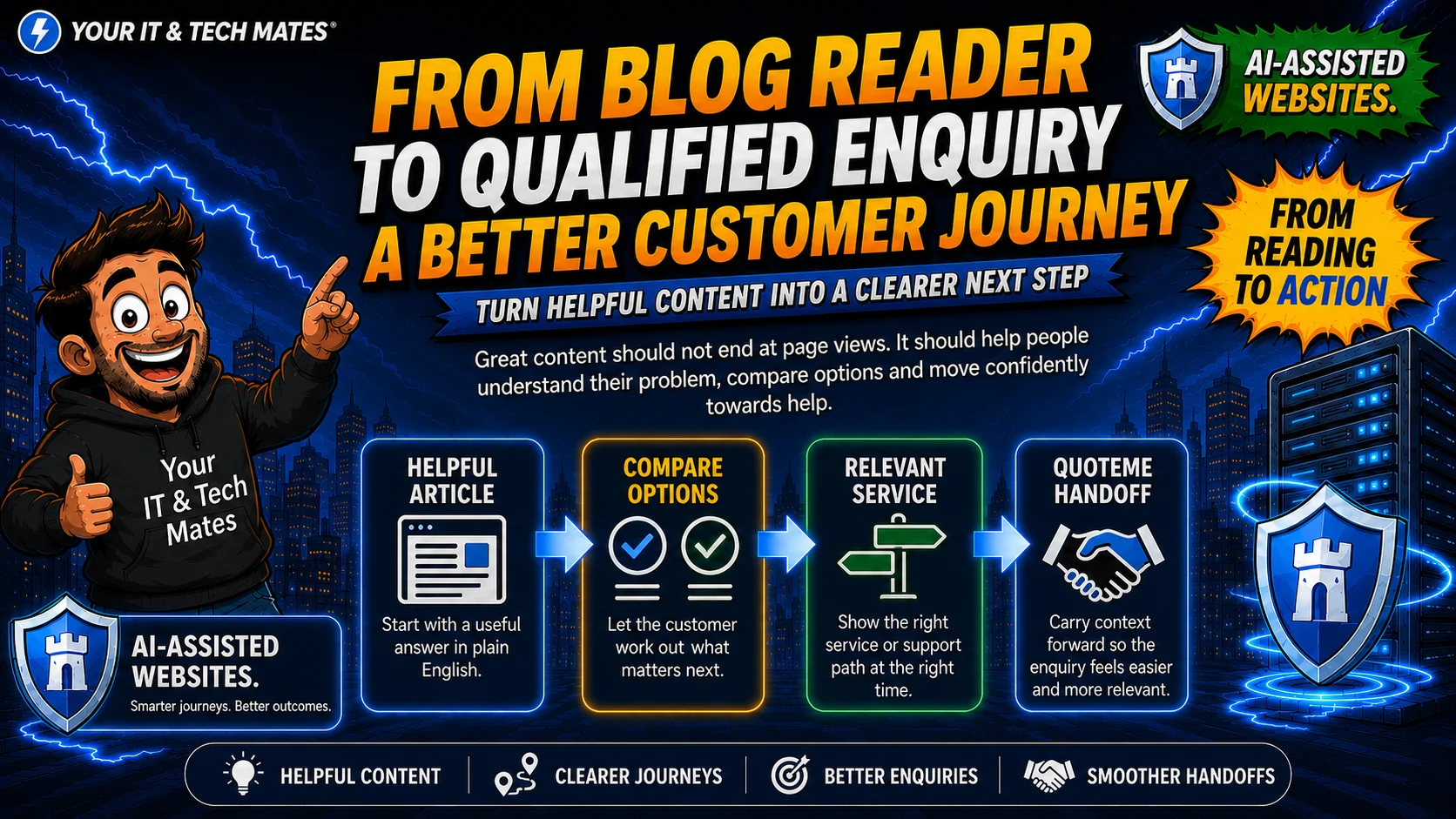
From Blog Reader to Qualified Enquiry: A Better Customer Journey
Good content should solve part of the customer’s problem and make the next step clearer, not simply push every reader into a form.
Quick answer
A better content-to-enquiry journey starts with a useful answer, helps the reader compare relevant options, links to the right service when appropriate, and carries only confirmed context into the enquiry. The goal is a clearer handoff, not a harder sell.
Why this matters for businesses
Most websites still measure success mainly through traffic, clicks and form submissions. Those numbers are useful, but they do not explain whether the customer understood the problem, followed a sensible path or reached the right service. Intent-aware design adds meaning to the journey while keeping important decisions under customer and human control.
Why many blog journeys break at the end
A common pattern is article → generic “Contact us” button → long form. The article may have explained the problem well, but the handoff throws away that context and asks the customer to start again.
A qualified enquiry journey should preserve the useful parts of the interaction while still letting the customer confirm what they actually need.
Step 1: answer the real question first
If someone searches for “laptop turns on but screen is black”, the article should explain likely causes, safe checks and when professional diagnosis is appropriate. It should not hide the answer behind a sales pitch.
This builds trust and helps the customer decide whether the issue is relevant to your service before they spend time on a form.
Step 2: help the reader compare or narrow options
Useful decision blocks can ask one relevant question such as whether the problem affects one device or several, or whether the customer wants to compare repair and replacement. These choices improve the article and also provide explicit journey context.
The customer remains in control because they are choosing what to explore rather than being silently profiled.
Step 3: connect to the right service
When the article and the customer’s choices consistently point to a service, the website can bring that service forward. A Wi-Fi troubleshooting journey can lead to network support; a business workflow journey can lead to software and automation help.
The link should explain why the service is relevant rather than simply saying “Buy now”.
Step 4: carry context into QuoteMe carefully
QuoteMe can receive a suggested help area or summary of the confirmed journey, then ask the customer to confirm or change it. It should never silently convert browsing into a binding diagnosis or service scope.
This reduces repetition and gives staff a cleaner starting point while preserving the customer’s final say.
What makes the enquiry more qualified
Qualification comes from clarity: the customer understands the likely problem, knows what the business can help with, has chosen a relevant next step and provides enough information for staff to respond usefully.
That is more valuable than simply collecting more form submissions.
How this fits with the Your IT & Tech Mates Intent Engine
Our current design separates four jobs. Content declares what a page is for. The journey layer records recent interaction and checks whether it is coherent. The Intent Engine interprets what the customer appears to need, with explicit customer wording taking priority. Commercial readiness is assessed separately from intent confidence. Keeping those responsibilities separate makes the system easier to explain, test and improve.
We also deliberately avoid the rule “more browsing equals more confidence”. Passive reading stays weak evidence, repeated behaviour has diminishing returns, and sensitive support or security topics are not treated as ordinary sales signals.
Practical takeaway for another business
Start with one high-friction customer journey. Write down the real questions customers ask, the pages that help answer them, the small number of decisions that change the next step, and the service or human handoff that should follow. Make the content useful first. Then add automation only where it removes repetition or confusion.
The result should feel less like “AI watching the customer” and more like a well-trained staff member who remembers the relevant part of the conversation, asks a sensible next question and accepts correction without argument.
Frequently asked questions
Should every blog reader be pushed to QuoteMe?
No. Some readers only need an answer. A good journey offers the next step when it is relevant rather than forcing conversion.
What context can be carried into an enquiry?
A suggested topic, journey stage or selected service can be carried as non-binding context, with customer confirmation.
Does this replace a CRM?
No. It improves the website handoff into existing forms, CRM or support workflows.
How does this improve lead quality?
Customers reach the enquiry stage with a clearer understanding of the problem and the relevant service.
Can the website diagnose the problem from reading behaviour?
No. Browsing can support context, but diagnosis and important commitments still require explicit information and appropriate human review.
What should businesses measure?
Measure successful handoffs, customer corrections, enquiry completeness and outcomes, not only clicks or form starts.
Continue the Intent-Aware Website series
Could this approach help your business website?
If customers regularly choose the wrong form, repeat themselves, struggle to find the right service or arrive with incomplete context, an intent-aware journey may help. The first step is usually a workflow and content review, not replacing your whole website.