How We Measure Whether Our AI Receptionist Is Actually Getting Smarter
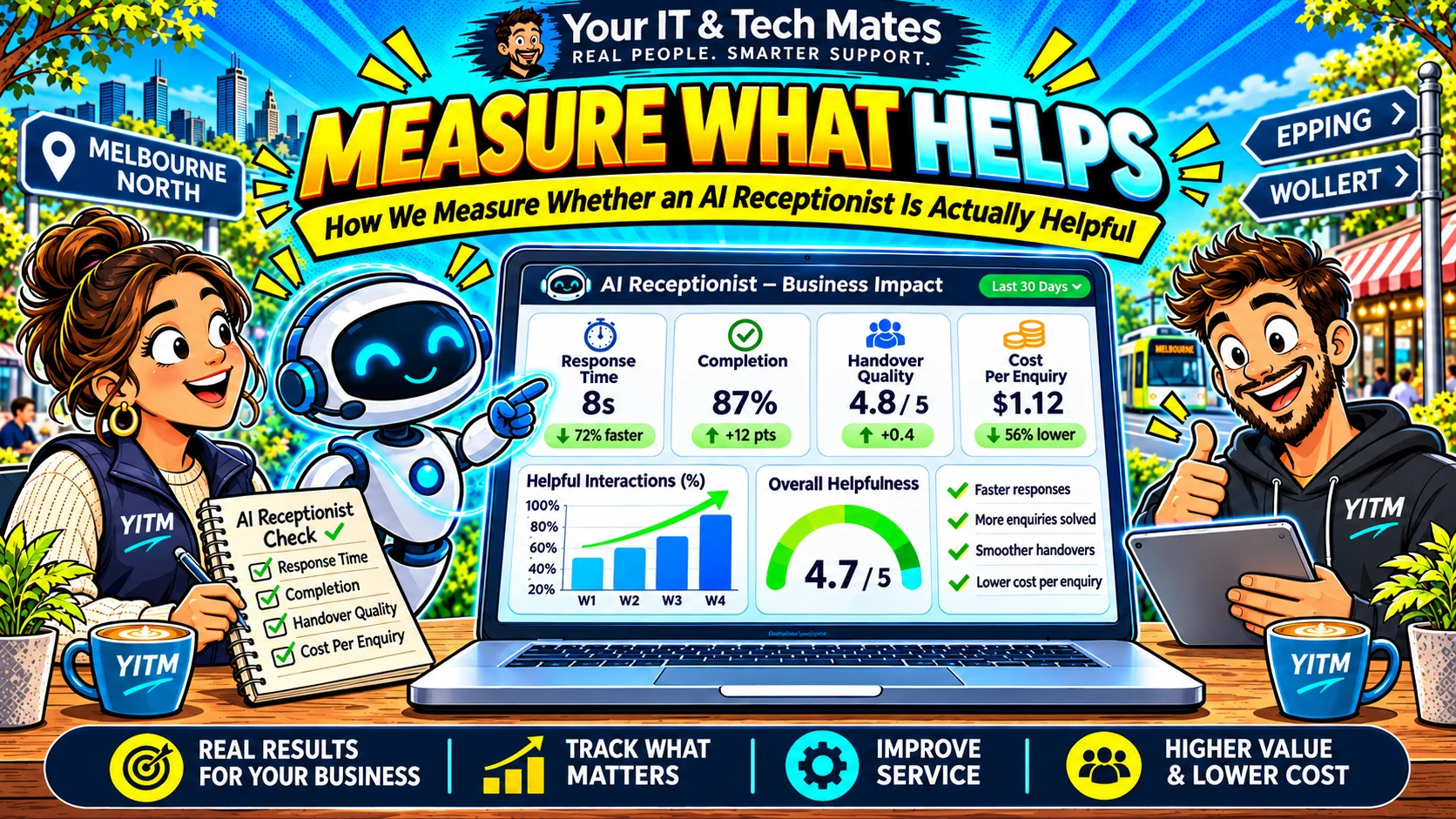
Measure clarification value, corrections, repeated questions, handover quality and operating cost without retaining private text in aggregate metrics.
Quick answer
Measure clarification value, corrections, repeated questions, handover quality and operating cost without retaining private text in aggregate metrics. This article is part of a five-part development series showing how Your IT & Tech Mates is improving its Virtual Receptionist, Intent Engine and QuoteMe. It explains the design and intended benefits; These planned improvements are still subject to engineering, regression testing and release approval. Examples are illustrative, not claims about a real customer or a completed repair.
Why we're building this
Not necessarily. A system can look fast by skipping important questions, or look busy while repeating information customers already supplied. Better customer service needs evidence. Our development approach therefore includes a way to measure whether language matching and question selection are helping rather than simply generating more messages.
A completed enquiry alone does not prove that the system interpreted the problem correctly. We need to examine correction rates, uncertainty, repeated questions and whether the information handed to QuoteMe matches what the customer intended.
Which signals actually matter
Useful measures include the share of cases that need clarification, how often a customer changes an answer, whether the same fact was asked twice, how often ‘Not sure’ appears and how many steps occur before the customer reaches a reviewable request. For ambiguous enquiries, we also need visibility into whether the governed AI interpretation succeeded, was rejected or fell back.
AI cost is another useful measure, but it must be considered alongside quality. A low-cost service that misunderstands customers is not a good outcome. Likewise, using AI on every obvious question is unnecessary expense.
A practical example: the laptop model question
If customers repeatedly struggle with ‘Which exact laptop model do you have?’, that might suggest the question is too demanding at an early stage. Asking for the brand first, or providing an optional safe photo route, may be easier. We would not assume this based on one conversation; we would check aggregate evidence and compare a proposed question sequence against labelled synthetic cases.
This is the difference between measuring clicks and learning whether a question adds value. A good question helps customers describe the issue accurately and reduces the information staff have to chase later.
Privacy must shape the measurement design
Your IT & Tech Mates intends the analytics layer to use approved, privacy-safe event categories and aggregate counts rather than storing customer problem text in a general-purpose reporting dashboard. Contact details, secrets, account information and arbitrary messages should not be copied into telemetry. Customer-specific information still belongs in the appropriate protected workflow.
The staff dashboard should make trends visible without pretending that a machine-generated score is ground truth. Human review and quality testing are needed before changing a matching rule or question order.
What businesses can take from this
For a service business in Melbourne's north, missed enquiries and slow follow-ups are operational issues. Measuring time to first helpful response, enquiry clarity and avoidable clarification can be more useful than counting chatbot interactions. The same principle applies to quoting forms, service websites and internal workflow automation.
This development story shows how Your IT & Tech Mates approaches practical AI: start with the business problem, instrument the workflow, protect customer information and use the findings to make targeted improvements. We will report verified results after the relevant testing and release gates are complete.
How Your IT & Tech Mates builds measurable AI automation
The most useful quality measures are tied to the customer’s task. The measurement design aims to compare the number of clarification turns, repeated questions and customer corrections with the quality of the final reviewable enquiry. The same evaluation must include provider failures, model calls and the cost of interpreting genuinely ambiguous messages.
This is also a software engineering discipline: define a baseline, design privacy-safe events, run labelled synthetic conversations, compare a candidate change and document any regression before release. A dashboard is only useful if it distinguishes evidence from assumptions and does not leak the content of private customer enquiries.
Related reading: Read the existing customer-effort measurement guide · Explore business AI workflow services in Melbourne.
See the customer experience behind this development
Our earlier story, How We Built an AI Receptionist That Asks Better Questions, introduces the customer journey. The next question is how to measure whether clarification makes enquiries better, without inventing results or exposing private conversations.
How this connects to the existing customer journey
The Virtual Receptionist helps visitors begin with ordinary language. The existing Intent Engine interprets likely requests, and QuoteMe provides a structured, reviewable way to send an enquiry. This improvement work extends those systems rather than replacing them with a separate chatbot or uncontrolled AI agent.
For a household in Epping or Wollert, that should mean clearer technical help. For a small-business team across Melbourne’s north, it demonstrates the software design, conversational automation and controlled AI integration skills Your IT & Tech Mates is developing in its own day-to-day operations. Learn about small-business software and AI solutions.
Customer contact details, consent, private account information, diagnosis and final pricing retain their existing human and system safeguards. We will not describe a proposed improvement as live until it passes testing and release approval.
Frequently asked questions
Does a completed conversation prove the AI was correct?
No. Corrections, repeated questions and assessed handovers provide additional context for evaluating quality.
Are customer messages placed in general analytics?
The proposed quality dashboard relies on privacy-safe aggregated events; sensitive customer text must stay in protected workflows.
How will results be published?
Only verified measures should be described as measured outcomes after acceptance and release.
Read the other articles in this series
- Part 1: Beyond Keywords: Teaching Our AI Receptionist to Understand Everyday Problems
- Part 2: How Our AI Matches Customer Problems to the Right Tech Help
- Part 3: You Already Told Us: Why QuoteMe Shouldn't Ask the Same Question Twice
- Part 5: Can an AI Receptionist Learn From Customers Without Making Risky Decisions?
Also see A Friendlier First Step: AI Virtual Receptionist and the related customer-language guide.
Technology help with a person behind it
Describe what is happening in your own words. Our team can review your enquiry and confirm suitable next steps; no repair or price is authorised merely by using the website assistant.