Beyond Keywords: Teaching Our AI Receptionist to Understand Everyday Problems
From vague expressions to structured, customer-stated facts: device, symptoms, behaviour, goals and uncertainty.
Quick answer
From vague expressions to structured, customer-stated facts: device, symptoms, behaviour, goals and uncertainty. This article is part of a five-part development series showing how Your IT & Tech Mates is improving its Virtual Receptionist, Intent Engine and QuoteMe. It explains the design and intended benefits; These planned improvements are still subject to engineering, regression testing and release approval. Examples are illustrative, not claims about a real customer or a completed repair.
Why we're building this
A customer in Wollert might say their laptop is ‘having a fit’. A small business owner in Epping might report that ‘everything goes funny whenever I open the invoicing software’. Neither description identifies a cause. The right response is to understand the device, the observed behaviour and the customer’s goal before suggesting a route. A long list of technology jargon asks customers to diagnose themselves. That is exactly the experience this work aims to replace.
Everyday wording changes with age, experience and situation. ‘My laptop is cooked’, ‘the whole thing locks up’ and ‘it has stopped cooperating’ may sound similar, yet they can describe very different symptoms. A responsible assistant notices ambiguity instead of pretending these phrases all mean a broken component.
A shared language for the entire enquiry
The process begins by defining a consistent set of concepts: device or service, customer goal, reported symptom, timing, trigger, impact, uncertainty, negation and explicit correction. These concepts are different from a diagnosis. ‘Dell laptop freezes in video meetings’ supplies a device, a behaviour and a trigger. It does not confirm whether the problem lies with software, power, memory, graphics or another cause.
Today, multiple stages of an online enquiry can collect the same information in slightly different formats. The proposed shared taxonomy allows the Virtual Receptionist, Intent Engine and QuoteMe to reason about the same approved facts without maintaining three competing interpretations.
An example using rainbow lines
Suppose someone types ‘My laptop screen's gone weird’. A suitable clarification is ‘Do you see lines, a black screen, flickering or something else?’ The customer answers ‘Rainbow lines’. The system now has useful reported evidence, but no reason to declare that the LCD panel must be replaced.
The next step should depend on what has already been reported. If the customer also says ‘It still turns on and it’s a Dell’, those details belong in the current enquiry rather than being asked again as though no conversation happened.
What this means for a Melbourne small business
A plumber hears ‘the hot water comes and goes’. An accountant hears ‘I got a strange ATO letter’. A service company hears ‘can someone sort out the booking mess?’ Each needs an intake system capable of distinguishing a customer's situation from an internal category. The design pattern can support business websites beyond IT, provided the domain rules, approved services and human responsibilities remain specific to each business.
Your IT & Tech Mates works with technology problems and small-business software and AI workflows across Melbourne’s north, including Epping and Wollert. The practical engineering skill is not a clever chatbot sentence; it is joining plain-language interpretation to reliable business processes.
What we are testing before release
The next development tests will include misspellings, colloquial phrases, vague subjects, negations such as ‘it is not the screen’, corrections and two problems in one message. We will measure whether important customer facts survive the handover. If a phrase remains genuinely unclear, the existing governed AI planner or human review must remain available rather than a guessed match.
The success standard is simple: a customer can explain a problem naturally, see their own words respected and receive one useful next question. It should not take dozens of new hardcoded keywords to achieve that.
How Your IT & Tech Mates designs shared meaning
A practical semantic model needs more than labels. Your IT & Tech Mates’ existing CaseMemory and enquiry services already distinguish customer-provided answers from other state. The updated design extends that approach so a report such as “it only freezes during video calls” can be represented as a device-related symptom with an explicit trigger and evidence source. A tentative interpretation must remain tentative until its supporting words are validated.
The engineering work includes a controlled schema, defensive validation, correction and negation handling, and synthetic dialogues that deliberately try to confuse the classifier. That is what turns a natural-language demonstration into maintainable customer software rather than an impressive but fragile chatbot.
Related reading: Read the existing customer-language intent engine explanation · Explore practical small-business software and AI services.
See the customer experience behind this development
Want to see how the earlier receptionist handles an unclear first message? Read how Your IT & Tech Mates built an AI receptionist that asks better questions. This article builds on that customer-first approach by explaining how different ways of describing the same problem can be organised without guessing a diagnosis.
How this connects to the existing customer journey
The Virtual Receptionist helps visitors begin with ordinary language. The existing Intent Engine interprets likely requests, and QuoteMe provides a structured, reviewable way to send an enquiry. This improvement work extends those systems rather than replacing them with a separate chatbot or uncontrolled AI agent.
For a household in Epping or Wollert, that should mean clearer technical help. For a small-business team across Melbourne’s north, it demonstrates the software design, conversational automation and controlled AI integration skills Your IT & Tech Mates is developing in its own day-to-day operations. Learn about small-business software and AI solutions.
Customer contact details, consent, private account information, diagnosis and final pricing retain their existing human and system safeguards. We will not describe a proposed improvement as live until it passes testing and release approval.
Frequently asked questions
What does natural language understanding mean here?
It means recognising the customer's reported device, problem and uncertainty from ordinary wording, without treating that wording as a diagnosis.
Can it understand phrases it has never seen?
That is the aim of governed semantic interpretation, subject to evidence checks and testing. Clear phrases can use existing rules; ambiguity may need clarification.
Does the assistant replace the technician?
No. The customer reviews the request, and a technician remains responsible for technical assessment and final pricing.
Read the other articles in this series
- Part 2: How Our AI Matches Customer Problems to the Right Tech Help
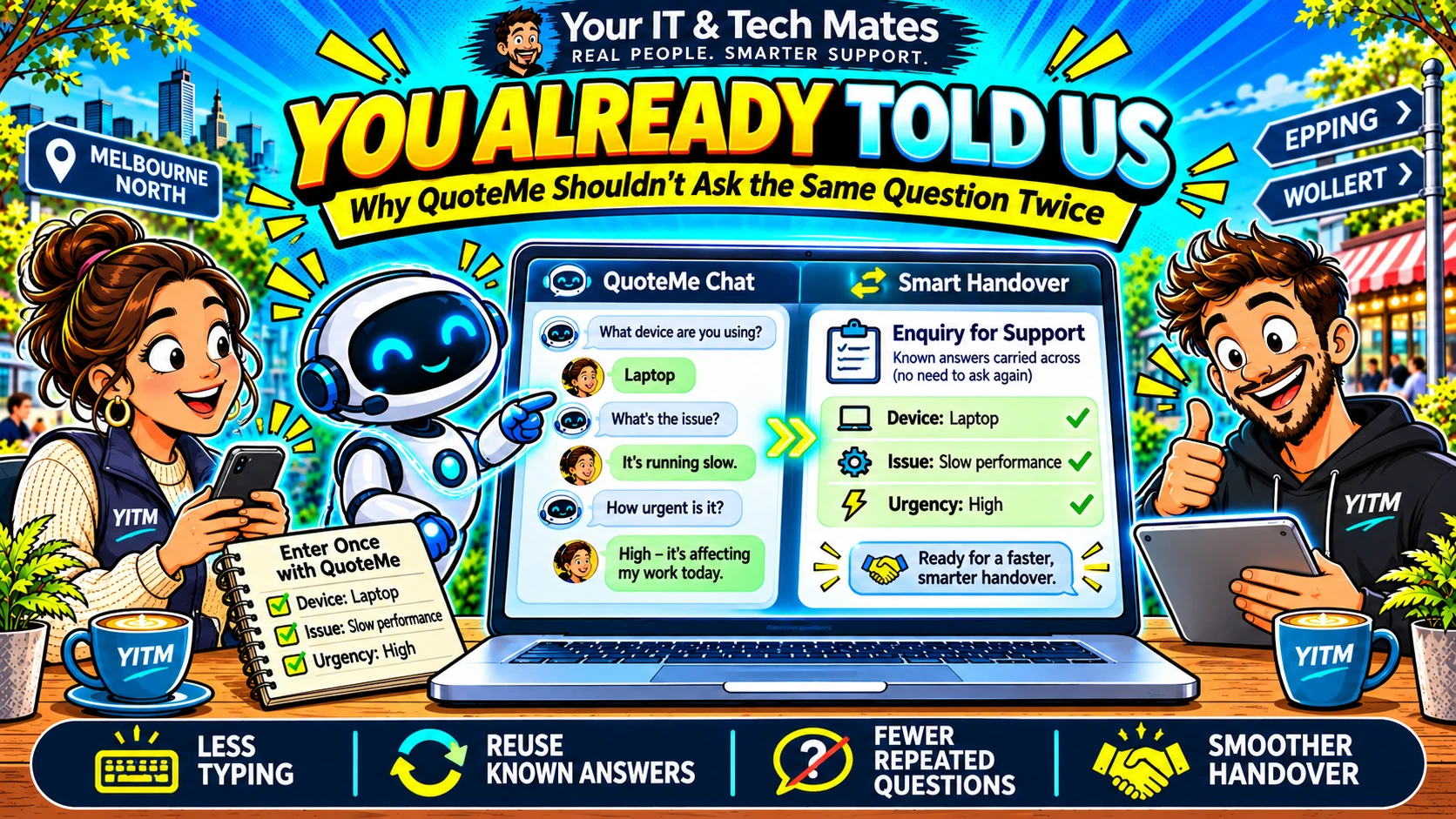
- Part 3: You Already Told Us: Why QuoteMe Shouldn't Ask the Same Question Twice
- Part 4: How We Measure Whether Our AI Receptionist Is Actually Getting Smarter
- Part 5: Can an AI Receptionist Learn From Customers Without Making Risky Decisions?
Also see A Friendlier First Step: AI Virtual Receptionist and the related customer-language guide.
Technology help with a person behind it
Describe what is happening in your own words. Our team can review your enquiry and confirm suitable next steps; no repair or price is authorised merely by using the website assistant.