Can an AI Receptionist Learn From Customers Without Making Risky Decisions?
Use validated, privacy-safe matching patterns to propose improvements that are tested and human-approved before release.
Quick answer
Use validated, privacy-safe matching patterns to propose improvements that are tested and human-approved before release. This article is part of a five-part development series showing how Your IT & Tech Mates is improving its Virtual Receptionist, Intent Engine and QuoteMe. It explains the design and intended benefits; These planned improvements are still subject to engineering, regression testing and release approval. Examples are illustrative, not claims about a real customer or a completed repair.
Why we're building this
A customer says ‘my computer is cooked’. Another says the same thing about a laptop with a damaged charger. If software automatically learns that ‘cooked’ means ‘replace the motherboard’, the next customer could receive a misleading recommendation. More examples do not necessarily create better knowledge if the examples are not correctly interpreted.
The next improvement aims to improve matching and question selection from recurring, privacy-safe patterns while protecting approved service definitions and customer consent.
From observed confusion to a proposed improvement
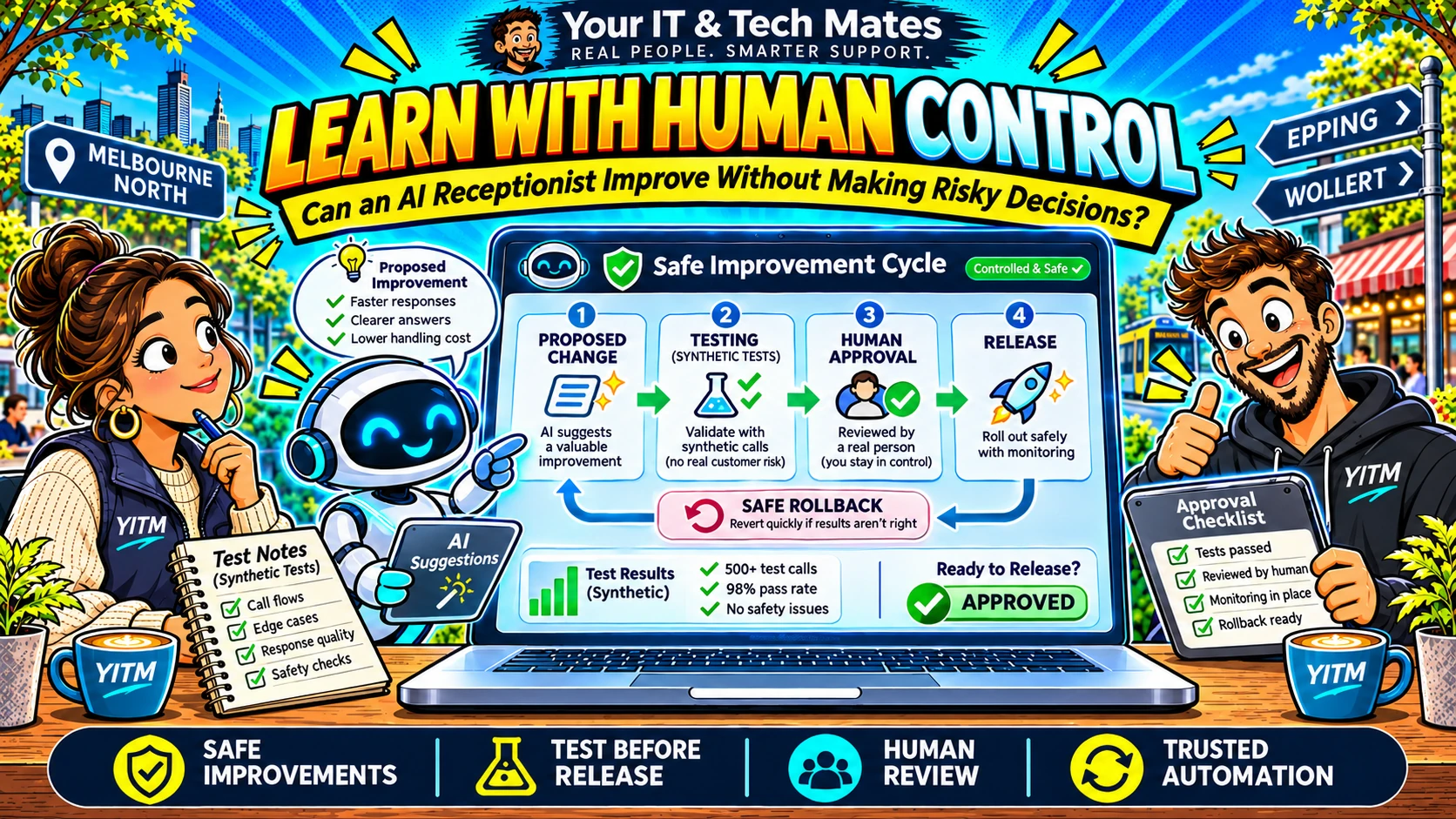
Imagine many customers select ‘Not sure’ when asked for an exact laptop model. That is a signal to investigate. The system might suggest asking for brand first, or allowing an optional photo at the appropriate point. It should not quietly rewrite the live question based on aggregate counts alone.
A change proposal must describe the intended benefit, possible side effects and evidence that triggered it. The actual customer messages should not become a public training library.
Testing before changing live behaviour
Every proposed improvement should run against synthetic dialogues: clear problems, vague descriptions, typo-heavy messages, safety cases, contradictory answers, multiple issues and requests to speak to a person. A revised matching rule must not improve one example while breaking existing service routes or stripping important facts.
We should compare results with the current approved baseline and keep a rollback path. If a new question makes the customer journey longer or more confusing, the change should be rejected or revised.
Human control remains the point
The AI can help suggest an interpretation and identify a likely missing fact. It cannot confirm a diagnosis, authorise repairs, access another customer's private case, promise a booking or decide a final price. Staff and approved systems remain responsible for those outcomes.
Continuous improvement also means knowing when to stop asking. If the information is sufficient for a human to assess the request, more AI questions may add no value.
The practical business lesson
For small businesses in Epping, Wollert and surrounding Melbourne suburbs, the best use of AI is often improving ordinary workflows: clear enquiries, fewer repeat questions, better follow-up and a smoother handover to a real person. Reliable improvements come from testing and review, not from turning every customer message into a new machine-learning rule.
Your IT & Tech Mates is developing these methods as part of its own service experience and as an example of how controlled AI and software automation can support other small-business workflows. This five-part series documents that approach without making claims about results that have not yet been measured.
How Your IT & Tech Mates tests learning before release
An improvement proposal should come with reproducible examples and a reason for change. The proposed improvement process uses privacy-safe aggregate signals to identify a weak question or match, then evaluates a proposed revision against labelled synthetic conversations and established regression cases. The rule does not become a production truth merely because customers have used a similar phrase.
Your IT & Tech Mates’ approach joins practical service operations with responsible software development: bounded AI suggestions, PHP validation, evidence-based testing, human approval and a rollback path. This gives other small businesses a more useful model for automation than an agent that rewrites its own policies without supervision.
Related reading: Read why an AI system must learn, correct and forget · Explore workflow automation for small businesses.
See the customer experience behind this development
The customer journey starts with asking useful questions. See How We Built an AI Receptionist That Asks Better Questions before exploring how proposed improvements can be tested, reviewed and safely released.
How this connects to the existing customer journey
The Virtual Receptionist helps visitors begin with ordinary language. The existing Intent Engine interprets likely requests, and QuoteMe provides a structured, reviewable way to send an enquiry. This improvement work extends those systems rather than replacing them with a separate chatbot or uncontrolled AI agent.
For a household in Epping or Wollert, that should mean clearer technical help. For a small-business team across Melbourne’s north, it demonstrates the software design, conversational automation and controlled AI integration skills Your IT & Tech Mates is developing in its own day-to-day operations. Learn about small-business software and AI solutions.
Customer contact details, consent, private account information, diagnosis and final pricing retain their existing human and system safeguards. We will not describe a proposed improvement as live until it passes testing and release approval.
Frequently asked questions
Does the system retrain itself from every chat?
No. Proposed improvements must be tested and reviewed before a production change.
Can an AI model approve repair prices?
No. Final pricing and service decisions remain under human and approved business controls.
Can wrong learned patterns be retired?
That is part of the planned controlled improvement lifecycle: evaluate, revise, approve and retain rollback options.
Read the other articles in this series
- Part 1: Beyond Keywords: Teaching Our AI Receptionist to Understand Everyday Problems
- Part 2: How Our AI Matches Customer Problems to the Right Tech Help
- Part 3: You Already Told Us: Why QuoteMe Shouldn't Ask the Same Question Twice
- Part 4: How We Measure Whether Our AI Receptionist Is Actually Getting Smarter
Also see A Friendlier First Step: AI Virtual Receptionist and the related customer-language guide.
Technology help with a person behind it
Describe what is happening in your own words. Our team can review your enquiry and confirm suitable next steps; no repair or price is authorised merely by using the website assistant.