Giving AI Tools Without Giving It the Keys: QuoteMe’s Limits
A helpful AI tool does not need unlimited permissions. When we added tool use to QuoteMe, the important design question was how little authority it could have and still be useful.
Inside this part
- Useful information is different from permission to act
- An allowlist defines the available checks
- Price guidance stays non-binding
- What the tools cannot do
- The founder lesson
In this founder development series, we explain the design and implementation behind QuoteMe. Future work is identified as development direction; an implemented component does not establish that every deployment or customer outcome has been verified.
Useful information is different from permission to act
A service catalogue can help explain a support option. Public price guidance can help a customer understand the starting conversation. Neither needs to authorise a repair, modify an account or collect a payment.
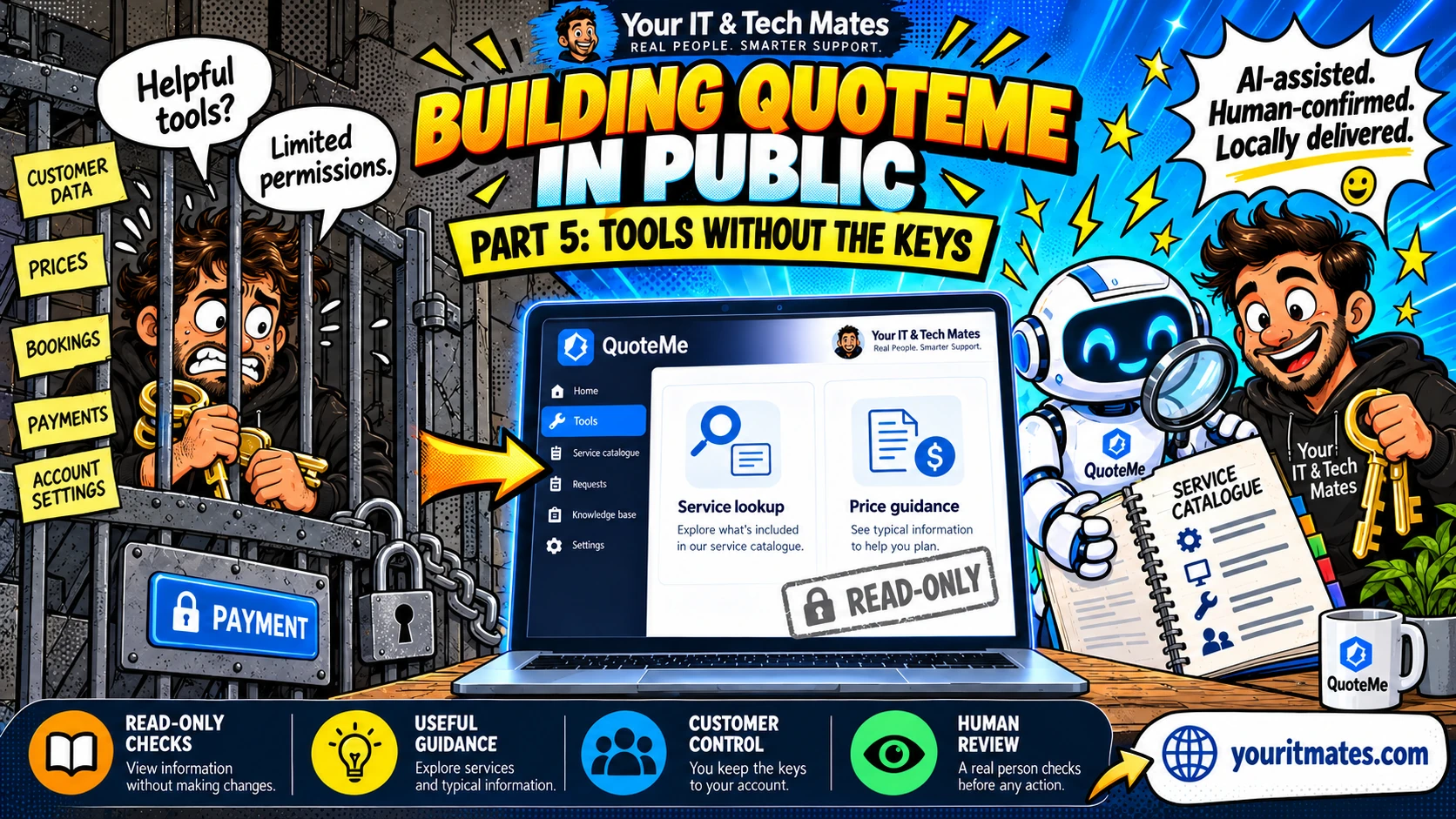
That is the boundary behind QuoteMe’s bounded tool execution. The implemented tool set includes approved service lookup and non-binding price guidance. These are information checks. They do not give an AI general access to the business or the customer’s device.
An allowlist defines the available checks
The tool planner and executor work with a limited set of permitted checks. Unknown tools, duplicate candidates and requests outside the execution budget cannot simply expand that authority. Incomplete or safety-related situations also need the right handling before commercial information is considered.
These limits are enforced by code, not just by asking the model to behave. A reassuring sentence in an AI prompt is not an access control. If a tool is not permitted, a convincing explanation should not make it available.
Price guidance stays non-binding
A published guide is not a diagnosis or a final quote for a particular device. The actual fault, work scope, parts and service conditions may need review. QuoteMe should preserve that distinction when presenting information from our pricing guidance.
A customer who sees a possible service option still decides whether to continue with a request. The technician’s review and any later agreement about work remain separate from the AI’s information gathering.
What the tools cannot do
The read-only tool layer does not book appointments, take payments, set a final price, modify customer accounts or authorise paid work. Preparing a handover is also different from performing the service.
This is why we describe QuoteMe as AI-assisted, human-confirmed and locally delivered. Customers can receive clearer information without handing important decisions to an unrestricted agent. See our guide to using AI without losing human control for the wider website principle.
The founder lesson
The useful measure of an agent is not how many tools it can reach. It is whether the permitted tools reduce friction safely and predictably. Small, inspectable permissions make the system easier to explain and test.
Next comes another boundary: even when a request is ready, who gets to press the final button?
Frequently asked questions
Can QuoteMe’s AI tools book or pay for a repair?
No. The described tool layer is limited to approved read-only information checks.
Is the price guidance a final quote?
No. It is non-binding guidance. The team needs to review the actual request and confirm the applicable scope and price.
Explore the existing guides
Building QuoteMe in Public — From Intent to Action
Part 5 of 10. Follow the customer problem, development decisions and human service behind QuoteMe.
Building Your IT & Tech Mates + TheFixers.APP, one practical problem at a time.
Start with what is happening
Describe your technology problem in your own words. Check the prepared request before sending it, and our team can discuss the next practical step.
Your IT & Tech Mates | Real people. Smarter support.