
From a Form to a Conversation: How QuoteMe Asks Better Questions
People do not talk in database fields. They explain what happened, add details as they remember them and sometimes answer tomorrow’s question before today’s. Building QuoteMe meant learning to work with that reality.
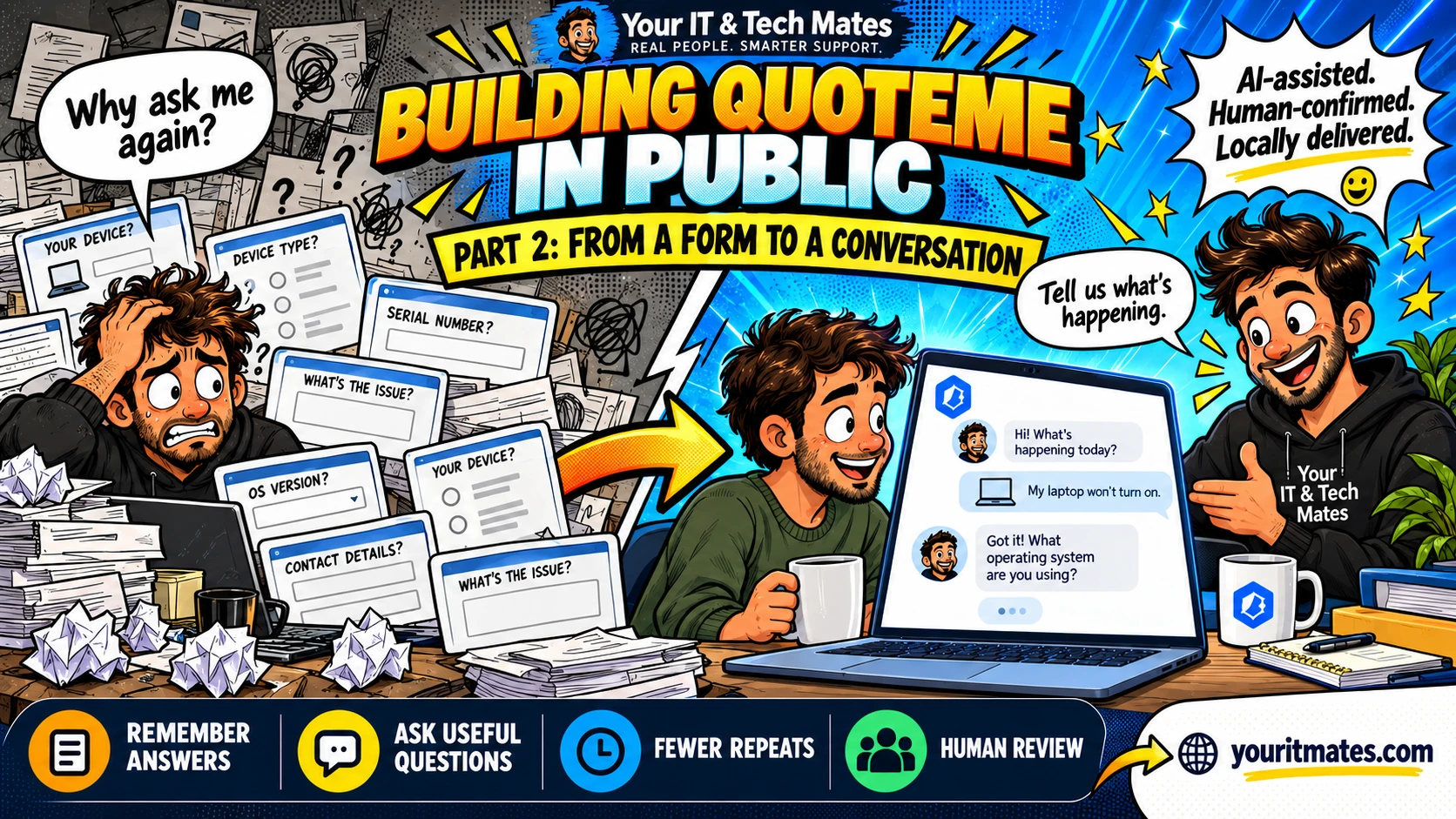
Inside this part
- A service category is only the beginning
- Keep what is known; ask what matters next
- Confidence should lead to clarification
- What this changes for local IT support
- The founder lesson
In this founder development series, we explain the design and implementation behind QuoteMe. Future work is identified as development direction; an implemented component does not establish that every deployment or customer outcome has been verified.
A service category is only the beginning
In Part 1, we started with a familiar problem: “My laptop won’t turn on.” Identifying a likely support area helps, but it does not tell a technician whether there are power lights, whether the files matter or what the customer has already tried. A category alone cannot prepare a useful handover.
The next challenge was to ask for the missing information without turning the conversation back into a long form. If the customer has already said they use a laptop, asking “What device is it?” again adds friction rather than understanding.
Keep what is known; ask what matters next
QuoteMe’s conversation code separates known answers from details that still need clarification. A next-question policy uses the current support flow to decide which missing answer matters. Where a choice makes an answer easier, the interface can offer choices instead of demanding technical language.
For example, a customer might mention the device, suburb and urgency in one sentence. Those details should help shape the next question. The aim is not to collect every possible field; it is to prepare enough relevant information for a useful next step.
Confidence should lead to clarification
An automated interpretation can be incomplete or wrong. Treating an uncertain interpretation as a confirmed diagnosis would make the conversation less trustworthy. We use structured answers and follow-up questions to resolve uncertainty, with a human handover when the situation needs one.
The request summary is another checkpoint. Customers can check whether the description matches their problem before sending it. “Laptop has lights but a black screen” is more useful than a confident but unverified claim that a component has failed.
What this changes for local IT support
For Your IT & Tech Mates, the benefit is a clearer starting point for the technician. For customers across Melbourne’s northern suburbs, it means less pressure to know the right service name and fewer reasons to repeat the same explanation.
This is a development account of how the conversation is structured, not a promise that every phrase will be interpreted perfectly. The practical test is whether the next question helps a person move forward. Our next challenge was what happens when that person says “Actually…” and changes the information.
The founder lesson
Good intake software should make the customer’s explanation easier to understand. It should not make the customer adapt their explanation to the software. That lesson also applies to small-business website and workflow improvements: start with the repeated friction, then choose the simplest useful change.
Frequently asked questions
Do I need technical language to use QuoteMe?
No. Describe what is happening in your own words. Useful follow-up questions help organise the request.
Does a conversation replace technician assessment?
No. The conversation prepares information. A technician still needs to assess the problem and confirm suitable support.
Explore the existing guides
Building QuoteMe in Public — From Intent to Action
Part 2 of 10. Follow the customer problem, development decisions and human service behind QuoteMe.
Building Your IT & Tech Mates + TheFixers.APP, one practical problem at a time.
Start with what is happening
Describe your technology problem in your own words. Check the prepared request before sending it, and our team can discuss the next practical step.
Your IT & Tech Mates | Real people. Smarter support.